Critically Endangered
Camilla's Saddle Bush-cricket
Ephippiger camillae
Camilla's saddle bush-cricket (Ephippiger camillae) is a katydid known only from the Madonie Mountains of northern Sicily. The IUCN Red List assessed it as Critically Endangered in 2016 and flagged it as possibly extinct. It was formally named only in 2000, and almost nothing is known about its life.
How to recognise it
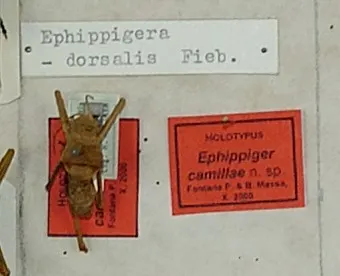
The species was described in 2000 by Paolo Fontana and Bruno Massa in the Italian journal Il Naturalista siciliano, and little has been published on its appearance since.
Bush-crickets of the genus Ephippiger take their name from the Latin word for a saddle, because the plate behind the head is saddle-shaped. Their wings are so reduced that they cannot fly, and males use them only to make sound by stridulation. These are traits of the genus, so they probably apply to this species too. Ephippiger was named by Berthold in 1827 and currently includes 14 species, found mainly in the Palaearctic, including Italy, France and Spain.
Where it lives
The species is endemic to Italy, and within Italy only to Sicily. The IUCN lists a single location with an extent of occurrence and area of occupancy of just 4 square kilometres.
The Madonie are the island's second highest range after Mount Etna, with Pizzo Carbonara reaching 1,979 m. The mountains have been protected as the Madonie Regional Natural Park since 1989. Whether this cricket lives inside the park is recorded by the IUCN as unknown. Its specific habitat and habits are also listed as unknown.
Pins are Wikidata “endemic to” fields. Orange dots, when present, are GBIF occurrence tiles — survey bias included.
Why it is in trouble
The assessment rates the population as decreasing, but it names no specific threat and gives no population count. The Critically Endangered rating rests on the tiny range, a single location and a continuing decline in the number of mature individuals.
The IUCN flags the species as possibly extinct, meaning no recent confirmed record of a living population is known, though extinction has not been proven. Its Madonie range is small and poorly surveyed.
What is being done
Very little is on record. The IUCN states there is no recovery plan, no systematic monitoring scheme, and no captive or reintroduction programme. Population size, distribution and trends are the single research need it lists. Until someone relocates a living population, the first step for this insect is simply finding out whether it still exists.
Sources
Written for this catalog in our own words from the sources below, checked against them on 12 November 2026. Population figures are estimates and carry the year they were made. Status and assessment year: IUCN. 2026. The IUCN Red List of Threatened Species. Version 2026-1. iucnredlist.org.




