Critically Endangered
Elongated tortoise
Indotestudo elongata
Elongated tortoise is a tortoise in the family Testudinidae — Indotestudo elongata, recorded as Critically Endangered.
Appearance
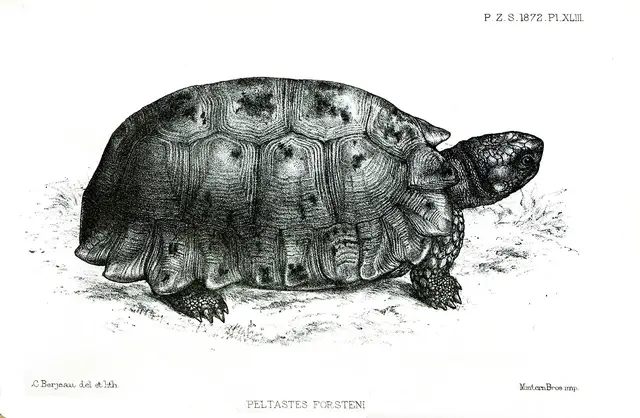
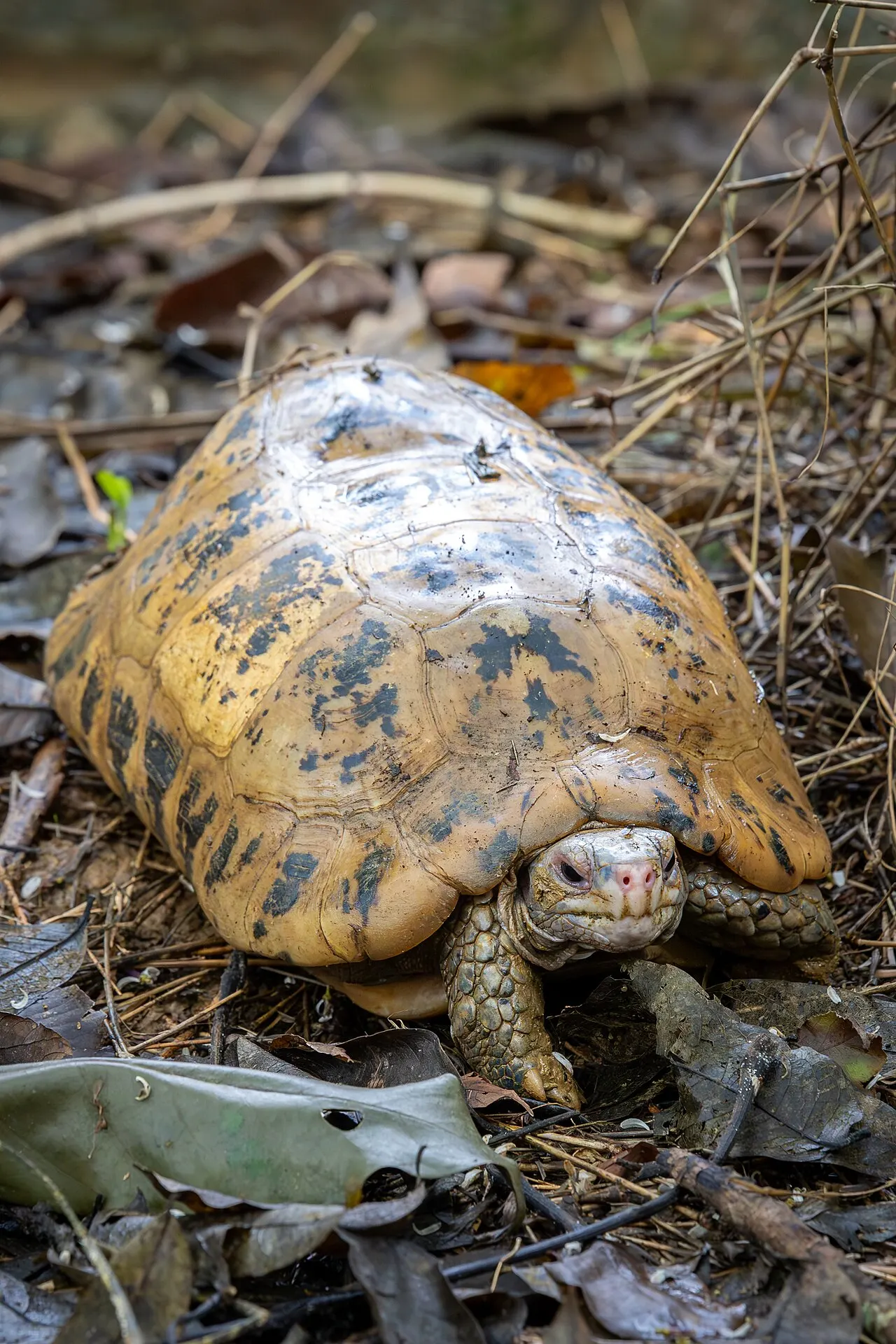
Shell considerably depressed, more than twice as long as deep, with flat vertebral region. Anterior and posterior margins slightly reverted, strongly serrated in young, feebly in old specimens; shields concentrically striated, except in old specimens; nuchal present (rarely absent), narrow and elongate; supracaudal undivided, more or less incurved; first vertebral usually nearly as long as broad in the adult, the others broader than long and nearly as broad as the costals. Head moderate. A pair of large praefrontal shields, usually followed by a nearly equally large frontal; beak feebly hooked, tricuspid; alveolar ridge of upper jaw short and rather feeble. Anterior face of fore limbs with moderate, unequal-sized, imbricate scales, that are largest towards the outer side. No enlarged tubercles on the thighs; tail ending in a claw-like horny tubercle.
Range and habitat
The species is found in India (Tripura, Jalpaiguri, East Bengal, and Singhbhum in Jharkhand), Nepal, Mizoram, Bangladesh, Burma (or Myanmar), Laos, Thailand (incl. The elongated tortoise is a tortoise found in Southeast Asia and parts of South Asia.
The type locality — the place tied to the name-bearing specimen — is Arakan, Tenasserim, Burma.
Pins are Wikidata “endemic to” fields. Orange dots, when present, are GBIF occurrence tiles — survey bias included.
In crisis
The elongated tortoise is a critically endangered species and is in severe decline across its natural range. The principal threats to this species are the mass hunting of the remaining wild populations for the large and growing food markets in China and elsewhere in East Asia. In addition, other threats are habitat destruction and illegal collecting for the pet trade.
CITES lists this taxon on Appendix II. Confirm the current appendix on the CITES checklist.
Elongated tortoise is Critically Endangered on the IUCN Red List (assessed 2019, criteria A2cd). Confirm the official criteria and any later count on the assessment page.
Sources
Adapted from the English Wikipedia article on Elongated tortoise (CC BY-SA 4.0; authors are listed in the article history; changes were made), Wikidata item Q846001. Family and order context is original field-guide writing about the group, not a copied assessment of this one species. Not an IUCN assessment. Counts, when quoted, can change — confirm them on the recovery programme and on iucnredlist.org. Status and assessment year: IUCN. 2026. The IUCN Red List of Threatened Species. Version 2026-1. iucnredlist.org.