Critically Endangered
Spring pygmy sunfish
Elassoma alabamae
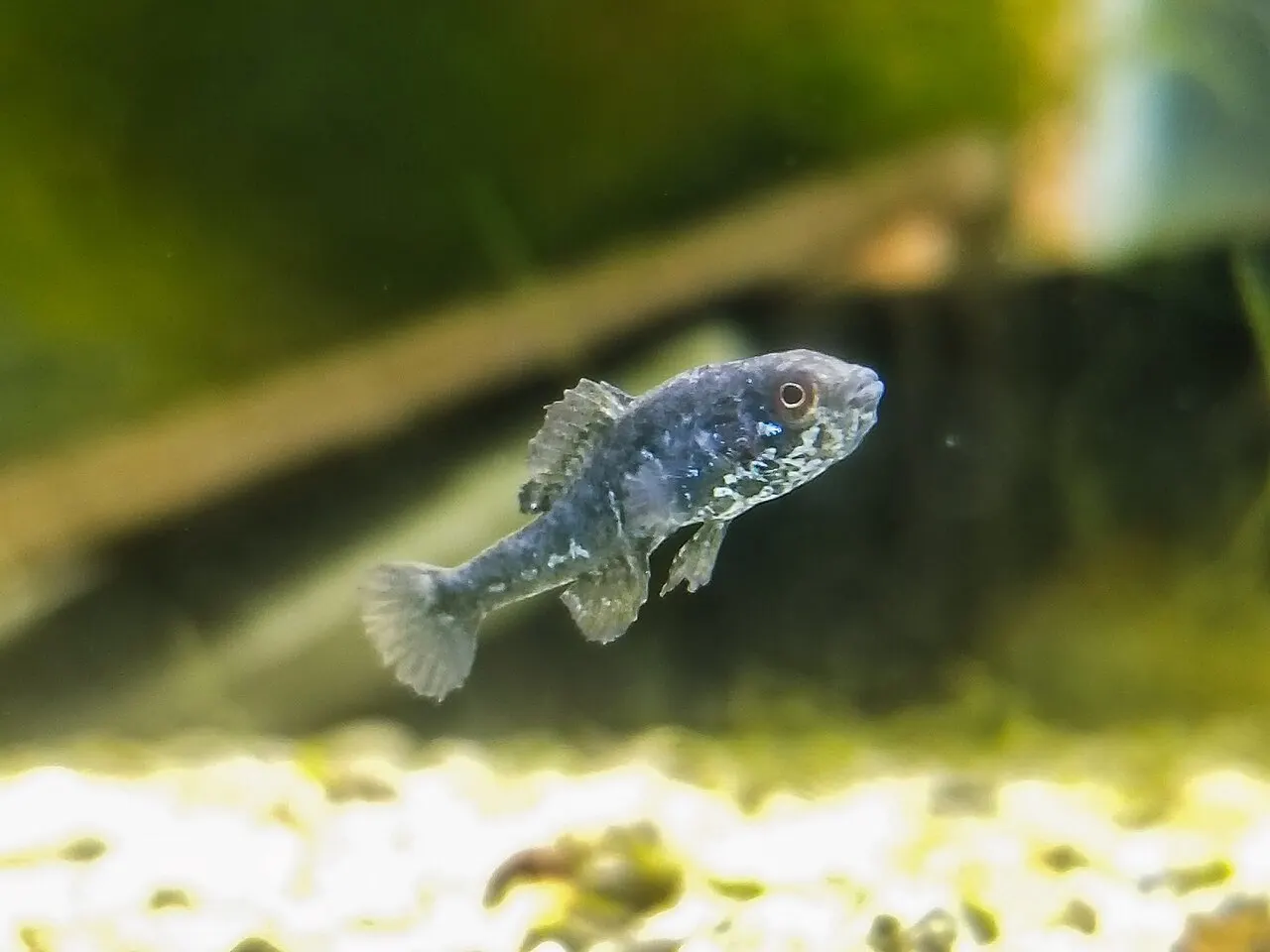
The spring pygmy sunfish (Elassoma alabamae) is a tiny fish, under an inch long, that lives only in a few clear springs and spring-fed wetlands of northern Alabama. The IUCN Red List rated it Critically Endangered in 2014. Breeding males turn almost black with blue-green bars.
How to recognise it
This is the smallest fish in its genus. Adults of both sexes average under 25 millimeters (1 inch) in standard length, and males are usually a little smaller than females.
The sexes look quite different. Breeding males are very dark to black, with iridescent blue-green bars down the sides and a shimmering mottled patch on the cheek. Females are plainer, brown above with a cream to white belly.
Where it lives
The species is endemic to springs on the north side of the Tennessee River in Alabama. It lives in clear to slightly stained spring water, in the spring head where cool groundwater wells up, the pool below it, the run downstream, and the shallow vegetated wetlands the water feeds. It is most abundant right at the spring head and pool.
Today it is known from two systems. One is the Beaverdam Spring and Creek complex in Limestone County, which holds a linked group of sites that genetic work in 2024 split into two populations. The other is Blackwell Swamp in Madison County. The Tennessee River separates the two systems.
It once lived elsewhere. The first specimens came from Cave Spring in Lauderdale County in 1937, but the site was flooded the next year when Pickwick Reservoir filled. Researchers from the University of Tennessee found the fish again at the Beaverdam Spring complex in 1973, after it had been presumed extinct. Richard Mayden formally described it as a species in 1993. A population at Pryor Spring in Limestone County has also disappeared, and the Cave Spring population is considered lost.
Pins are Wikidata “endemic to” fields. Orange dots, when present, are GBIF occurrence tiles — survey bias included.
How it lives
Spring pygmy sunfish are short-lived, with an average lifespan of a year or less, so the population turns over almost completely each year. They spawn when the water is roughly 14 to 20 degrees Celsius (57 to 68 degrees Fahrenheit), which in some springs can happen anywhere from January to October.
Their prey includes small aquatic invertebrates such as water fleas, amphipods, midge larvae and small snails. The fish depend on submerged and edge vegetation for breeding, raising young, and shelter from predators. They need the steady temperature and flow that only springs provide.
Why it is in trouble
Impoundments drowned some spring habitat and cut the rest into isolated pieces, so fish cannot easily recolonize a site after a bad year. Falling water quality, groundwater withdrawal for irrigation, paving that changes how water recharges the aquifer, and stormwater runoff all affect the springs.
The U.S. Fish and Wildlife Service also points to genetic problems seen at Pryor Spring before its fish vanished, and to the risk that a severe drought or toxic spill could hit a very small range.
What is being done
The species was listed as threatened under the U.S. Endangered Species Act on 2 December 2013, and critical habitat was designated on 1 July 2019. That covers about 5.2 stream kilometers (3.2 miles) at Beaverdam Spring and Creek, 2.3 kilometers (1.4 miles) at Blackwell Swamp and Run, and 3.4 kilometers (2.1 miles) at Pryor Spring and Branch, which no longer holds fish.
Much of the remaining habitat lies on conservation land, including national wildlife refuge land. A draft recovery plan released in July 2026 proposes reducing sediment, improving water quality, encouraging native submerged plants, and adding at least one more self-sustaining population. Captive propagation and translocation are planned where needed to restore fish to unoccupied habitat, with Pryor Spring as the priority site. Conservation Fisheries, a nonprofit hatchery, kept an assurance colony from 2008 to 2025.
Sources
Written for this catalog in our own words from the sources below, checked against them on 12 November 2026. Population figures are estimates and carry the year they were made. Status and assessment year: IUCN. 2026. The IUCN Red List of Threatened Species. Version 2026-1. iucnredlist.org.




