Endangered
Elachistocleis erythrogaster
Elachistocleis erythrogaster
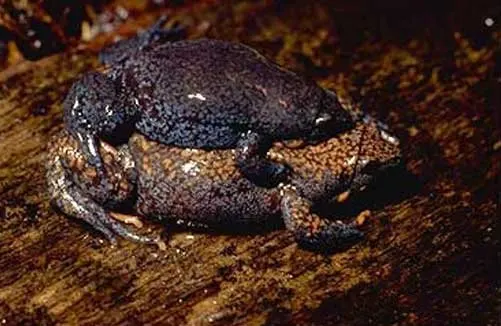
Elachistocleis erythrogaster, the Pro-Mata oval frog, is a small narrow-mouthed frog from the uplands of southern Brazil, in Rio Grande do Sul and Santa Catarina. The IUCN Red List rated it Endangered in 2023, up from Near Threatened in 2004. Its species name means red-bellied.
How to recognise it
This is a narrow-mouthed frog in the family Microhylidae, a group of small, plump frogs. The species name erythrogaster means red-bellied, a nod to the colour of its underside.
It was described in 1998 by Kwet and Di Bernardo from an adult male collected on 24 January 1997. The common name, Pro-Mata oval frog, comes from the place where that first frog was found.
Where it lives
The type locality is about one kilometre from the entrance to the Pro-Mata nature research and conservation centre in São Francisco de Paula, Rio Grande do Sul, at around 960 metres above sea level. The Red List assessment gives the species an elevation range of 900 to 1,200 metres, with records in Rio Grande do Sul and Santa Catarina.
Its estimated extent of occurrence is small, somewhere between 919 and 6,315 square kilometres, and it is known from three to five locations. The Global Biodiversity Information Facility holds only 14 occurrence records, all from Rio Grande do Sul, so this is a thinly documented animal.
Pins are Wikidata “endemic to” fields. Orange dots, when present, are GBIF occurrence tiles — survey bias included.
How it lives
The Red List habitat listing names dry subtropical or tropical grassland, small seasonal freshwater marshes and pools, and pastureland. It lives on land and in fresh water, and it does not migrate. Little else about its daily life, breeding or call has been published in sources that are easy to find.
Why it is in trouble
The Red List assessment names agro-industry plantations and tourism and recreation areas as the threats. Both convert or degrade the open habitat the frog uses, and the area it occupies is still shrinking. The population trend is listed as decreasing, though no population size has been estimated.
Its category was Near Threatened in 2004. The 2023 reassessment moved it to Endangered under criterion B1ab(iii), which covers a small range, few locations and continuing habitat decline.
What is being done
The species occurs in at least one protected area. The assessment lists resource and habitat protection, site and area management, control of invasive or problematic species, and policies and regulations among the conservation actions.
Sources
Written for this catalog in our own words from the sources below, checked against them on 12 November 2026. Population figures are estimates and carry the year they were made. Status and assessment year: IUCN. 2026. The IUCN Red List of Threatened Species. Version 2026-1. iucnredlist.org.




