Endangered
Edentulina moreleti
Edentulina moreleti
Edentulina moreleti is a small land snail found only in the Seychelles, on the islands of Silhouette and Mahe. It lives in humid forest at a couple of sites. The IUCN Red List assessed it as Endangered in 2009. It is the only member of its family known to eat plants rather than other snails.
How to recognise it
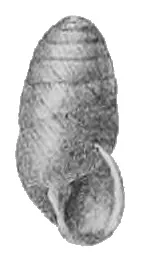
The shell is tan brown, tall and narrow, 11 to 14 mm high and 5.3 to 6.5 mm wide, with roughly seven whorls and no spiral ridges. Edentulina dussumieri, the other Edentulina in the Seychelles, is bigger, with shells over 14 mm tall and spiral sculpture.
Body colour changes with age. Newborns are yellow, juveniles are yellow with crimson tentacles, and adults are dark brown, though a nineteenth-century description called the body red.
Where it lives
Henry Adams described the snail in 1868 from Silhouette Island, and it is also known from Mahe. The IUCN counts only two locations, at roughly 540 to 600 m above sea level, in moist tropical forest.
Museums hold few specimens. Up to 1999, just 34 were known from collections. It is also thinly spread where it does live, with about 160 individuals counted across a 2 hectare site. The IUCN's estimate, from the 2009 assessment, is a total population of about 84,000 with a stable trend. It puts the area occupied at about 4 square kilometres, inside an extent of about 5. The two figures are hard to reconcile, so the true number is uncertain.
Pins are Wikidata “endemic to” fields. Orange dots, when present, are GBIF occurrence tiles — survey bias included.
How it lives
The Seychelles are rich in streptaxid snails, with 20 species listed, 16 of them endemic. Streptaxids are normally predators of other snails. This one isn't. It is the only known plant-eating streptaxid, probably grazing algae and decaying plant matter on the leaves of Dracaena reflexa, a plant that is plentiful where the snail is found. In captivity it has been fed carrot, apple and rotting leaves.
It gives birth to live young rather than laying eggs.
Why it is in trouble
The IUCN names two threats. Small-holder plantations took over some forest in the past, a pressure it considers unlikely to return. The ongoing one is cinnamon (Cinnamomum verum), an introduced tree that the assessment lists as affecting the whole population, with its effect described as unknown.
What is being done
At the 2009 assessment, a recovery plan was in place and conservation sites had been identified across its whole range. None of the population, though, lay in a protected area, and there was no monitoring scheme or captive breeding. The IUCN's listed actions are site protection and management and control of introduced species.
Sources
Written for this catalog in our own words from the sources below, checked against them on 12 November 2026. Population figures are estimates and carry the year they were made. Status and assessment year: IUCN. 2026. The IUCN Red List of Threatened Species. Version 2026-1. iucnredlist.org.




