Critically Endangered
Dwarf sturgeon
Pseudoscaphirhynchus hermanni
The dwarf sturgeon (Pseudoscaphirhynchus hermanni) is a small, bottom-living sturgeon of the Amu Darya river basin in Central Asia. It is recorded in Uzbekistan and Turkmenistan and possibly Tajikistan. The IUCN rated it Critically Endangered in 2022, and few are caught now.
How to recognise it
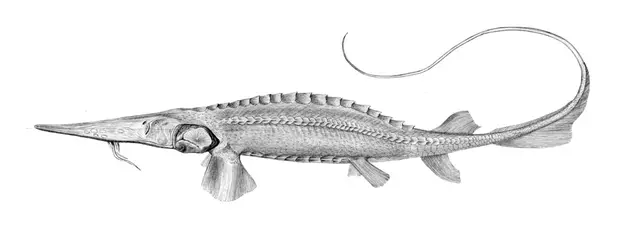
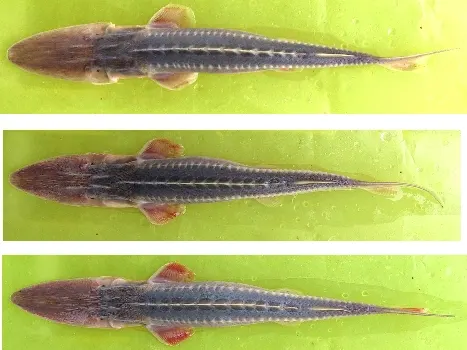
Next to most sturgeons this one is tiny. The largest recorded fish measured about 27 cm and the heaviest weighed only 51 g, and the oldest known age is six years. It belongs to the shovelnose group, with a flattened snout. Unlike its larger relative the Amu Darya sturgeon, it has no tail filament, and it shows a crease along the outer edge of the pectoral fin.
Where it lives
It is found only in the Amu Darya basin. The IUCN lists it as present in Uzbekistan and Turkmenistan and possibly present in Tajikistan. It once ranged as far as the Aral Sea.
It lives in permanent rivers, close to the bed, and feeds on small invertebrates. The IUCN classes it as a full migrant, and other sources describe it as moving within fresh water.
Pins are Wikidata “endemic to” fields. Orange dots, when present, are GBIF occurrence tiles — survey bias included.
Why it is in trouble
The population is decreasing. Fishermen in the lower Amu Darya report that catches of shovelnose sturgeons have dropped sharply over roughly the last decade, and a conservation project in Uzbekistan calls the dwarf sturgeon especially rare.
The Red List assessment names a spread of pressures, each rated low impact on its own: dams, groundwater abstraction for farming, pesticides and herbicides, soil erosion and silt, drought and small-scale harvest. The Uzbek project adds that water withdrawals for irrigation and dams such as Vakhsh and Tuyamuyun have changed flows and damaged spawning sites. It also reports poaching, fed by a local belief that the fish cures female infertility.
What is being done
The dwarf sturgeon is on CITES Appendix II, and it occurs in at least one protected area. Khorezm National Wildlife Park in Uzbekistan, established in 2019, was set up in the habitat of both Amu Darya shovelnose species.
Captive work has been a struggle. Fish caught in the lower Amu Darya in 2014 and 2015 were kept in pools at the Khorezm Mamun Academy in Khiva. The project was suspended in May 2020 because of COVID-19 restrictions, lack of funds, equipment failures and extreme heat, and the fish were released near Khanka.
The Nukus Balyk hatchery in Nukus was registered in 2020 as a breeding facility for these sturgeons and runs a recirculating water system. The aim is a genetically varied breeding stock, regular captive breeding and, eventually, release of hatchery-raised fish into the lower Amu Darya.
Sources
Written for this catalog in our own words from the sources below, checked against them on 12 November 2026. Population figures are estimates and carry the year they were made. Status and assessment year: IUCN. 2026. The IUCN Red List of Threatened Species. Version 2026-1. iucnredlist.org.