Endangered
Kotagama's toad
Kotagama's toad
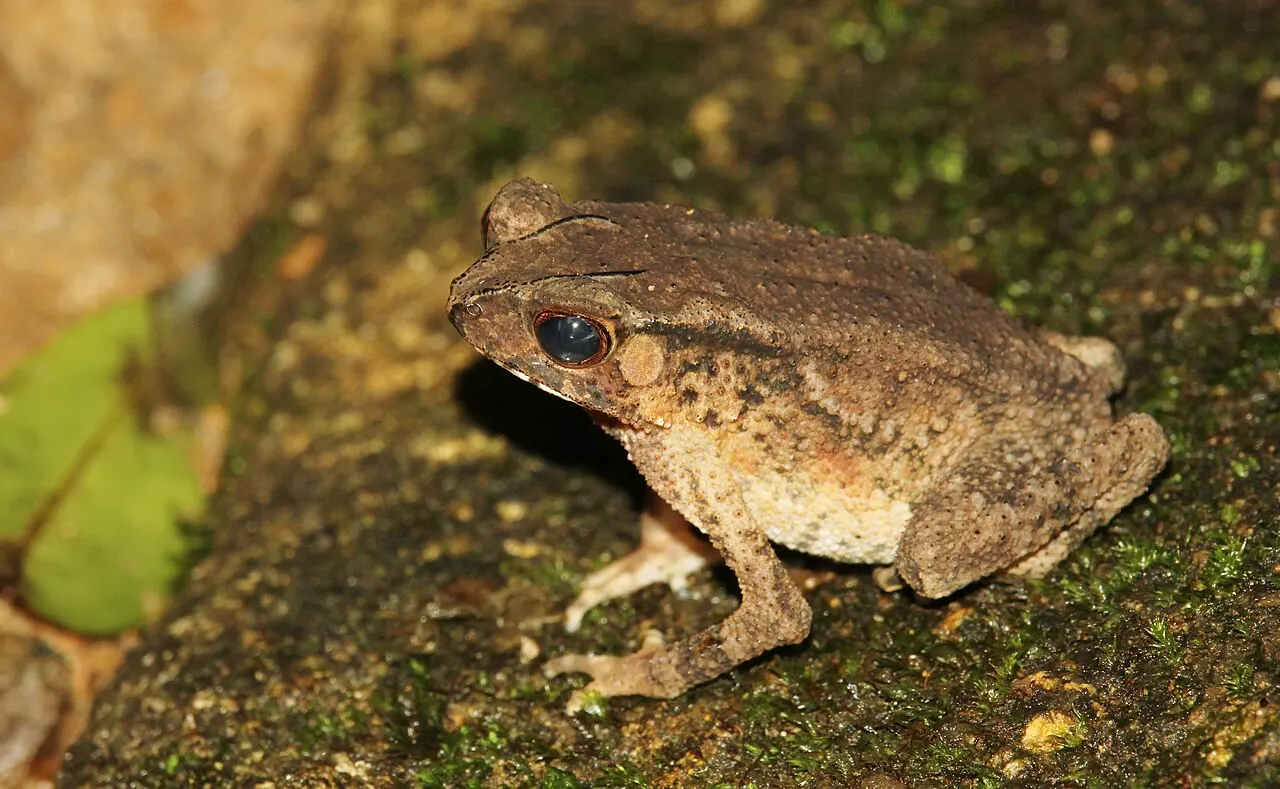
Kotagama's dwarf toad (Kotagama's toad) is a small orange-brown toad found only in the wet forests of Sri Lanka. The IUCN Red List lists it as Endangered (assessed 2020). It lives below about 1,070 metres, usually near streams in primary forest, and is among the rarest toads on the island.
How to recognise it
Females are much bigger than males. Males are reported at about 33 to 40 millimetres and females about 55 to 63 millimetres. The back is orange-brown mottled with dark brown, and young toads are a light golden colour. The underside is whitish with dark brown mottling, most strongly over the chest.
The skin is dry and warty. A pale band runs across the head between the eyes and darker bands cross the forearm, foot and legs. The original description also notes prominent ridges on the head, long narrow parotoid glands and black tips on the digits and warts.
The toad was described in 1994 by Fernando and Dayawansa as Bufo kotagamai, and is named after Sarath Kotagama.
Where it lives
It was first described from the Sinharaja forest in south-western Sri Lanka. A 2012 paper in Amphibian and Reptile Conservation listed Kitulgala, Massena, Erathna and Delwala as the other known forest areas, then added two new sites, in the Samanala Nature Reserve and on a mountain near Deraniyagala. The direct distance from the original site to the new records is about 80 kilometres.
The IUCN gives an elevation range of 150 to 1,070 metres and counts four to five locations. It lists moist lowland and moist montane forest and permanent streams as habitat.
Pins are Wikidata “endemic to” fields. Orange dots, when present, are GBIF occurrence tiles — survey bias included.
How it lives
In a 2012 survey of the Uda Maliboda trail in the Samanala Nature Reserve, 11 toads were found between 2009 and 2011, all in primary forest and none in disturbed ground. All but one were within about 10 metres of a small stream, and most were seen at night, on stream banks, boulders and leaf litter. The species reportedly shelters under rocks or in decaying leaves, and eats termites and grasshoppers.
Its breeding has not been recorded. It presumably takes place in water, probably in streams. Handled toads were aggressive and gave a low repeated distress call.
Why it is in trouble
The population is decreasing. The Red List names small-holder and large-scale farming, housing, tourism and recreation, fire, pesticides and herbicides, drought and acid rain among the threats, and records a continuing decline in the area it occupies. The Samanala survey team suspected that local populations had already died out and that the toad survives only in a few isolated patches of primary forest.
In that forest, the paper also named illegal timber cutting, encroachment, slash and burn clearing, tea plantations, gem mining, a hydroelectric power plant under construction, road traffic and litter left by visitors as pressures. The Uda Maliboda trail itself is rarely used by pilgrims heading for Adam's Peak, though other trails there are used every year.
What is being done
The toad occurs in at least one protected area, and the Red List records site protection, area management and habitat protection as the actions in place or needed. Survey work such as the 2012 Samanala study has widened its known range, which helps show which forests deserve priority.
Sources
Written for this catalog in our own words from the sources below, checked against them on 12 November 2026. Population figures are estimates and carry the year they were made. Status and assessment year: IUCN. 2026. The IUCN Red List of Threatened Species. Version 2026-1. iucnredlist.org.




