Endangered
Chamula mountain brook frog
Duellmanohyla chamulae
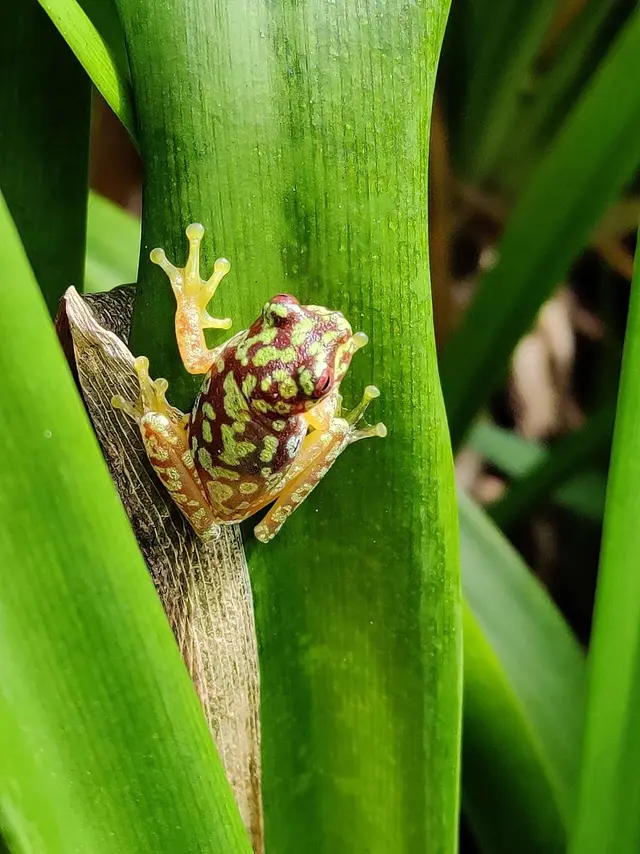
The Chamula mountain brook frog (Duellmanohyla chamulae) is a small tree frog tied to fast mountain streams in the cloud forests of southern Mexico, centred on the highlands of Chiapas. It was assessed as Endangered in 2020 because its range is small and its forest keeps shrinking.
Where it lives
William Duellman described the frog in 1961 under the genus Ptychohyla. It belongs to the tree frog family, Hylidae. The old core of its range lies on the northern side of the Chiapas highlands between Jitotol and Solosuchiapa, in moist cloud forest, at a recorded 350 to 1,700 metres above sea level.
The picture grew in 2009, when researchers found one on 6 March at 230 metres in lowland rainforest in the Uxpanapa region of Veracruz. That site was about 170 kilometres west of the nearest known locality and 120 metres lower than the lowest earlier record. The current Red List assessment gives a range of about 4,860 square kilometres, lists Chiapas, Oaxaca, Veracruz and Tabasco, and counts four locations.
Pins are Wikidata “endemic to” fields. Orange dots, when present, are GBIF occurrence tiles — survey bias included.
How it lives
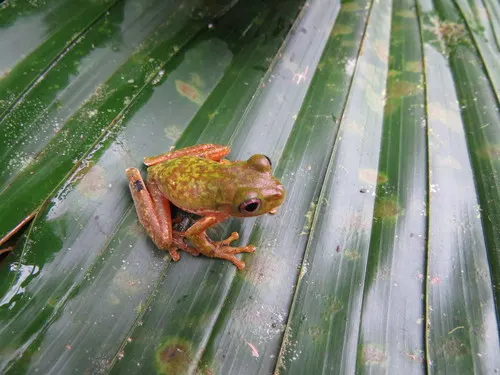
The assessment lists permanent streams, cloud forest and lowland moist forest as its habitats. The Veracruz frog was a juvenile, 20 millimetres long and weighing half a gram, sitting inactive on a herb leaf 30 centimetres above the ground on a slope near a stream at 1:30 in the afternoon.
Frogs in this genus are said to breed in fast-flowing mountain streams. Egg laying has not been seen in this species, but females are thought to place eggs on foliage above the water so that the tadpoles drop in when they hatch. The tadpoles have oral discs that let them cling to surfaces in the current.
In Chiapas the frog is mainly a cloud forest animal and is not considered rare. In Veracruz, a year of searching 8 sites (128 person-hours plus a direct search of 38,400 square metres) turned up only that single frog, so the researchers judged it rare there.
Why it is in trouble
The Red List names shifting agriculture, small-holder farming, grazing and ranching, and small-scale unintended harvest as threats. Cloud forest is being cleared and cut up, and the area of habitat continues to decline. Mexico's 2001 national list of species at risk put the frog in its special protection category.
Chytridiomycosis, the amphibian fungal disease, is considered a possible further threat.
What is being done
The assessment lists habitat and site protection, awareness work, habitat restoration and alternative livelihoods among the actions relevant to the frog. It also calls for research on population size and trends, threats and ecology.
Sources
Written for this catalog in our own words from the sources below, checked against them on 12 November 2026. Population figures are estimates and carry the year they were made. Status and assessment year: IUCN. 2026. The IUCN Red List of Threatened Species. Version 2026-1. iucnredlist.org.