Endangered
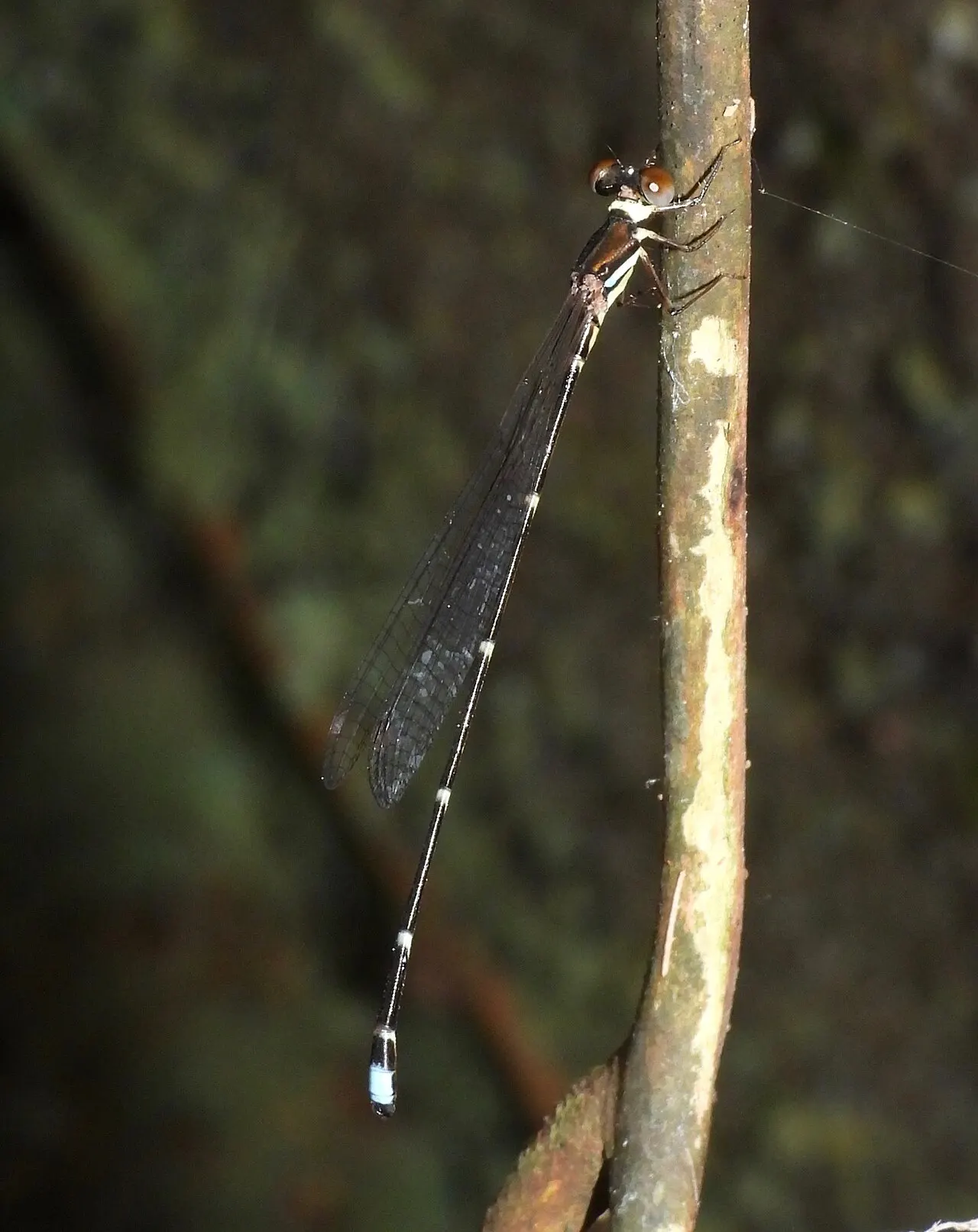
Drepanosticta adami
Drepanosticta adami
Adam's shadowdamsel (Ceylonosticta adami, placed by some authors in Drepanosticta) is a slender forest damselfly found only in Sri Lanka, mostly in and around the Knuckles range. The IUCN Red List rated it Endangered in 2021 (Critically Endangered in 2006). Its records come from a handful of shaded streams.
How to recognise it
Adam's shadowdamsel belongs to the shadowdamsels, the family Platystictidae. These are damselflies with narrow wings and long, thin abdomens that live mostly in shaded forest streams, and the adults seem to disperse poorly. Many species in the family are known from a single locality or a very small range.
F. C. Fraser described this one in 1933 from specimens collected at Madugoda near Urugalla. Its name is a small puzzle. The IUCN uses Ceylonosticta adami, while other sources keep it in the genus Drepanosticta. Both names point to the same animal.
Where it lives
It is endemic to Sri Lanka and is tied to the Knuckles range and its outskirts. Named sites include Madugoda near Urugalla, Simpson's Forest near Hunnasfalls and the Dothalugala camp site area. The IUCN counts eight locations between about 500 and 1,338 m above sea level.
The assessment lists lowland moist forest, montane moist forest and permanent streams as its habitat. It puts the area the species actually occupies at roughly 48 to 100 square kilometres, within a wider range of about 363 to 1,202 square kilometres. Up to ten sites are known, but some lie so close together that they count as eight locations.
Pins are Wikidata “endemic to” fields. Orange dots, when present, are GBIF occurrence tiles — survey bias included.
A thin record
After the 1932 specimens, the species went unrecorded until April 2006. Karen Conniff then photographed it in Simpson's Forest in 2006, 2007 and 2010. In May 2009 she and Matjaz Bedjanic saw a single young female near Urugalla, and in October 2012 Bedjanic found it at two streams in Simpson's Forest.
It is easy to miss. Highland Sri Lankan Ceylonosticta damselflies are generally seen for only a couple of months, during or just after the southwest monsoon, and Adam's shadowdamsel has been called one of the rarest endemic damselflies on the island.
Why it is in trouble
The IUCN judges the population to be decreasing, with its habitat severely fragmented and the area it occupies still shrinking. The threats it lists are changes to the habitat and the taking of surface water from streams. A damselfly that rarely strays far from its home stream has little chance of recolonising a section that dries up or loses its forest.
What is being done
The species occurs in at least one protected area. The IUCN assessment names site protection and management, protecting resources and habitat, restoring habitat and raising awareness among the conservation actions that apply to it.
Sources
Written for this catalog in our own words from the sources below, checked against them on 12 November 2026. Population figures are estimates and carry the year they were made. Status and assessment year: IUCN. 2026. The IUCN Red List of Threatened Species. Version 2026-1. iucnredlist.org.




