Critically Endangered
Sam Roi Yot leaf-toed gecko
Dixonius kaweesaki
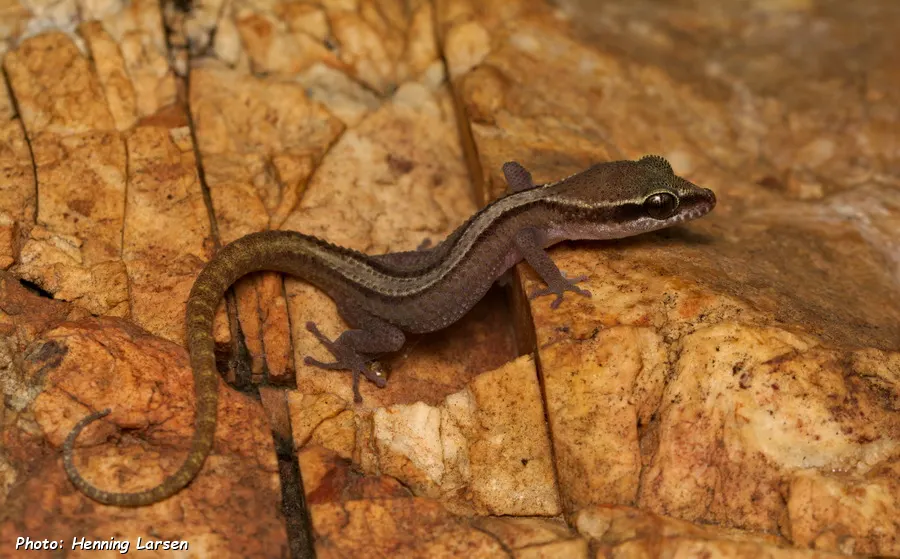
The Sam Roi Yot leaf-toed gecko (Dixonius kaweesaki) is a tiny, striped gecko known only from limestone hills in Prachuap Khiri Khan Province, Thailand. It was described as new to science in 2017. The IUCN Red List classed it as Critically Endangered in 2018, with a decreasing population, and names collecting as the threat.
How to recognise it
This is a small gecko in the family Gekkonidae, the eighth species described in the genus Dixonius. The largest measured snout-to-vent length is 41.6 mm. Two bold dark stripes run from the snout to the base of the tail, with a pale stripe down the middle of the back between them.
Scientists separate it from its relatives by scale counts: 12 or 13 lengthwise rows of tubercles on the back and 24 rows of belly scales across the abdomen. Males have a continuous row of 9 to 11 pores in front of the vent, and females have none.
Where it lives
It is endemic to Thailand and is tied to the Khao Sam Roi Yot limestone massif in Prachuap Khiri Khan Province. The type series came from Khao Daeng, a limestone mountain in Kui Buri District that forms part of that massif. The holotype, an adult male, was collected on 20 June 2014.
It lives on rocky ground in dry shrubland, at elevations of about 5 to 300 m. The IUCN assessment lists a single location, an extent of occurrence of about 99 square km, and records that it occurs in at least one protected area. A range map on Thai National Parks lists Khao Sam Roi Yot National Park, though that site warns its maps rest on limited data.
Pins are Wikidata “endemic to” fields. Orange dots, when present, are GBIF occurrence tiles — survey bias included.
How it lives
Very little is recorded. Reptile Database says it is most active between 01:00 and 04:00, especially after rain. It lists the species as egg-laying, but by inference rather than observation. The same hills hold other geckos, including the tokay (Gekko gecko) and Cnemaspis siamensis.
Why it is in trouble
The 2018 assessment uses criteria B1ab(v), which describes a very small range and a continuing decline in the number of mature animals. The IUCN lists the threat as intentional use in which the species is the target, with mortality as the result, and records its use as a pet or display animal.
What is being done
The assessment lists no conservation actions as needed or in place beyond occurring inside a protected area. Its only research priority is harvest, use and livelihoods.
Sources
Written for this catalog in our own words from the sources below, checked against them on 12 November 2026. Population figures are estimates and carry the year they were made. Status and assessment year: IUCN. 2026. The IUCN Red List of Threatened Species. Version 2026-1. iucnredlist.org.




