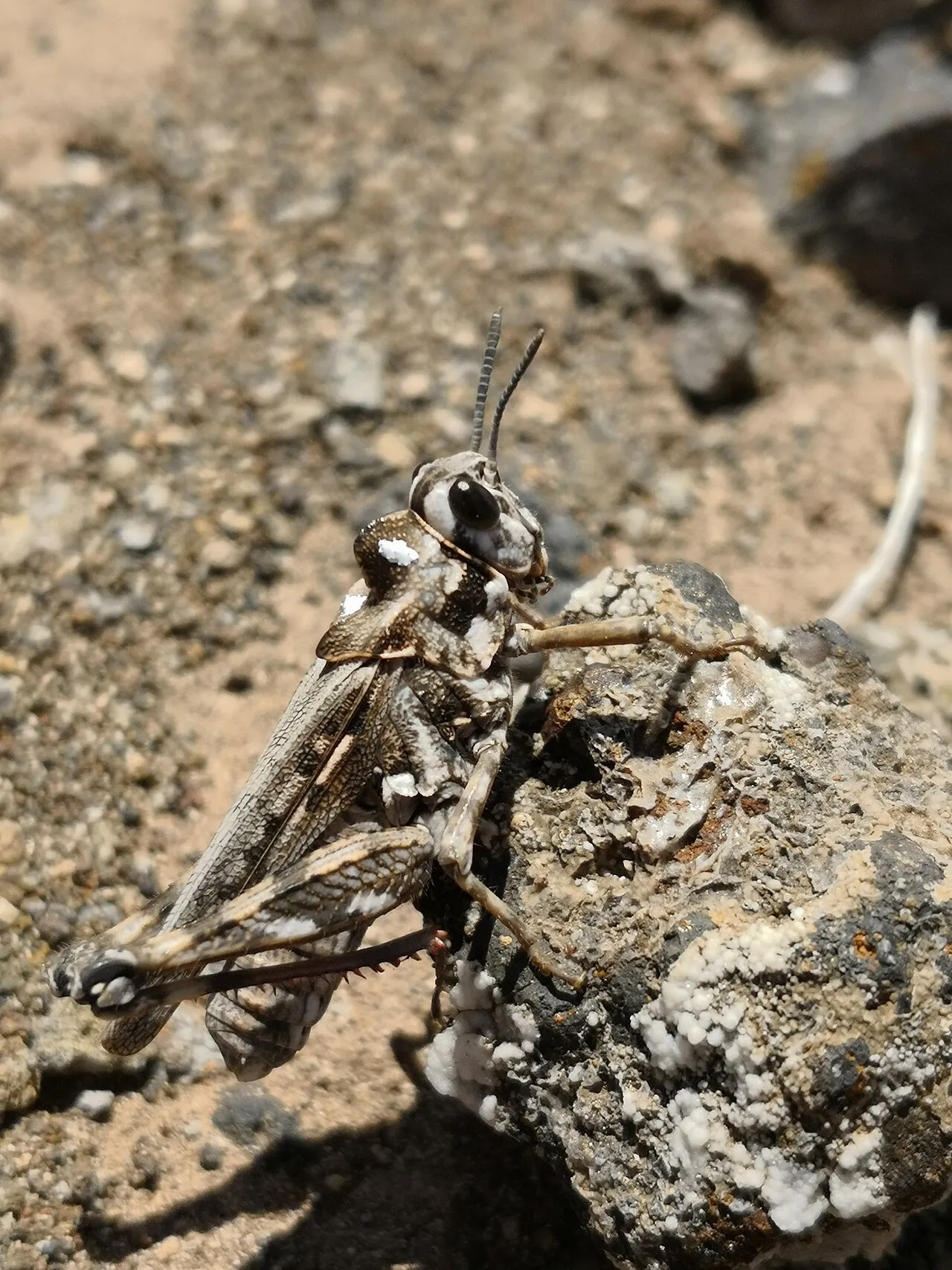
Critically Endangered
Maspalomas bow-legged grasshopper
Dericorys minutus
The Gran Canaria crested grasshopper (Dericorys minutus), also called the Maspalomas bow-legged grasshopper, is found only on Gran Canaria in Spain's Canary Islands. Known from a single specimen for decades, it was rediscovered in 2015 and is rated Critically Endangered on the IUCN Red List (assessed 2016).
A species once thought lost
Chopard described Dericorys minutus in 1954. For a long time the only record was one male collected at Maspalomas, on the south coast of Gran Canaria, in 1949. Nobody found another, and the grasshopper was considered extinct.
In 2015 it turned up again on the island, and Erasmus students working with grasshopper specialist Axel Hochkirch at the Spanish research institute IPNA-CSIC took part in the rediscovery, gathering information on its distribution and ecology. A field trip in the summer of 2016 found a second population. It has still not been found around Maspalomas since 1949.
Where it lives
It is endemic to Gran Canaria. The Red List gives an area of occupancy of 4 to 8 square kilometres and an extent of occurrence of 4 to 10, at elevations up to about 50 m. The only locality known before 2016 was on the island's north-western coast. A small population in the north of the island is probably not viable.
A small conservation grant awarded in October 2016 set out to estimate the population size at the north-western locality, map where the species occurs to pick priority conservation areas, and check whether it lives nearby. Beyond the Red List figures above, no published population count exists.
Pins are Wikidata “endemic to” fields. Orange dots, when present, are GBIF occurrence tiles — survey bias included.
Why it is in trouble
The Red List records a decreasing population, with rapid declines across the whole range. The two threats it scores as high impact are tourism and recreation areas, and housing and urban development, which destroy and degrade the coastal ground it needs. The grant report says part of the second population lies outside a protected area, close to banana plantations and industrial areas.
A range of just a few square kilometres makes the whole species vulnerable to a single development or disturbance.
What is being done
The conservation measures listed by the IUCN are habitat protection and site protection. Sources differ on cover: the 2016 assessment says the species does not occur in a protected area, while the grant report says the second population lies within one, with part of it outside. The largest part was described as relatively well protected.
Sources
Written for this catalog in our own words from the sources below, checked against them on 12 November 2026. Population figures are estimates and carry the year they were made. Status and assessment year: IUCN. 2026. The IUCN Red List of Threatened Species. Version 2026-1. iucnredlist.org.




