Critically Endangered
Dendrotriton rabbi
Dendrotriton rabbi
The Guatemalan bromeliad salamander (Dendrotriton rabbi) is a small, long-tailed salamander of montane forest in the highlands of western Guatemala. The IUCN Red List rated it Critically Endangered in 2020. It is known from a single location, and its forest home is being cleared for wood and small farms.
How to recognise it
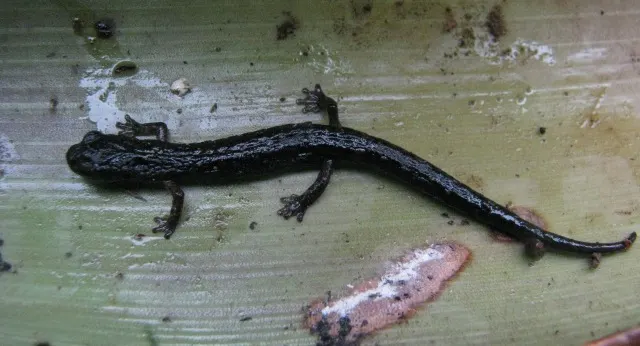
It is a small, slender salamander. The largest measured adults are around 37 mm from snout to vent, and the tail of an adult is longer than the body. The limbs are slim and fairly long, and the feet are slightly webbed.
The back is dark brown with faint orange flecks and paler pigment down the midline. Some animals carry a light stripe along the back, a pair of stripes either side of the spine, or a netlike pattern of blotches. The belly is light grey, peppered with tiny dark specks.
Where it lives
Lynch and Wake described the species in 1975, originally in the genus Chiropterotriton, and it is named for the American zoologist George Rabb. It is known from the Montañas de Cuilco, close to the Mexican border, and from the Sierra de los Cuchumatanes. GBIF holds 128 occurrence records, 127 of them from Guatemala.
Whether it also reaches Mexico is uncertain. The IUCN assessment lists both Guatemala and Mexico, while other sources describe it as endemic to Guatemala with a range that may extend across the border.
It lives between about 2,100 and 3,000 m in moist mountain forest at the transition between subtropical and temperate zones. The assessment counts a single location, describes the population as severely fragmented, and records that the species is not known from any protected area.
Pins are Wikidata “endemic to” fields. Orange dots, when present, are GBIF occurrence tiles — survey bias included.
How it lives
As the common name suggests, it shelters in bromeliads, the water-holding plants that perch on tree branches. It is also found under bark on stumps and logs. Salamanders over about 25 mm long are treated as mature. Its diet, breeding and behaviour have not been described in the sources available.
Why it is in trouble
The IUCN lists the species under criterion B1ab(iii) and records a decreasing population. Its range is small and cut into pieces, and the quality of its habitat is falling.
The main threat is loss of forest, from clearing for wood and from the spread of small-holder farming. The assessment also records drought and small-scale harvesting as ongoing threats, and an unnamed species as a future threat.
What is being done
The assessment points to site protection and management, protection of resources and habitat, and control of invasive or problematic species. It records that the salamander does not occur in a protected area. The sources do not describe a specific programme for it.
Sources
Written for this catalog in our own words from the sources below, checked against them on 12 November 2026. Population figures are estimates and carry the year they were made. Status and assessment year: IUCN. 2026. The IUCN Red List of Threatened Species. Version 2026-1. iucnredlist.org.




