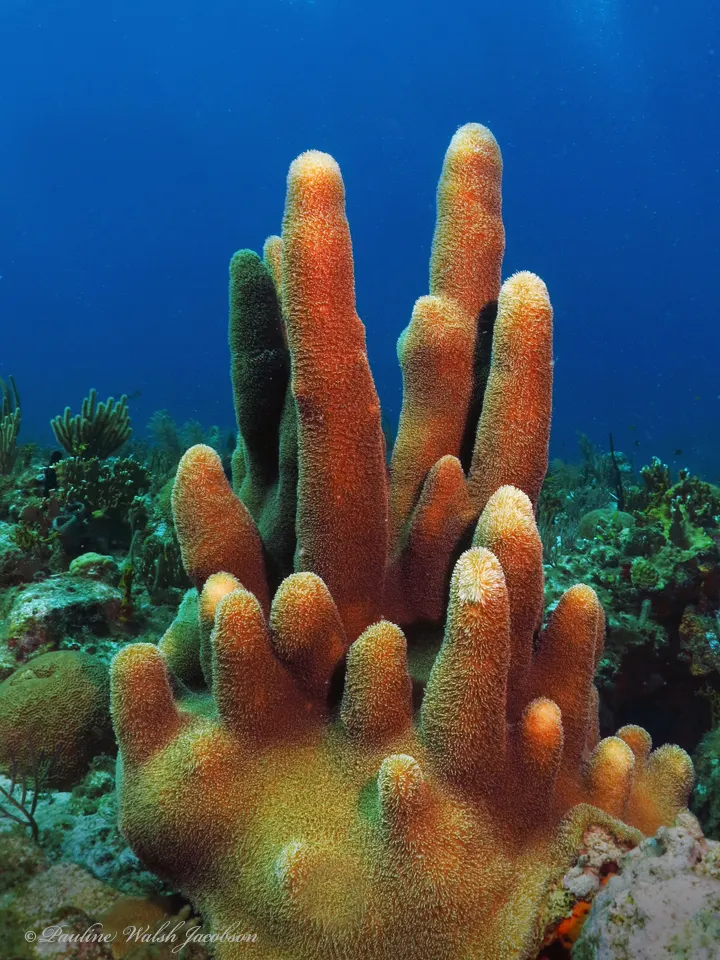
Critically Endangered
Pillar coral
Dendrogyra cylindrus
Pillar coral (Dendrogyra cylindrus) is a reef-building coral of the western Atlantic and Caribbean that grows in tall, finger-like columns. The IUCN Red List rated it Critically Endangered in 2022, with a decreasing trend. Stony coral tissue loss disease has nearly erased it from Florida's reefs.
How to recognise it
Few corals are easier to pick out. Pillar coral grows from a low, crusty base into upright, round-tipped cylinders that never branch, like a cluster of cigars. Colonies can reach about 3 m (10 ft) tall, though most are smaller, and individual pillars can be more than 10 cm (4 in) across.
The colour is usually beige to grey-brown. Unlike most hard corals, its polyps stay extended through the day, which gives the columns a soft, furry look. The skeleton underneath has meandering valleys with tiny cups, each under 1 cm wide.
Where it lives
It lives in the western Atlantic, from Florida and the Bahamas south through the Caribbean to Trinidad and Tobago, with a northern outpost on the Yucatan Peninsula and in the Gulf of Mexico. The IUCN lists it as present in more than 40 countries and territories, from Mexico and Belize to Barbados, Cuba and the Virgin Islands. Panama and Bermuda are marked only as possibly extant, and Bermuda has had a single reported colony.
Pillar coral sits on reefs at about 1 to 20 m depth, most often at 5 to 15 m. NOAA gives a slightly wider range of 1 to 25 m.
Pins are Wikidata “endemic to” fields. Orange dots, when present, are GBIF occurrence tiles — survey bias included.
How it lives
Colonies are normally either male or female, though a few hermaphrodite colonies have been seen. Once a year, several nights after the full moon in late summer, colonies release eggs and sperm into open water, where fertilisation happens. That only works if males and females are close enough together.
Growth is slow, around 0.8 cm a year according to NOAA, and colonies can live for hundreds of years. The IUCN calls the species uncommon or rare across most of its range, though locally common in some places. Broken fragments can regrow, and a toppled colony can send up new pillars.
Why it is in trouble
The main killer is stony coral tissue loss disease, which strips living tissue from the skeleton, and pillar coral is one of the species it hits hardest. A 2021 paper in Frontiers in Marine Science reported that Florida's wild population had fallen to less than 6% of its 2014 level by the end of 2020. A 2025 study in the same journal found a further 96% loss of live tissue and a 78% loss of colonies from 2021 to early 2025. Only about 9.6 square metres of tissue on 23 colonies (15 genotypes) remained. The IUCN considers the Florida population reproductively extinct.
The IUCN also records heat stress, storms, sedimentation, coastal development, shipping and recreational damage as pressures, and puts the decline across the Caribbean at 80% or more. NOAA adds ocean acidification, land-based pollution and small population size.
What is being done
Starting in 2015, rescuers in Florida collected over 550 fragments from wild colonies, thought to represent 128 genotypes. As of February 2025, eight facilities on the reef and on land were caring for rescued corals. Over five years, 105 of the rescued colonies spawned in captivity, and 82 young corals raised from that spawning were being reared in early 2025. Two of the lab-bred corals spawned six years after settling.
The species was listed as threatened under the US Endangered Species Act in 2014, and a rule reclassifying it as endangered took effect in March 2025. NOAA has designated critical habitat and supports coral nurseries, gene banking and sperm cryopreservation. The IUCN notes it occurs in at least one protected area.
Sources
Written for this catalog in our own words from the sources below, checked against them on 12 November 2026. Population figures are estimates and carry the year they were made. Status and assessment year: IUCN. 2026. The IUCN Red List of Threatened Species. Version 2026-1. iucnredlist.org.




