Endangered
Danafungia scruposa
Danafungia scruposa
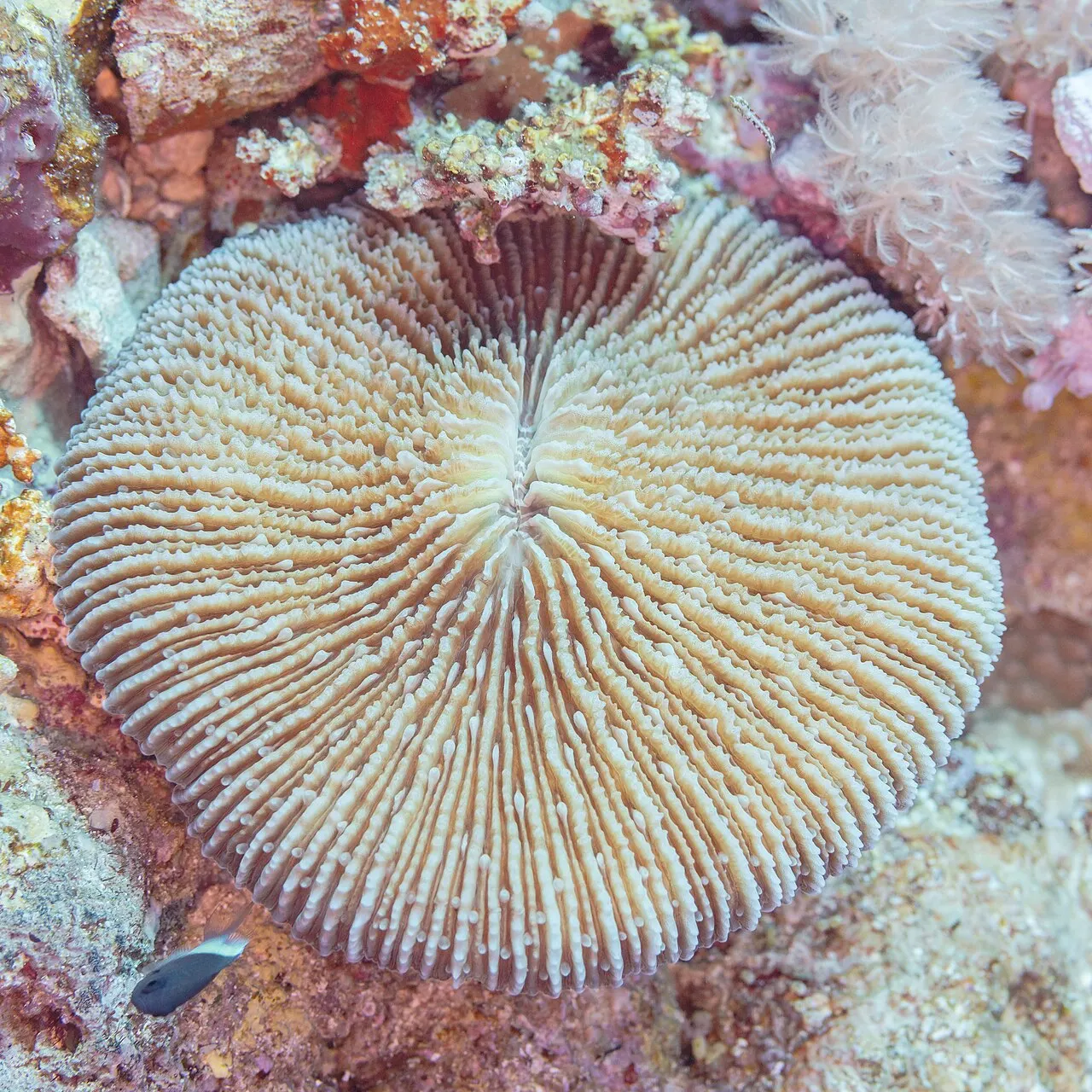
Danafungia scruposa is a mushroom coral that lives as a single unattached disc on reef slopes and lagoons across the Indian and western Pacific oceans. The IUCN Red List moved it from Least Concern to Endangered in 2024. In 2009 one was photographed eating a moon jellyfish.
How to recognise it
This coral is a single flattened or gently domed disc rather than a branching colony. It is usually about 25 cm across, and one reference gives up to 38 cm. Colour is described as pale brown in one account and blue or brown in another.
The upper surface carries dense septa, the ridges of the skeleton, whose edges have large pointed teeth. The underside is ribbed, with pits between the ribs. It was long placed in the genus Fungia, and older papers still use the name Fungia scruposa.
Where it lives
The 2024 assessment lists dozens of countries and territories, from the Red Sea and east Africa through the Maldives, Southeast Asia and northern Australia to Fiji, Samoa and French Polynesia. It lives on coral reefs, on slopes and in lagoons, and is reported as common in the Red Sea and western Indian Ocean and uncommon elsewhere.
Depth limits differ between sources: the Red List gives 1 to 55 m, while other accounts give about 0 to 40 m or 1 to 27 m.
Pins are Wikidata “endemic to” fields. Orange dots, when present, are GBIF occurrence tiles — survey bias included.
How it lives
Like most reef corals, it gets energy from algae living in its tissue, and it also feeds on bacteria and small plankton. In March 2009, researchers surveying reefs near Eilat in the Red Sea saw one take a moon jellyfish (Aurelia aurita) during a jellyfish bloom. A 2009 paper in Coral Reefs described it as the first photographed case of a coral eating adult jellyfish. How the coral caught its prey is still unknown.
The Red List gives a generation length of about 10 years.
Why it is in trouble
Earlier assessments in 2008 and 2014 rated the species Least Concern. The 2024 assessment uses criterion A3c, which covers a projected future decline linked to loss of habitat quality. It gives a projected reduction of about 63% and a decreasing population trend.
The threats named are temperature extremes, storms and flooding, sedimentation and soil erosion, coastal housing and commercial development, shipping lanes, and recreation and tourism.
What is being done
The assessment lists site protection and management, habitat restoration, species recovery, captive breeding and a genome resource bank as conservation actions for the species. As a stony coral it is covered by CITES Appendix II, which regulates trade, and it appears in the aquarium hobby.
Sources
Written for this catalog in our own words from the sources below, checked against them on 12 November 2026. Population figures are estimates and carry the year they were made. Status and assessment year: IUCN. 2026. The IUCN Red List of Threatened Species. Version 2026-1. iucnredlist.org.




