Endangered
Dalmatian barbelgudgeon
Aulopyge huegelii
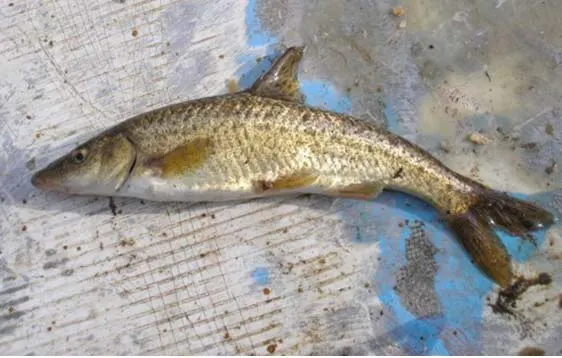
The Dalmatian barbelgudgeon (Aulopyge huegelii) is a small, nearly scaleless carp relative found only in the karst waters of Croatia and Bosnia and Herzegovina. It is the sole member of its genus and retreats underground in dry spells. The IUCN assessed it as Endangered in 2024.
How to recognise it
It has an elongated body with two pairs of barbels, and scales that are almost or completely absent. The last hard ray of the dorsal fin is serrated. Females have a long urogenital papilla joined to the front edge of the anal fin. FishBase gives a maximum standard length of 20 cm.
The common name reflects a look somewhere between a barbel and a gudgeon. The gudgeon resemblance is reportedly convergent rather than a sign of close kinship, and the genus is reportedly among the closest relatives of the true barbels.
Where it lives
The species is endemic to the Adriatic basin and the Dinaric karst. In Croatia it occurs in the Cetina and Krka drainages. The Zrmanja population had not been confirmed in recent surveys when the species was summarised in 2006, and it may be gone. In Bosnia and Herzegovina it lives in the waters of the Livno, Glamoč and Duvno fields and in Lake Buško.
Several lake populations come from people moving fish. A 2023 paper in the Croatian Journal of Fisheries cites a transfer from Lake Buško into Lake Blidinje, introductions to Šatorsko Lake in the 1970s and 1980s, and evidence of introduction to Mostarsko Blato. The 2024 assessment counts five locations, an extent of occurrence of about 10,300 square kilometres and an area of occupancy of about 400 square kilometres.
Pins are Wikidata “endemic to” fields. Orange dots, when present, are GBIF occurrence tiles — survey bias included.
How it lives
Adults use fast streams, still water and lakes, and are reportedly mainly active at night. In winter and dry seasons they move into subterranean karst water. FishBase lists the species as omnivorous.
Spawning is reported to last a month or more once the water reaches about 20 degrees C. One account places it in karst caves, with the female pushing eggs of 1.5 to 2 mm into rock and gravel crevices using a specialised ovipositor, while FishBase says it spawns in shallow areas of rivers and lakes. The sources do not fully agree.
Why it is in trouble
Dams, groundwater and surface water abstraction for homes and farms, pesticides, nutrient runoff, sewage and soil erosion all appear in the assessment, along with several introduced species. A survey reported in the Iranian Journal of Ichthyology in 2018 found 88 fish at four neighbouring sites in the Buško Blato reservoir, a clear drop from earlier studies. The fish had withdrawn to a small part of the reservoir connected to groundwater, apparently to escape four non-native predatory fish species.
The species is still locally common, but numbers have fallen and the current trend is recorded as unknown. It was listed as Endangered in 1990 and 1994, Vulnerable in 1996, and Endangered again from 2006.
What is being done
The species occurs in at least one protected area, and conservation sites have been identified over part of its range. The assessment records no recovery plan, no monitoring scheme and no captive breeding.
Sources
Written for this catalog in our own words from the sources below, checked against them on 12 November 2026. Population figures are estimates and carry the year they were made. Status and assessment year: IUCN. 2026. The IUCN Red List of Threatened Species. Version 2026-1. iucnredlist.org.




