Critically Endangered
Dahl's toad-headed turtle
Mesoclemmys dahli
Dahl's toad-headed turtle (Mesoclemmys dahli) is a freshwater turtle found only in northern Colombia, in the lower Magdalena and Sinú river basins. The IUCN Red List lists it as Critically Endangered (assessed 1996). Its dry forest home has mostly been cleared, and the surviving turtles live in small, isolated groups.
How to recognise it
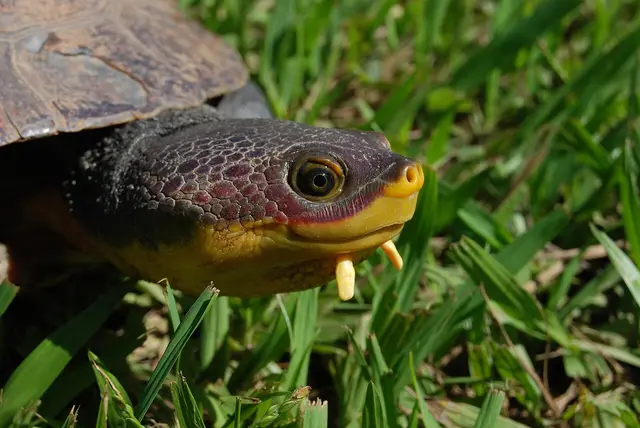
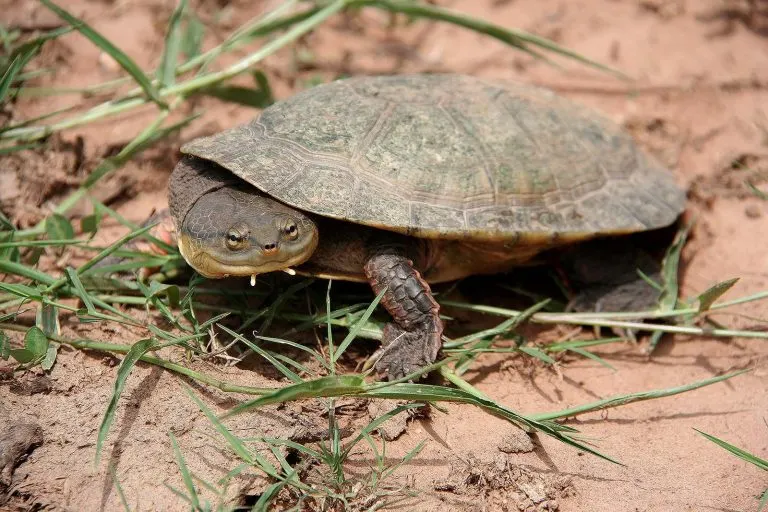
This is a medium-sized side-necked turtle. The shell is oval, olive to brown, and reaches about 23 cm (9 inches) in length. The rear edge is slightly serrated. The underside is cream to yellow with grey seams between the plates.
The head is large and broad, with two barbels (small fleshy feelers) on the chin. The top of the head is grey to olive brown, while the jaw and sides are cream to yellow. Males have longer, thicker tails and narrower heads. Females have a head that looks swollen behind the eyes.
Where it lives
The species is endemic to northern Colombia and is known from the lower Magdalena and Sinú basins, across the departments of Atlántico, Bolívar, Córdoba and Sucre. It is the only member of its family of side-necked turtles found west of the Andes, according to the Turtle Survival Alliance.
It prefers shallow, quiet water, such as ponds and small brooks inside dry tropical forest, where it forages along the bottom. In dry periods it can retreat onto land and wait for the water to return.
Pins are Wikidata “endemic to” fields. Orange dots, when present, are GBIF occurrence tiles — survey bias included.
How it lives
Dahl's toad-headed turtle is mostly a meat eater. It takes snails, aquatic insects and other invertebrates, fish and amphibians, and it will eat carrion too.
Mating has been reported in June and July, and nesting peaks in September and October, though females may nest at other times. They lay several clutches a year of one to six white, brittle-shelled eggs. Hatchlings have shells only about 3 cm long.
Why it is in trouble
Tropical dry forest in northern Colombia has been converted to cattle pasture, farmland and infrastructure. Less than 10 percent of it is thought to remain. The area around the type locality, where the species was first collected, was once forest ponds and streams and is now pasture.
A genetic study published in Conservation Genetics in 2017 sampled blood from 127 turtles over about a year and a half. It found at least four small subpopulations with little contact between them. Genetic diversity was still fairly high, but every subpopulation showed signs of potentially harmful inbreeding.
What is being done
In December 2019 the Turtle Survival Alliance, the Wildlife Conservation Society and Rainforest Trust bought a 120-hectare (about 297-acre) property in San Benito Abad, Sucre. La Carranchina Natural Reserve was the first protected area in Colombia set aside for a turtle. Its population is described as the country's most abundant and genetically diverse.
In 2024 the reserve was recognised as a Key Biodiversity Area because of its distinct genetic diversity, and it is reported to protect about 30 percent of the species' unique genetic variation. The researchers behind the 2017 study called for genetic rescue (moving turtles between subpopulations), a protected area for the species, and restoration of the dry forest.
Sources
Written for this catalog in our own words from the sources below, checked against them on 12 November 2026. Population figures are estimates and carry the year they were made. Status and assessment year: IUCN. 2026. The IUCN Red List of Threatened Species. Version 2026-1. iucnredlist.org.