Critically Endangered
Fanshell
Cyprogenia stegaria
The fanshell, Cyprogenia stegaria, is a freshwater mussel of medium to large rivers in the eastern United States. Once found across the Ohio, Cumberland and Tennessee river systems, it now breeds in only three rivers. The Red List rates it Critically Endangered, in an assessment dating from 1996.
How to recognise it
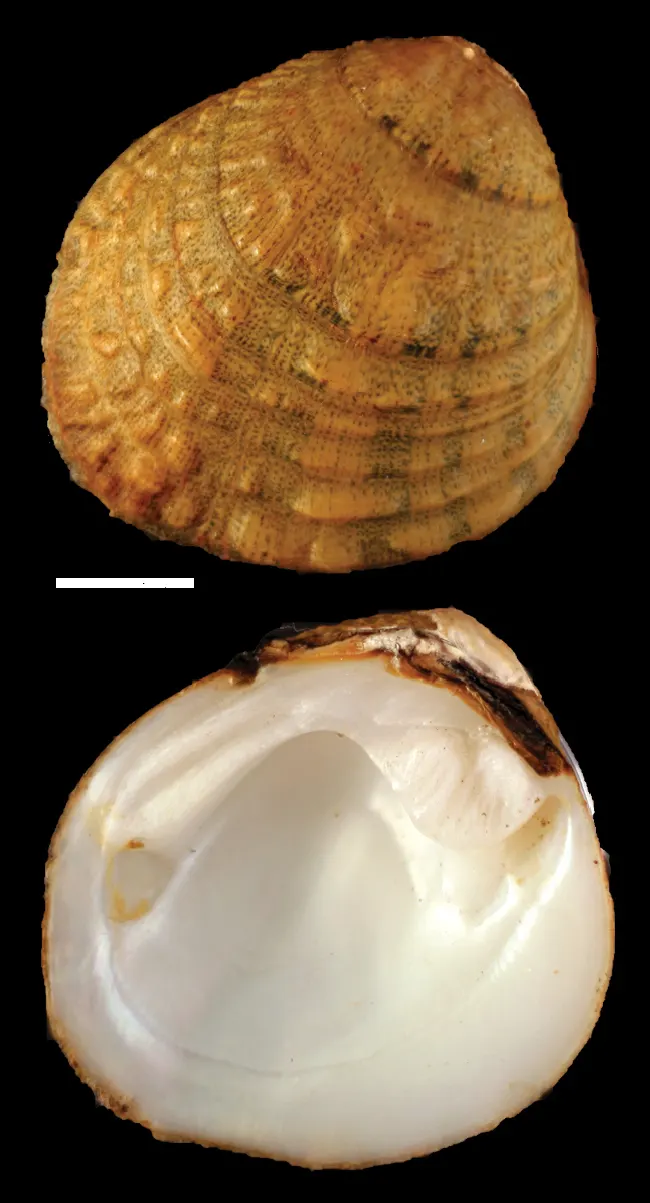
The fanshell is a medium-sized mussel with a roughly round shell that rarely grows beyond 3.2 inches (8.1 cm). The outside is light green or yellow with green rays and mottling, and the inside is usually silvery white, sometimes tinged flesh-pink. Rafinesque described the species in 1820.
Where it lives
It lives in medium to large rivers, typically on shoals of coarse gravel and sand in deeper water with moderate current. Historically it occurred in the Ohio, Wabash, Cumberland and Tennessee drainages across nine states.
Reproducing populations are now known from only three rivers: the upper Clinch in Tennessee and Virginia, and the Green and Licking in Kentucky. A small breeding population may exist in the Tennessee River, and scattered relict populations that do not appear to reproduce persist in other rivers. A US Fish and Wildlife Service estimate cited in 2002 put the river length still holding the species at about 760 km, roughly 10 percent of its historic range.
Pins are Wikidata “endemic to” fields. Orange dots, when present, are GBIF occurrence tiles — survey bias included.
How it lives
Like most freshwater mussels, the fanshell's young must spend time on a fish. Instead of releasing loose larvae, the female packages them in red, worm-like clumps, 20 to 80 mm long, that resemble small aquatic worms. A fish that bites the lure gets the larvae on its gills.
A study of Clinch River fanshells, based on four gravid females, estimated about 22,000 to 63,000 larvae per mussel. Of 16 fish species tested, nine acted as hosts, among them mottled sculpin, banded sculpin, greenside darter, logperch and several other darters. Shells examined from the Clinch were 6 to 26 years old.
Why it is in trouble
Dams, dredging, sand and gravel mining, coal mining, and sewage and other pollution have driven the decline. Reservoir operations and oil and gas runoff are concerns on the Green, coal mining and toxic spills on the Clinch, and possible water-supply development on the Licking. Small, isolated groups also lose genetic variety.
Surveys on the Clinch showed average mussel density falling from about 11.6 to 6 per square metre between 1979 and 1988, with fanshells under 1 percent of the animals sampled. One conservation summary warned that about 75 percent of populations could be lost soon, since only three of 12 known populations were reproducing.
What is being done
The fanshell has been federally listed as Endangered in the United States since 21 June 1990. Hatchery work followed: in the Clinch River study, newly transformed juveniles were raised in dishes of sand or silt, with a mean survival of 72 percent at two weeks and 38 percent at four weeks in the best system.
A 2003 US Fish and Wildlife Service bulletin reports that from 1998 through 2001, nearly 260,000 hatchery-raised juveniles of nine mussel species, fanshell among them, were released into the Clinch and Powell and the Hiwassee river systems. The bulletin gives no separate figure for fanshells.
Sources
Written for this catalog in our own words from the sources below, checked against them on 12 November 2026. Population figures are estimates and carry the year they were made. Status and assessment year: IUCN. 2026. The IUCN Red List of Threatened Species. Version 2026-1. iucnredlist.org.
- IUCN Red List assessment, Cyprogenia stegaria (1996)
- Jones and Neves 2002, Life history and propagation of the endangered fanshell pearlymussel, J. N. Am. Benthol. Soc. 21(1)
- Encyclopedia.com, Fanshell
- Wikipedia, Fanshell
- USFWS Endangered Species Bulletin 2003 (Clinch and Powell, Hiwassee propagation and release)




