Critically Endangered
Cynolebias elegans
Cynolebias elegans
Cynolebias elegans is a tiny seasonal killifish from the semiarid Caatinga of Bahia, Brazil, known from a single temporary pool. The IUCN Red List rated it Critically Endangered in 2021 and flags it as possibly extinct. The type series was collected in 2005, and no one has recorded it since.
How to recognise it
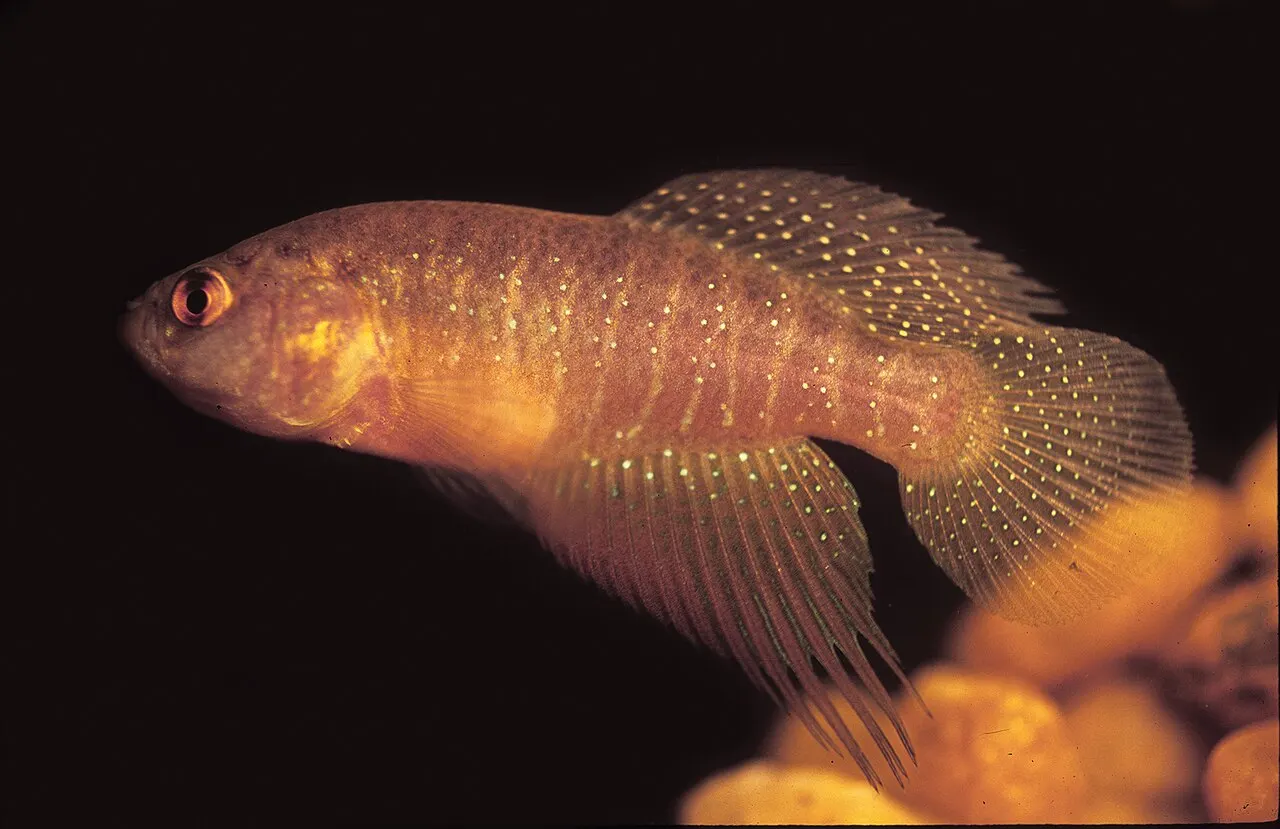
This is a very small fish. The largest specimen measured was 37.9 mm in standard length, and the species appears to be the smallest in its genus. Males are slender, with long, pointed dorsal and anal fins that reach the base of the tail fin, and the anal fin ends in long filaments.
Living males have a light purplish brown flank crossed by 10 or 11 paler golden bars, with tiny white dots in vertical groups, a pale pink anal fin and a yellow iris. Females look plainer: similar bars, one or two black spots mid-flank and clear fins. The fish was named elegans (Latin for fine or elegant) for the males' slim build and long fins.
Where it lives
It is known from one site: a temporary pool beside the BR-122 road, about 8 km south of Pindai in Bahia, in the floodplain of Mata Veado Creek. The pool lies in the Verde Grande River drainage of the Sao Francisco basin, at roughly 630 m above sea level. The IUCN assessment puts its extent of occurrence and area of occupancy at 4 square km each and lists one location.
The species was described in 2017 by the Brazilian ichthyologist Wilson Costa, together with a second Caatinga killifish, Cynolebias gorutuba. Both belong to a group of seasonal killifishes that live in pools formed during the rainy season.
Pins are Wikidata “endemic to” fields. Orange dots, when present, are GBIF occurrence tiles — survey bias included.
How it lives
Seasonal killifishes pass dry periods as drought-resistant eggs in the dried pool bed, and the pools refill when the rains return. Costa suggested that C. elegans depended on dense aquatic and marginal vegetation, which gives small fish shelter. The IUCN lists its habitat as small seasonal freshwater pools and marshes under 8 hectares.
Why it is in trouble
The pool was first surveyed in January 2002 and held other killifish but no C. elegans. In January 2005, after cattle had been brought in and the original vegetation replaced by grass, six specimens turned up alongside an abundant, larger predatory relative, Cynolebias oticus. Searches in May 2009 and January 2010 found none. By January and May 2017 the site had become a permanent pool containing only small characins.
Costa concluded that once pools lose the dense vegetation that shelters small species, those species become exposed to larger predators and disappear. The IUCN names agriculture, grazing and ranching as the threat, and estimates the population at 0 to 49 mature individuals. Its population trend is listed as unknown.
What is being done
Very little is in place. The assessment records no recovery plan, no monitoring scheme, no protected area covering the pool and no captive population. It lists site protection and captive breeding as actions needed, and research on population size, distribution and trends.
Sources
Written for this catalog in our own words from the sources below, checked against them on 12 November 2026. Population figures are estimates and carry the year they were made. Status and assessment year: IUCN. 2026. The IUCN Red List of Threatened Species. Version 2026-1. iucnredlist.org.




