Critically Endangered
Cycloramphus stejnegeri
Cycloramphus stejnegeri
Stejneger's button frog (Cycloramphus stejnegeri) is a leaf-litter frog known only from the Serra dos Órgãos mountains of southeastern Brazil. The IUCN Red List rated it Critically Endangered in 2023, with the added tag "possibly extinct", because no individual has been recorded since 1979.
How to recognise it
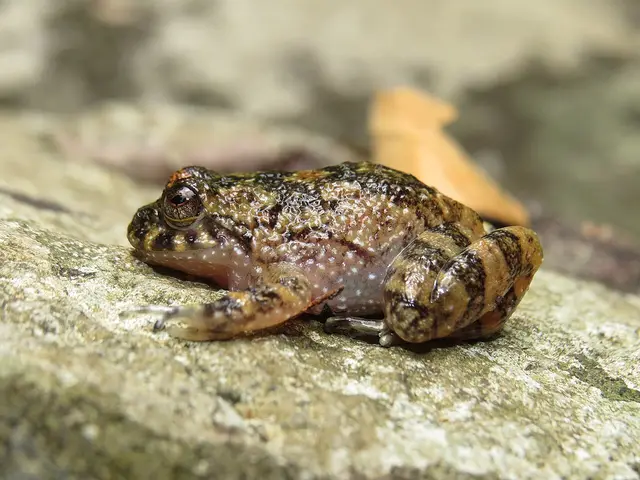
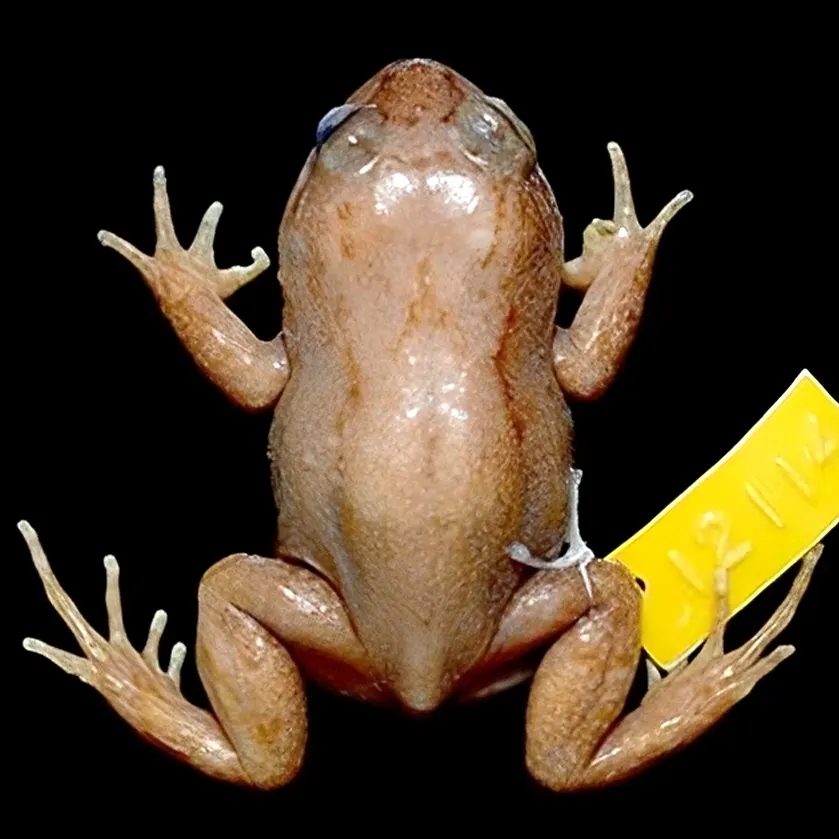
It's a medium-sized frog. Adult males measure about 45 to 47 mm from snout to vent, and females 45 to 56 mm. The snout is rounded or slopes down, and the toes have no webbing or fringes, which fits a frog that doesn't live in water.
The back can be smooth or granular, usually with regular ridges, and the colour is plain, either uniform or marked with chevron shapes. The backs of the thighs carry light spots, small in some frogs and larger in others.
Where it lives
The species is endemic to the Serra dos Órgãos in the state of Rio de Janeiro, inside Serra dos Órgãos National Park. Gladwyn Kingsley Noble described it in 1924, naming it for the herpetologist Leonhard Stejneger. The type locality lies at either 1,000 or 1,500 m above sea level, and the frog's full elevation range is not known.
It's a forest frog of fairly high ground. The Red List records the whole population as living inside a protected area, and the frog has never been found in disturbed habitat. Even so, it's listed as possibly extinct in Rio de Janeiro.
Pins are Wikidata “endemic to” fields. Orange dots, when present, are GBIF occurrence tiles — survey bias included.
How it lives
Stejneger's button frog is usually found under leaf litter and sometimes in burrows. It doesn't need a pond. Eggs are laid out of water, in burrows or under logs, and the tadpoles are terrestrial, developing away from streams. The frog depends on damp forest floor rather than open water.
It was described from a museum specimen collected in 1915, with further records from 1945. The last individual, a specimen kept in Rio de Janeiro's national museum, was collected at the type locality in 1979. Targeted surveys between 1988 and 2016 never found it, though the Red List notes that pitfall traps, which have recorded related frogs, were reportedly not used.
Why it is in trouble
The amphibian chytrid fungus (Batrachochytrium dendrobatidis) is the only threat the Red List scores, as a high impact with rapid declines. It is suspected rather than proven. No specimens of this frog are known to have been tested for it, and climate change working alongside the fungus can't be ruled out. The fungus has devastated frog populations in many mountain forests worldwide.
Direct human pressure on the habitat is low, because the frog's ground is high and hard to reach. If the frog survives at all, the Red List suggests fewer than 50 mature animals, and the population trend is listed as unknown.
What is being done
The type locality lies inside Serra dos Órgãos National Park, so the land itself is protected. The assessment lists no species-specific actions in place. It calls for exhaustive searches, and says that if they fail to find the frog within 5 to 10 years it should be considered for an Extinct listing. If frogs are found, a captive breeding programme and a management plan would follow.
Sources
Written for this catalog in our own words from the sources below, checked against them on 12 November 2026. Population figures are estimates and carry the year they were made. Status and assessment year: IUCN. 2026. The IUCN Red List of Threatened Species. Version 2026-1. iucnredlist.org.