Endangered
Spectaclecase
Cumberlandia monodonta
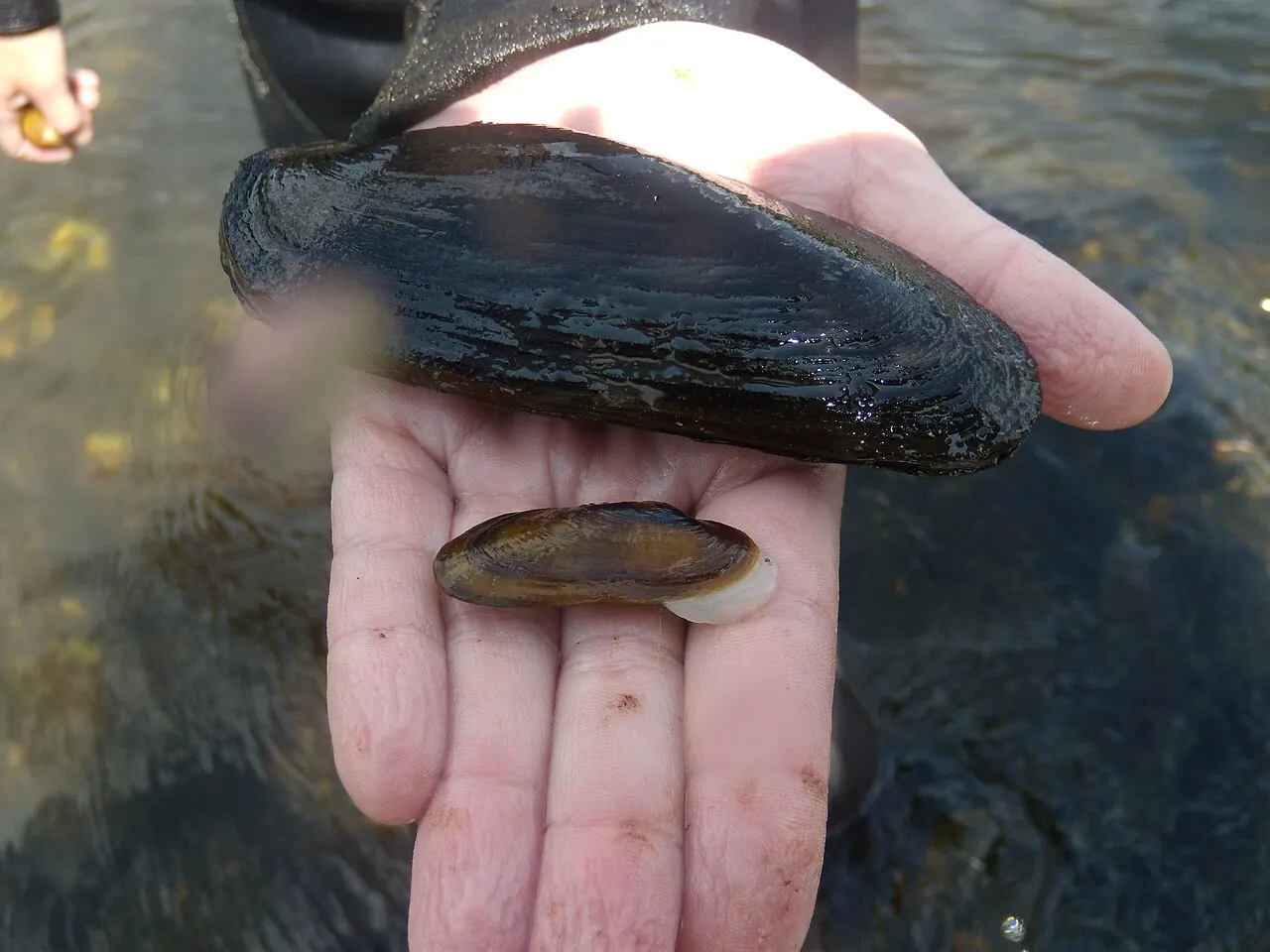
The spectaclecase (Cumberlandia monodonta) is a large freshwater mussel that lives in big rivers of the Mississippi, Ohio and Missouri basins in the central and eastern United States. The IUCN Red List assessed it as Endangered in 2012. It is the last surviving species of its genus, and dams are its biggest problem.
How to recognise it
The shell is long, narrow and somewhat curved, with rounded ends and a slight pinch in the middle that gives the mussel its name. Adults are commonly 5 to 8 inches (about 13 to 20 cm) long, and the largest reach about 9 inches (23 cm). Young shells are light yellowish-green, darkening to brown or black with age, and the outer layer is flaky. Inside, the shell is pearly white.
It is the only living member of its genus. The lineage has fossils dating back about 125 million years.
Where it lives
Historically it occurred in at least 44 streams in the Mississippi, Ohio and Missouri river basins, across 14 states. Today it is known from about 20 streams in 11 states, and most of those populations are small and limited to short stretches of river. The IUCN lists Alabama, Arkansas, Illinois, Iowa, Kentucky, Minnesota, Missouri, Tennessee, Virginia, West Virginia and Wisconsin. Missouri's conservation department says the species is concentrated mostly in the Meramec and Gasconade rivers.
It settles in medium to large rivers, in calmer water beside the main current, among boulders, under rock slabs and tree roots, or in firm mud and patches of gravel, sand and cobble. It can form dense colonies, in places up to 100 animals per square yard.
Pins are Wikidata “endemic to” fields. Orange dots, when present, are GBIF occurrence tiles — survey bias included.
How it lives
Adults sit partly or fully buried in the riverbed and filter algae, bacteria and fine organic matter from the water. Males release sperm into the current, and females draw it in. Eggs are fertilised in the female's gills and develop into larvae called glochidia, which must attach to a host fish. Mooneye and goldeye were confirmed as hosts in 2017, and the larvae have also been recorded on bigeye chub in Missouri.
Males reportedly mature at about 4 to 5 years and females at 5 to 7. Individuals can live 60 years or more, and the oldest documented animal was thought to be about 70.
Why it is in trouble
The U.S. Fish and Wildlife Service calls dams the most significant threat. They disrupt seasonal flows, scour river bottoms, alter water temperature and quality, and eliminate river habitat, leaving short, isolated patches. Because the mussel likely depends on fish to move upstream, dams that block fish also isolate upstream populations.
Other threats include sedimentation and channel work, pollution, mining, and invasive zebra mussels, which thrive in the slow, deep water behind dams. Small, fragmented populations add to the risk. The IUCN rated it Near Threatened in 1996 before raising it to Endangered in 2012.
What is being done
The U.S. Fish and Wildlife Service listed the spectaclecase as endangered in 2012 and published a recovery outline in 2014. No final recovery plan has been reported. Of the roughly 20 known populations, 5 were rated strongholds and 5 weakened in 2017 and 2018, with the rest unknown.
Work has focused on host fish and on raising young mussels in the lab. In 2018 researchers grew several hundred individuals in vitro, and genetic markers now let biologists spot the larvae on wild-caught fish, which could help locate new populations.
Sources
Written for this catalog in our own words from the sources below, checked against them on 12 November 2026. Population figures are estimates and carry the year they were made. Status and assessment year: IUCN. 2026. The IUCN Red List of Threatened Species. Version 2026-1. iucnredlist.org.




