Critically Endangered
Cuban gar
Atractosteus tristoechus
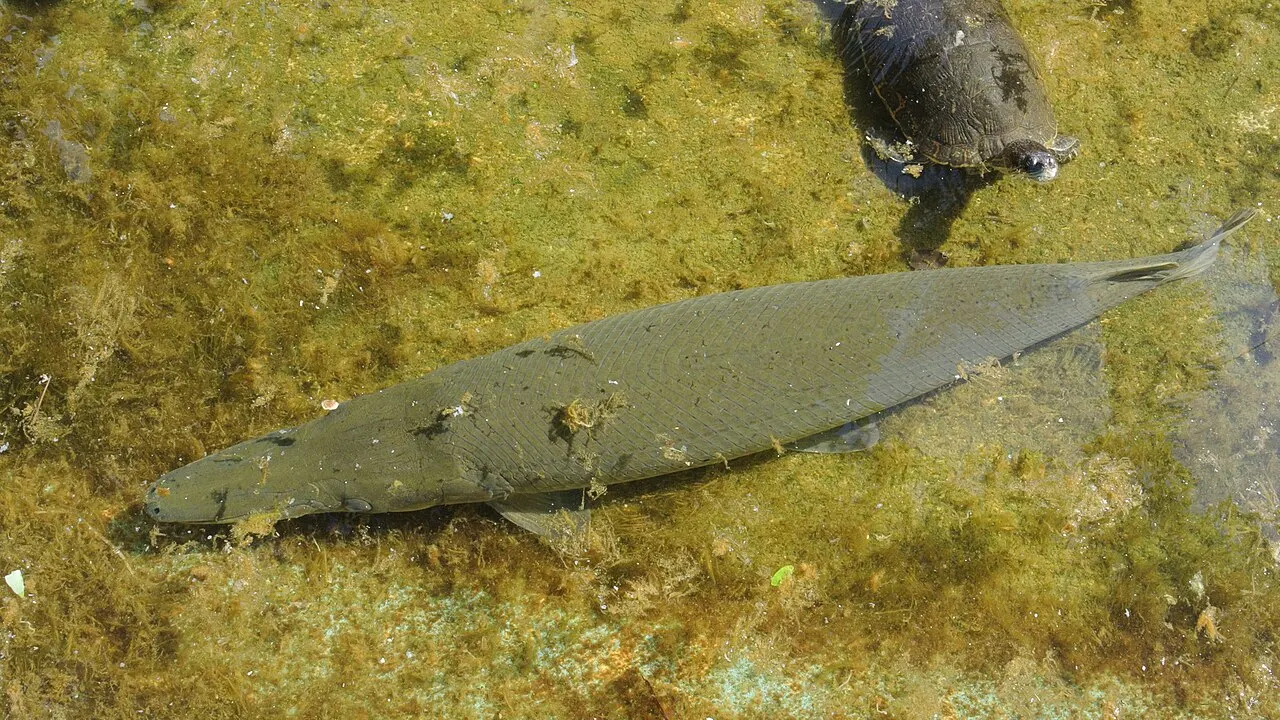
The Cuban gar, or manjuarí (Atractosteus tristoechus), is a long, armoured freshwater fish found only in Cuba. The IUCN Red List rated it Critically Endangered in its 2021 assessment. In the Zapata Swamp, its main stronghold, counts reportedly fell from 150 to 200 per kilometre to one to five after an invasive catfish arrived in 1999.
How to recognise it
The Cuban gar is a gar, one of seven living species in an old group of bony fishes. It has a long, cylindrical body covered in thick, bony scales and a narrow snout lined with sharp teeth. Adults are usually about a metre long and can reach about two metres, which makes it the second-largest living gar after the alligator gar. Males and females do not differ in length.
Like other gars it can gulp air as well as breathe through its gills, which helps in warm, low-oxygen water. The lineage is very old, though accounts differ on how old: the wider gar group goes back more than 240 million years, while a Cuban biologist quoted in 2025 called the species a relic of 140 or 150 million.
Where it lives
It is endemic to Cuba, recorded from western Cuba and the Isla de la Juventud (Isle of Youth). It lives in rivers, lakes, swamps and marshes, in fresh water and also in brackish water. The best-known population is in the Zapata Swamp in Matanzas province, protected within Ciénaga de Zapata National Park and described as among the best-preserved wetlands in the Antilles.
Where the fish remains is now poorly known. A 2024 article reported that the latest survey found none in the swamps of the Isle of Youth. The IUCN assessment counts two locations and describes the population as severely fragmented.
Pins are Wikidata “endemic to” fields. Orange dots, when present, are GBIF occurrence tiles — survey bias included.
How it lives
Adults eat freshwater fish and occasionally birds. They hunt mostly alone, but in the spawning season groups of around 20 gather, and a female may be accompanied by two to eight males. Spawning takes place in the floodplains of large rivers.
Gars grow slowly. Males begin breeding at 3 to 4 years old, females later, and individuals can live to about 25 years. That slow pace makes recovery from heavy losses a long process. Young gar are eaten by introduced largemouth bass.
Why it is in trouble
Before 1999, observers in the Zapata Swamp counted 150 to 200 gar per kilometre of waterway. Counts over the following decade were one to five, and the decline is reported as more than 80 percent. These come from a 2024 magazine article rather than a published survey, so treat them as indicative.
The African catfish Clarias gariepinus was introduced to Cuba for food in 1999, and it has since spread across the main island and the Isle of Youth. It eats young gar. The IUCN assessment names several other introduced fish, including largemouth bass, tilapia and carp, and also lists subsistence fishing and development such as roads, housing and tourism areas, with the scale of most of these unknown. The flesh is edible, but the eggs are poisonous to people.
Genetic diversity is a further worry. Researchers quoted in 2024 said the gene pool is small.
What is being done
Capturing, killing or trading the species without authorisation has been illegal in Cuba since 1996. At the Center for Indigenous Ichthyofauna Reproduction beside the Zapata Swamp, a team led by park biologist Andrés Hurtado learned to breed the gar and to raise the food its young need. About 60 breeding adults were reported in 2024, and young gar, about the size of a small pencil, are released into the swamp. Whether the released fish survive is not known.
The IUCN assessment records a recovery plan and a harvest management plan as in place, lists a genome resource bank and reintroduction among the actions needed, and notes there is no systematic monitoring scheme. The park administrator told reporters in November 2025 that gar are scarcer than before but an established population remains.
Sources
Written for this catalog in our own words from the sources below, checked against them on 12 November 2026. Population figures are estimates and carry the year they were made. Status and assessment year: IUCN. 2026. The IUCN Red List of Threatened Species. Version 2026-1. iucnredlist.org.




