Endangered
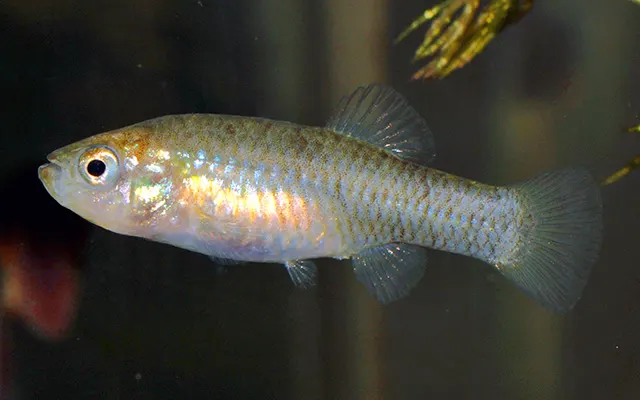
Cuatrocienegas killifish
Lucania interioris
The Cuatro Cienegas killifish (Lucania interioris) is a tiny fish that lives only in the desert springs, pools and marshes of the Cuatro Cienegas valley in Coahuila, Mexico. The IUCN Red List rated it Endangered in 2019. Its habitat is naturally split into isolated pieces.
How to recognise it
It's small, reaching about 4 cm in total length at most. Hubbs and Miller described it in 1965, and locally it is called sardinilla de Cuatro Cienegas.
Detailed descriptions of its colouring are scarce.
Where it lives
It is endemic to the Cuatro Cienegas Basin, a Chihuahuan Desert valley. The Red List counts about 10 locations and lists springs and oases, marshes, pools, lakes, rivers and streams as habitat. A 2015 genetic study found it in three major drainage regions of the basin, western, central and southeastern.
It is restricted mainly to naturally fragmented valley-floor habitats where the water chemistry is harsh.
Pins are Wikidata “endemic to” fields. Orange dots, when present, are GBIF occurrence tiles — survey bias included.
Isolated populations
A 2015 study of mitochondrial DNA in Western North American Naturalist sampled eight populations. Five carried a single haplotype, and both western populations shared just one. Haplotypes differed by only 0.3 to 0.9 percent, but differences among the three drainage regions were large enough that the researchers read them as complete isolation. Earlier work had found physical differences between western and central populations, and the southeastern fish may differ too.
Why it is in trouble
The Red List assessment lists drainage of surface water for agriculture as the named threat, with effects including habitat conversion and degradation, indirect ecosystem effects and disturbance. It records that the range is severely fragmented and still declining in area. The population trend is classed as unknown, and no population size is given.
Conservation actions recorded are site and area protection and habitat management. The assessment notes there was no recovery plan or systematic monitoring scheme in place.
Sources
Written for this catalog in our own words from the sources below, checked against them on 12 November 2026. Population figures are estimates and carry the year they were made. Status and assessment year: IUCN. 2026. The IUCN Red List of Threatened Species. Version 2026-1. iucnredlist.org.




