Critically Endangered
Ctenella chagius
Ctenella chagius
The Chagos brain coral (Ctenella chagius) is a pale brown, dome-shaped stony coral found nowhere except the Chagos Archipelago in the central Indian Ocean. The IUCN Red List rates it Critically Endangered (assessed 2024), mainly because repeated marine heatwaves have bleached and killed so much of the reef it depends on.
How to recognise it
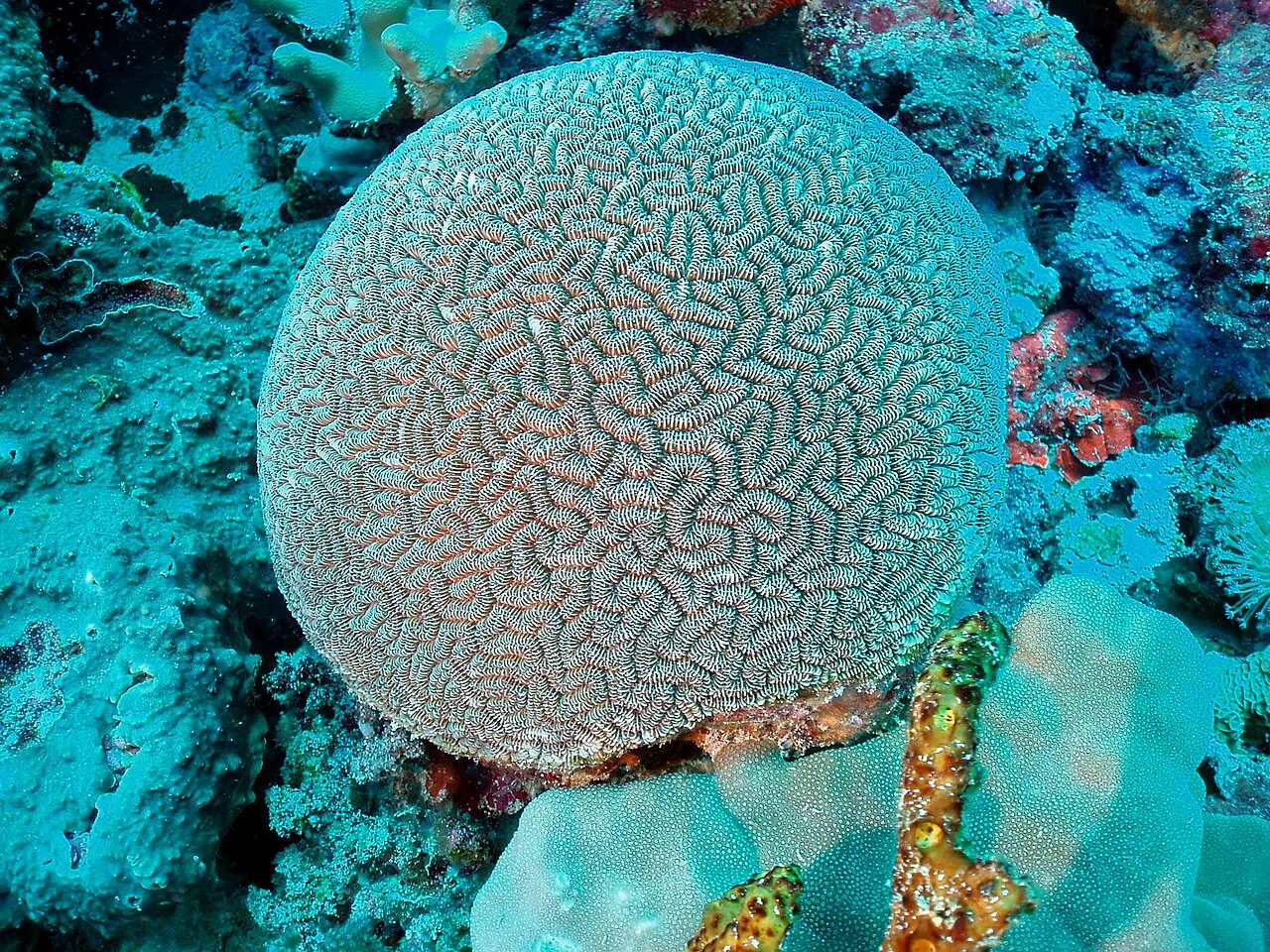
It's a massive, colonial coral that grows as a smooth, rounded dome, sometimes reaching about a metre across. The surface is folded into long, winding valleys, which gives it the brain-like look in its common name. Colonies are pale brown.
Up close, the ridges between the valleys are roughly 1.5 cm wide and the valleys about 1 cm deep. The thin plates inside each cup (septa) are fine, closely spaced and evenly distributed. Like most reef-building corals it carries symbiotic algae in its tissues, which is why it's vulnerable to bleaching.
Where it lives
The whole species is confined to the Chagos Archipelago, which the IUCN lists under the British Indian Ocean Territory and Mauritius. It lives on coral reef in lagoons and on reef slopes from about 1 to 45 m deep. The Red List treats it as a single location.
The Living Oceans Foundation, whose Global Reef Expedition surveyed the territory, describes its range as very restricted and says the team saw it often there. It is absent from the rest of the Pacific and Indian Oceans.
Pins are Wikidata “endemic to” fields. Orange dots, when present, are GBIF occurrence tiles — survey bias included.
Why it is in trouble
Heat is the main problem. A UK government climate report card says recurrent marine heatwaves since the 1970s have caused heavy coral death in the territory, and that reefs had not recovered from the severe bleaching of 2016 and 2017. The same report says the Chagos brain coral has greatly declined. Ctenella was first reported to have lost a lot of coral down to 20 m after the 1998 bleaching, and further losses followed later events.
The 2024 IUCN assessment lists the trend as decreasing and uses criterion A2bc, meaning a population reduction judged from lost habitat quality and an abundance index. It records a past reduction of 99 percent, with the cause understood but not ceased. Its list of pressures also includes temperature extremes, storms, sedimentation, shipping lanes, tourism and recreation, and coastal development, each scored as low impact.
The total number of colonies has never been counted, so the population size is unknown.
What is being done
All of the archipelago's waters sit inside the BIOT Marine Protected Area, designated in 2010 and covering about 640,000 square kilometres. That can limit local pressures, but it can't stop warming seawater. The IUCN's conservation action list includes site protection and management, habitat restoration, species recovery, captive propagation and a genome resource bank.
There was some good news in 2024. Bleaching hit the archipelago between April and June, with some sites losing most of their coral, yet observers confirmed the Chagos brain coral had survived. At a key site at Middle Brother, only one of about 20 colonies showed likely bleaching-related death, on part of its upper surface. A dive at a known spot on Diego Garcia found a single colony, which looked healthy. Recovery of the wider reefs is still described as uncertain.
Sources
Written for this catalog in our own words from the sources below, checked against them on 12 November 2026. Population figures are estimates and carry the year they were made. Status and assessment year: IUCN. 2026. The IUCN Red List of Threatened Species. Version 2026-1. iucnredlist.org.
- IUCN Red List assessment (Wilson, Cowburn and Obura, 2024)
- Ctenella chagius, general description
- Spalding et al. 2025, Coral bleaching and mortality in the Chagos Archipelago, 2024
- GCRMN, Bleaching in the Chagos Archipelago 2024
- CEFAS Blue Belt climate change impact on corals report card for BIOT and Pitcairn
- Living Oceans Foundation, Changing coral communities




