Endangered
White River springfish
Crenichthys baileyi
The White River springfish (Crenichthys baileyi) is a small fish that lives only in warm desert springs of eastern Nevada. The IUCN Red List assessed it as Endangered in 2014. Five subspecies are recognised, and introduced fish and water use threaten the springs they depend on.
How to recognise it
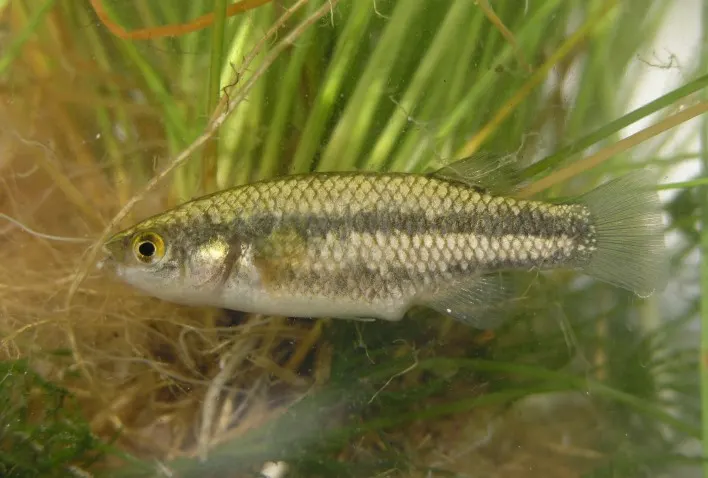
It's a small, deep-bodied fish, around 2 to 3 inches (5 to 7 cm) long. It has a big, steeply sloping head, a small mouth, a square tail and no pelvic fins. The dorsal and anal fins sit far back near the tail. The back is greenish-olive, the sides silvery with dark spots that can form a stripe along the flank. Breeding males are more strongly coloured.
Where it lives
The species lives only in isolated warm springs of the White River drainage in eastern Nevada. Cold water acts as a barrier that keeps populations in their own springs.
The nominate subspecies lives in Ash Spring, while the Hiko subspecies lives in Hiko and Crystal springs, all in Pahranagat Valley. The Moapa subspecies lives in five warm springs along the upper Muddy River. The Preston subspecies is another of the five recognised.
Pins are Wikidata “endemic to” fields. Orange dots, when present, are GBIF occurrence tiles — survey bias included.
How it lives
These fish tolerate very warm water and low oxygen. About half the diet is plant matter, mostly filamentous algae, with detritus, midge and caddisfly larvae and other small invertebrates making up the rest. In winter, when invertebrates are scarce, the diet turns mostly plant-based.
Males defend territories and court females in dense vegetation. A female lays 10 to 17 eggs per spawning, one at a time, onto plants. Incubation takes five to seven days.
Why it is in trouble
Introduced fish are a major problem. Shortfin mollies eat eggs, and convict cichlids attack the springfish and compete with it for food. Introduced fish also carry a parasitic copepod, Lernaea, that infects springfish. Game fish, including largemouth bass, wiped out the Hiko springfish in Hiko Spring in the 1960s. They were reintroduced in 1985, and a 1995 survey counted about 5,500 there, but fewer than 125 in nearby Crystal Spring.
The Red List also names groundwater and surface-water withdrawal for agriculture. A 1998 and 1999 survey of the Preston subspecies, described in a 2002 paper, found fewer than 5,000 fish persisting in only 4 of 6 spring systems where it had been caught.
What is being done
Two subspecies, the nominate form and the Hiko form, were listed as endangered under the US Endangered Species Act on September 27, 1985, with critical habitat at Ash, Crystal and Hiko springs. Suggested steps include removing feral and exotic animals near the springs, controlling agriculture, restricting nearby construction that could affect water quality and limiting human access. The Red List notes that a recovery plan is in place and records habitat restoration, invasive species control and species recovery as conservation actions.
Sources
Written for this catalog in our own words from the sources below, checked against them on 12 November 2026. Population figures are estimates and carry the year they were made. Status and assessment year: IUCN. 2026. The IUCN Red List of Threatened Species. Version 2026-1. iucnredlist.org.




