Critically Endangered
Murray hardyhead
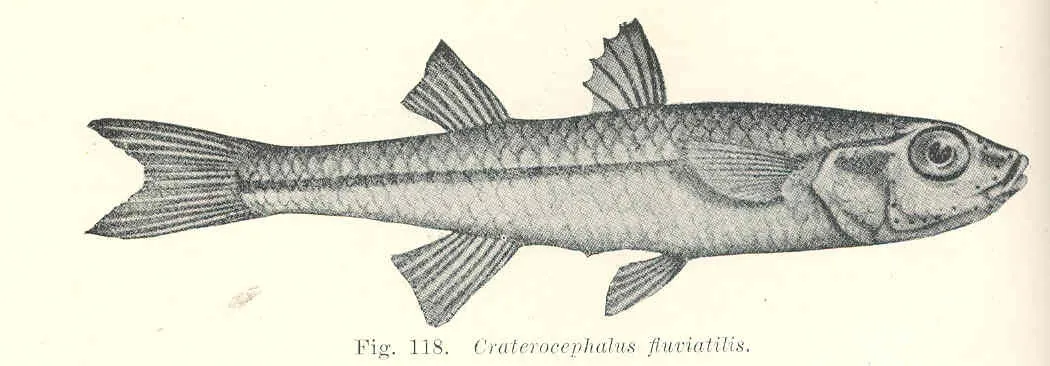
Craterocephalus fluviatilis
The Murray hardyhead (Craterocephalus fluviatilis) is a small silvery fish of salty wetlands and slow waters in south-eastern Australia's Murray-Darling Basin. The IUCN Red List rated it Critically Endangered in 2019. It lives less than two years, so every spawning season matters.
How to recognise it
It is a small schooling fish, growing to about 8 cm, and is often confused with the more common unspecked hardyhead. Allan Riverstone McCulloch first proposed it as a distinct species in 1912, but through much of the 20th century it was lumped with the Lake Eyre hardyhead. Its distinctness was only understood from the 1990s.
Where it lives
The species belongs to the Murray-Darling system. It was once widespread and abundant in the Murray and Murrumbidgee systems of southern New South Wales and northern Victoria, with a stronghold on the Murray between Kerang and Swan Hill and down to the lower lakes.
Today it survives in isolated pockets in Victoria, South Australia and New South Wales, mainly in northern Victoria. The IUCN counts 5 to 9 locations and 4 to 8 subpopulations, severely fragmented, with an area of occupancy of about 96 square kilometres. Populations in the Murray form four genetically distinct management units.
Pins are Wikidata “endemic to” fields. Orange dots, when present, are GBIF occurrence tiles — survey bias included.
How it lives
It favours shallow, slow or still water with submerged plants such as Ruppia, including salt lakes, irrigation basins, creeks and drainage channels, and has been found at salinities up to 110,000 EC. It feeds mainly on zooplankton and tiny invertebrates such as midge and mosquito larvae.
Sticky eggs are laid on aquatic plants in spring and summer, with peak hatching in November. Many adults die after spawning in December and January, and a second spawning can happen in autumn in ideal conditions.
Why it is in trouble
Around 2000 there were roughly 17 known populations in Australia, and by 2014 only 5 remained, according to the SWIFFT species page. A major reason is the Millennium drought, from 1997 to 2009, which sharply reduced its range, including in Victoria.
Ongoing problems include too little flow to reconnect floodplain wetlands, weirs that block dispersal and reduce salinity, large dams, water abstraction, and competition from introduced carp, redfin and mosquitofish. Because the fish is an annual species, one failed breeding season can wipe out a site.
What is being done
A recovery plan exists. Managers have moved fish to new sites, kept captive populations of at-risk fish as insurance, and used prepared surrogate dams. In 2018, 780 fish from the Riverland in South Australia were released into an environmentally watered floodplain wetland in far-west New South Wales. In February 2026, 466 fish from Koorlong Dam in Victoria were moved to Lyrup Lagoon in South Australia, where the species had once been abundant but had not been detected after a 2022 flood.
Sources
Written for this catalog in our own words from the sources below, checked against them on 12 November 2026. Population figures are estimates and carry the year they were made. Status and assessment year: IUCN. 2026. The IUCN Red List of Threatened Species. Version 2026-1. iucnredlist.org.




