Critically Endangered
Coryphaenoides rupestris
Coryphaenoides rupestris
The roundnose grenadier (Coryphaenoides rupestris) is a big-headed, long-tailed fish of the deep North Atlantic, found mostly 400 to 1,200 metres down. It has been fished commercially since the 1960s. The IUCN Red List classed it as Critically Endangered in 2015, citing a steep fall in abundance and heavy fishing.
How to recognise it
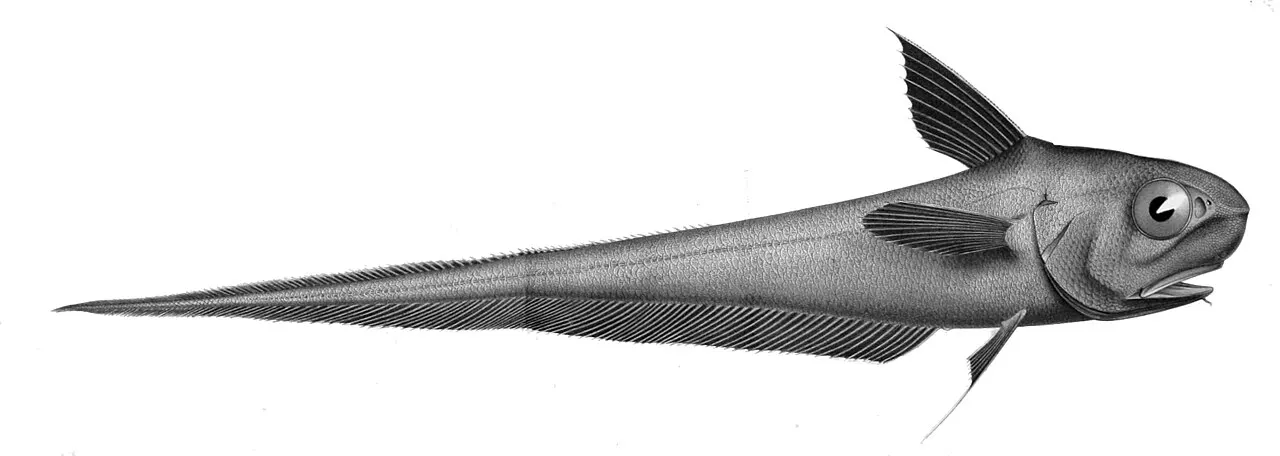
This is a large grenadier, also called a rattail. It can pass a metre in length, with a record of 110 cm and a heaviest recorded weight of about 1.7 kg. The head is broad and soft with a rounded snout that ends in a blunt scute. There's a small barbel on the chin.
The body tapers into a long, thin tail. Colour runs from medium brown to grey, with darker, blackish-brown fins and a dark mouth and gill cavity. The body scales carry dense, backward-curved spinules, so the skin feels rough.
Where it lives
It occurs across the North Atlantic, from Baffin Island, Greenland, Iceland and the Barents Sea south to the New England seamounts and the coast of North Africa. One report places it near the Bahamas. It lives on continental slopes, seamounts and ridges, and the recorded depth range is 180 to 2,600 metres.
In Canadian waters it follows the continental slope from Davis Strait to Georges Bank and is more abundant in the north. The Red List range list runs from the United States and Canada through Greenland, Iceland, Norway and Spain to Morocco.
Pins are Wikidata “endemic to” fields. Orange dots, when present, are GBIF occurrence tiles — survey bias included.
How it lives
Roundnose grenadiers eat mostly shrimps, amphipods and other small crustaceans, with a smaller share of squid and fish such as lanternfishes. They can gather in dense schools at around 600 to 900 metres and move up and down the water column daily. Fish reportedly sit deeper in summer and shallower in winter.
They grow slowly and live long. The oldest recorded age is 54 years in one database, and about 60 years in a Canadian assessment. Females mature at roughly 10 years old, and Canadian scientists put the generation time near 17 years. That is a slow pace for a species under fishing pressure. Spawning happens in batches and is believed to take place near Iceland in late summer or autumn.
Why it is in trouble
The only threat listed by the Red List is large-scale harvest. Soviet, Polish and East German factory ships began trawling for the species in the 1960s, and catches peaked at more than 80,000 tonnes in 1971. French and Spanish vessels have led the fishery since 1980, usually landing under 20,000 tonnes a year.
The IUCN assessment records an estimated reduction of about 91 percent, based on an abundance index and levels of exploitation. Its overall population trend is marked unknown. In Canada, survey catch rates of adults fell about 98 percent between 1978 and 1994, roughly one generation. Survey gear changed in 1995, so later figures can't be compared directly. Canada's expert committee (COSEWIC) assessed the fish as Endangered in 2008.
What is being done
No conservation actions are listed in the Red List assessment. Management happens through fisheries rules. Canada has halted directed fishing since 1997, though the fish is still caught as bycatch, mainly in the Greenland halibut fishery, with bycatch capped at 5 percent of the target catch.
In the northeast Atlantic, ICES gives catch advice by stock. For the stock covering ICES subareas 6 and 7 and divisions 5.b and 12.b it advised no more than 2,542 tonnes a year for 2025 and 2026, applying a precautionary approach. The fish was also listed as a UK Priority Species in 2010.
Sources
Written for this catalog in our own words from the sources below, checked against them on 12 November 2026. Population figures are estimates and carry the year they were made. Status and assessment year: IUCN. 2026. The IUCN Red List of Threatened Species. Version 2026-1. iucnredlist.org.




