Critically Endangered
Corematodus shiranus
Corematodus shiranus
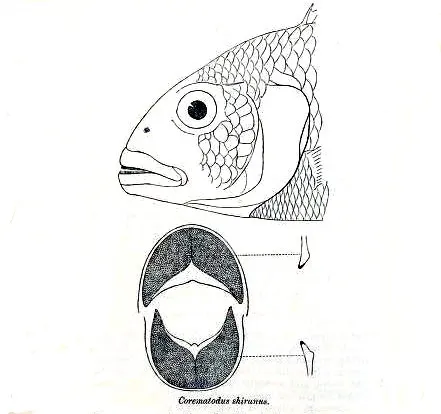
Corematodus shiranus is a scale-eating cichlid from Lake Malawi, Lake Malombe and the upper Shire River in East Africa. It disguises itself as a chambo, the fish it preys on. The IUCN rated it Critically Endangered in 2018 and flags it as possibly extinct. It was last reported in 1997.
How to recognise it
It's a cichlid that reaches about 27 cm in length, according to FishBase. Its trick is mimicry. It copies both the colour pattern and the swimming style of the chambo, cichlids in the subgenus Nyasalapia of the genus Oreochromis. Boulenger described the species in 1897. It has no widely used common name.
How it lives
This is an aggressive mimic. Looking and moving like a harmless chambo, it can approach a school and quickly take a mouthful of scales or fin. FishBase records the diet as scales from the tail fins of shoaling Oreochromis.
It shares its habitat with those prey fish but also turns up over open sandy bottoms, near rocks and in open water.
Pins are Wikidata “endemic to” fields. Orange dots, when present, are GBIF occurrence tiles — survey bias included.
Where it lives
Its range covers Lake Malawi, Lake Malombe and the upper Shire River. The IUCN assessment lists permanent freshwater lakes as the habitat. It marks the species as present in Mozambique and as possibly extinct in Malawi.
Why it is in trouble
Overfishing has sharply reduced chambo numbers, which reportedly harmed this cichlid too. The IUCN assessment puts the past reduction at about 90 percent, based on actual or potential levels of exploitation, and lists large-scale harvest as an ongoing threat across a majority of the species' range. The trend is recorded as decreasing, with a generation length of about 3 years.
The last report of the species dates to 1997. Because that is so long ago, the Red List tags the fish as possibly extinct while keeping it in the Critically Endangered category, since extinction has not been proven.
What is being done
The assessment lists no conservation actions in place. The only research need recorded is monitoring of population trends.
Sources
Written for this catalog in our own words from the sources below, checked against them on 12 November 2026. Population figures are estimates and carry the year they were made. Status and assessment year: IUCN. 2026. The IUCN Red List of Threatened Species. Version 2026-1. iucnredlist.org.




