Critically Endangered
Coral red pencilfish
Nannostomus mortenthaleri
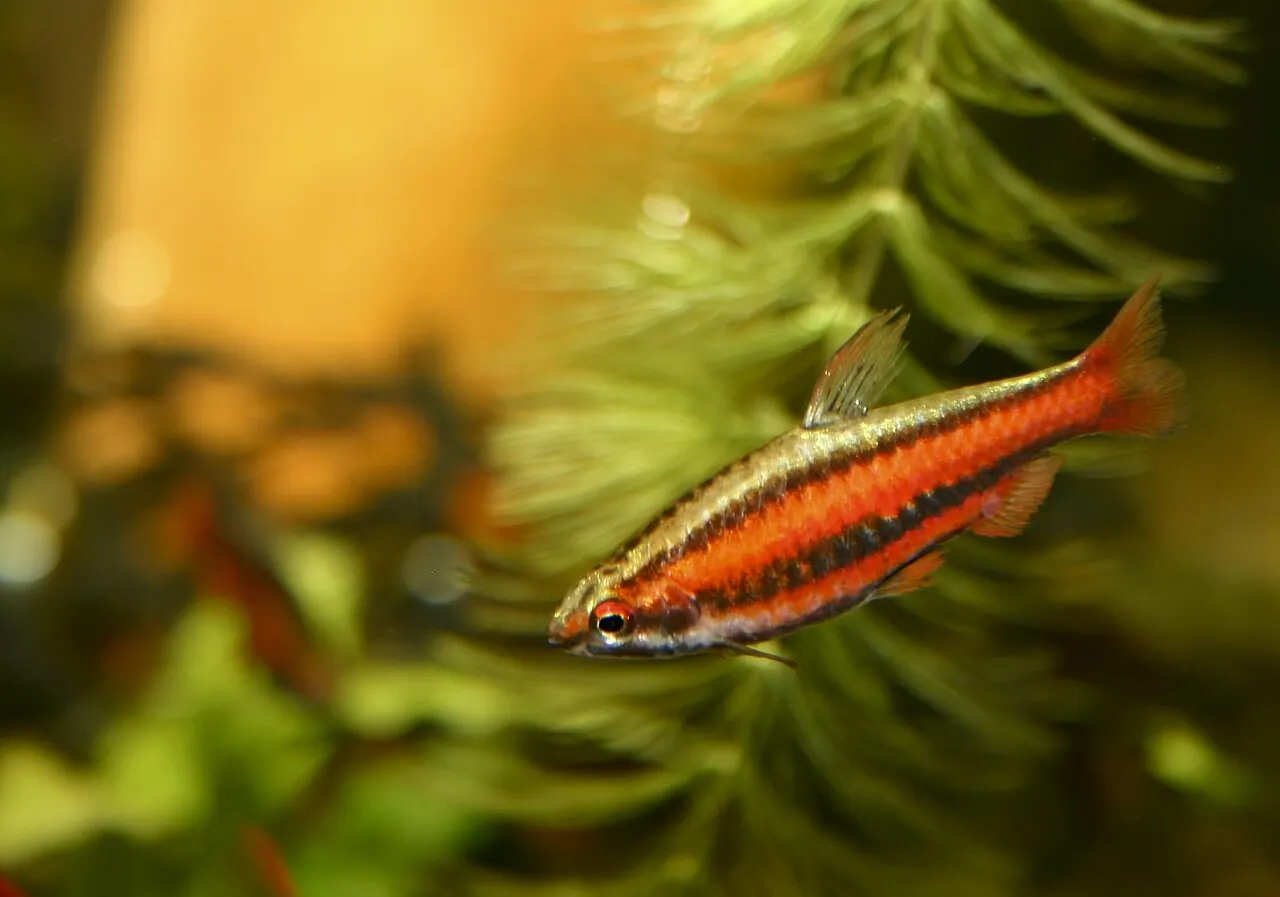
The coral red pencilfish (Nannostomus mortenthaleri) is a tiny, bright red characin from the blackwater streams and swamps of the Nanay and Tigre river systems in Loreto, Peru. The IUCN Red List rated it Critically Endangered in 2016, with large-scale collecting for the aquarium trade as the recorded threat.
How to recognise it
This is a very small fish. Adults reach about 3 cm, and references give a maximum between 2.9 and 3.5 cm depending on how length is measured. Its body and fins are a vivid coral red crossed by jet black stripes, which makes it one of the most colourful pencilfishes. Mature males have a thickened anal fin and show bright red between the upper dark stripes.
Traders sell it under several names, including red arc, Peruvian red, ruby red and red pencilfish.
Where it lives
It appears to be restricted to the Nanay basin and the Tigre system in Loreto, northern Peru. The type locality is a small tributary of the Río Nanay at Alvarenga, near Iquitos. The IUCN assessment lists Peru as its only country, counts a single location, and puts its elevation at 110 to 120 metres above sea level.
The blackwater streams and swamps it comes from are slow, tea-coloured, soft and acidic, with a pH of about 4 to 6 and temperatures of 24 to 28 °C. Conductivity measured in the Río Tigre was very low, 11 µS/cm.
Pins are Wikidata “endemic to” fields. Orange dots, when present, are GBIF occurrence tiles — survey bias included.
How it lives
In the wild it is a micropredator, picking tiny invertebrates and zooplankton out of the water. It is a peaceful, shoaling fish, though timid, and males spar with each other regularly. Keepers recommend groups of at least ten, with more females than males to ease aggression.
Aquarium breeding has been achieved. It is described as challenging, with few reported successes. Eggs hatch in 36 to 72 hours, depending on temperature, and well-fed fry take about two months to reach 1 cm.
A short history on paper
Paepke and Arendt described it in 2001 as a subspecies of the dwarf pencilfish (Nannostomus marginatus). Weitzman and Weitzman raised it to full species in 2003. The name honours Martin Mortenthaler (1961 to 2018), an aquarium fish exporter in Iquitos who collected the type specimen.
Why it is in trouble
The 2016 assessment lists large-scale harvesting as the only recorded threat. It describes a decreasing population and a very small range, and records no protected area or conservation site for the species.
The actions listed as needed are trade management and harvest management. No published population estimate or export volume was found.
Sources
Written for this catalog in our own words from the sources below, checked against them on 12 November 2026. Population figures are estimates and carry the year they were made. Status and assessment year: IUCN. 2026. The IUCN Red List of Threatened Species. Version 2026-1. iucnredlist.org.




