Endangered
Coral-billed Ground Cuckoo
Carpococcyx renauldi
Coral-billed Ground Cuckoo is a bird in the family Cuculidae (order Cuculiformes) — Carpococcyx renauldi, recorded as Endangered.
Appearance
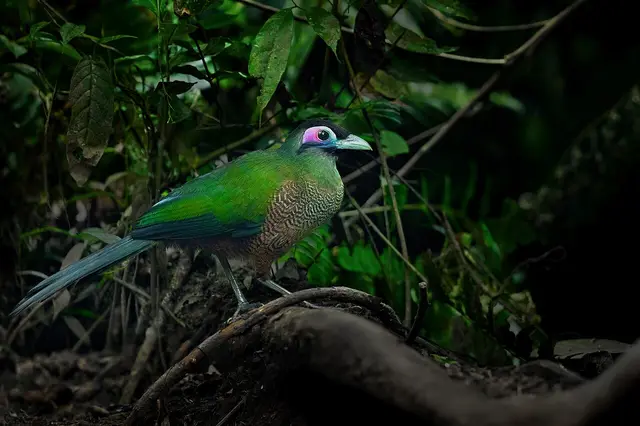
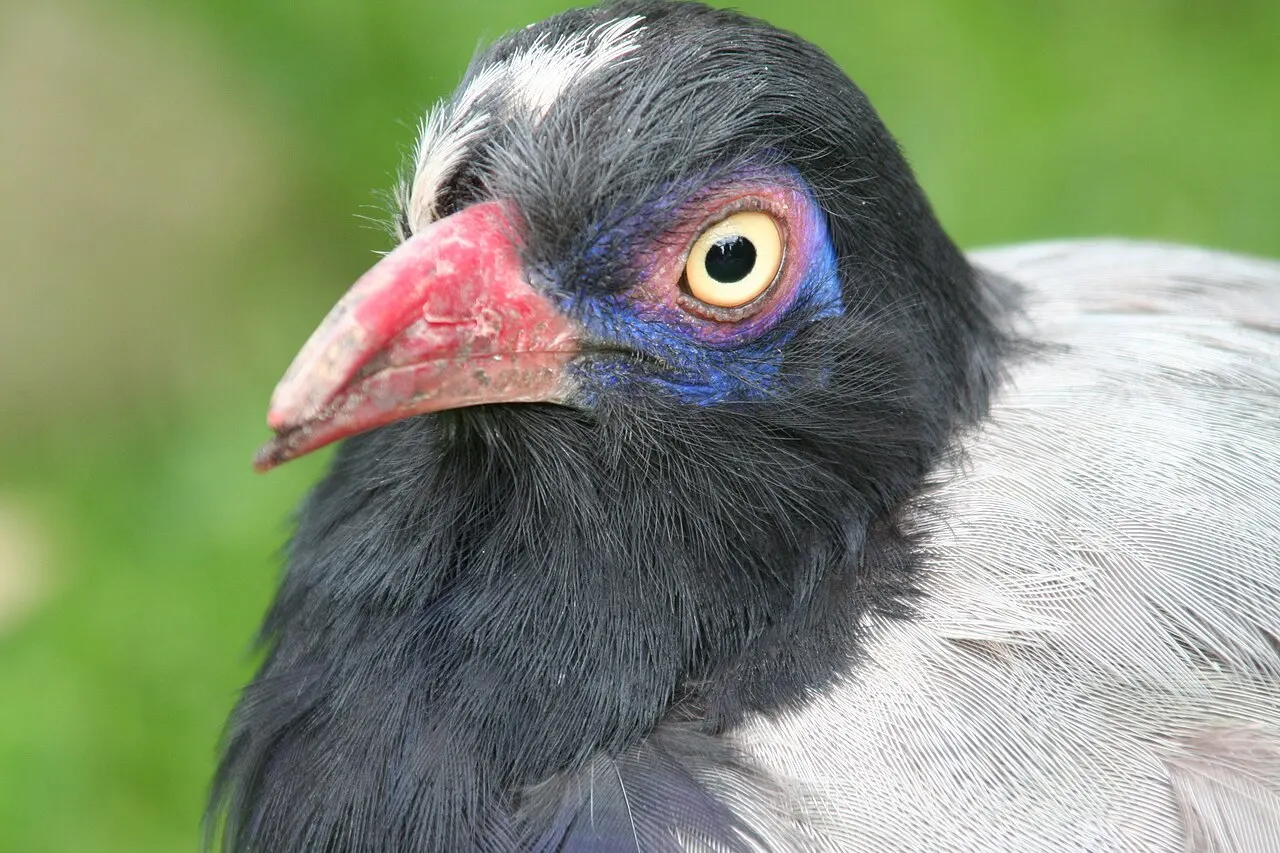
Their head, neck, upper breast, primaries, and tail are a glossy violet-black color, with a bare patch of red and violet-colored skin around the eyes. A white band sits below the neck, with the lower breast, flanks, belly, and undertail coverts being primarily white. Their back, rump, and secondaries are primarily grey, with the tips of the secondaries being violet.
The coral-billed ground cuckoo can grow up to 56-70 centimeters (22-28 inches) in length. One captive specimen was reported to weigh 400 grams (0.88 pounds) when close to being fully grown.
Range and habitat
The coral-billed ground cuckoo is found throughout Cambodia, Laos, Thailand, and Vietnam. Their natural habitat is broad-leaf evergreen forest with dense vegetation and ground cover. The coral-billed ground cuckoo, also known as Renauld's ground cuckoo, is a large, terrestrial species of cuckoo in the family Cuculidae, found in Cambodia, Laos, Thailand, and Vietnam.
Pins are Wikidata “endemic to” fields. Orange dots, when present, are GBIF occurrence tiles — survey bias included.
Diet and breeding
The coral-billed ground cuckoo nests in trees, creating a nest of large sticks. In captivity, some have been reported to create cup-like stick nests on both the ground and in trees. Eggs are laid from May to August, with both parents incubating for around 18-19 days. Both parents similarly feed and protect the young, with the young leaving the nest after 50-60 days.
In crisis
As of 2024, the species is listed as Endangered by the IUCN, with habitat degradation, habitat loss, and bycatch of industrial drift-fence cable snaring noted as major threats. The species has also been threatened by traditional hunting and capture for live trade.
Coral-billed Ground Cuckoo is Endangered on the IUCN Red List (assessed 2024, criteria A2cd+4cd). Confirm the official criteria and any later count on the assessment page.
Sources
Adapted from the English Wikipedia article on Coral-billed Ground Cuckoo (CC BY-SA 4.0; authors are listed in the article history; changes were made), Wikidata item Q946155. Family and order context is original field-guide writing about the group, not a copied assessment of this one species. Not an IUCN assessment. Counts, when quoted, can change — confirm them on the recovery programme and on iucnredlist.org. Status and assessment year: IUCN. 2026. The IUCN Red List of Threatened Species. Version 2026-1. iucnredlist.org.