Critically Endangered
Sangihe whistler
Coracornis sanghirensis
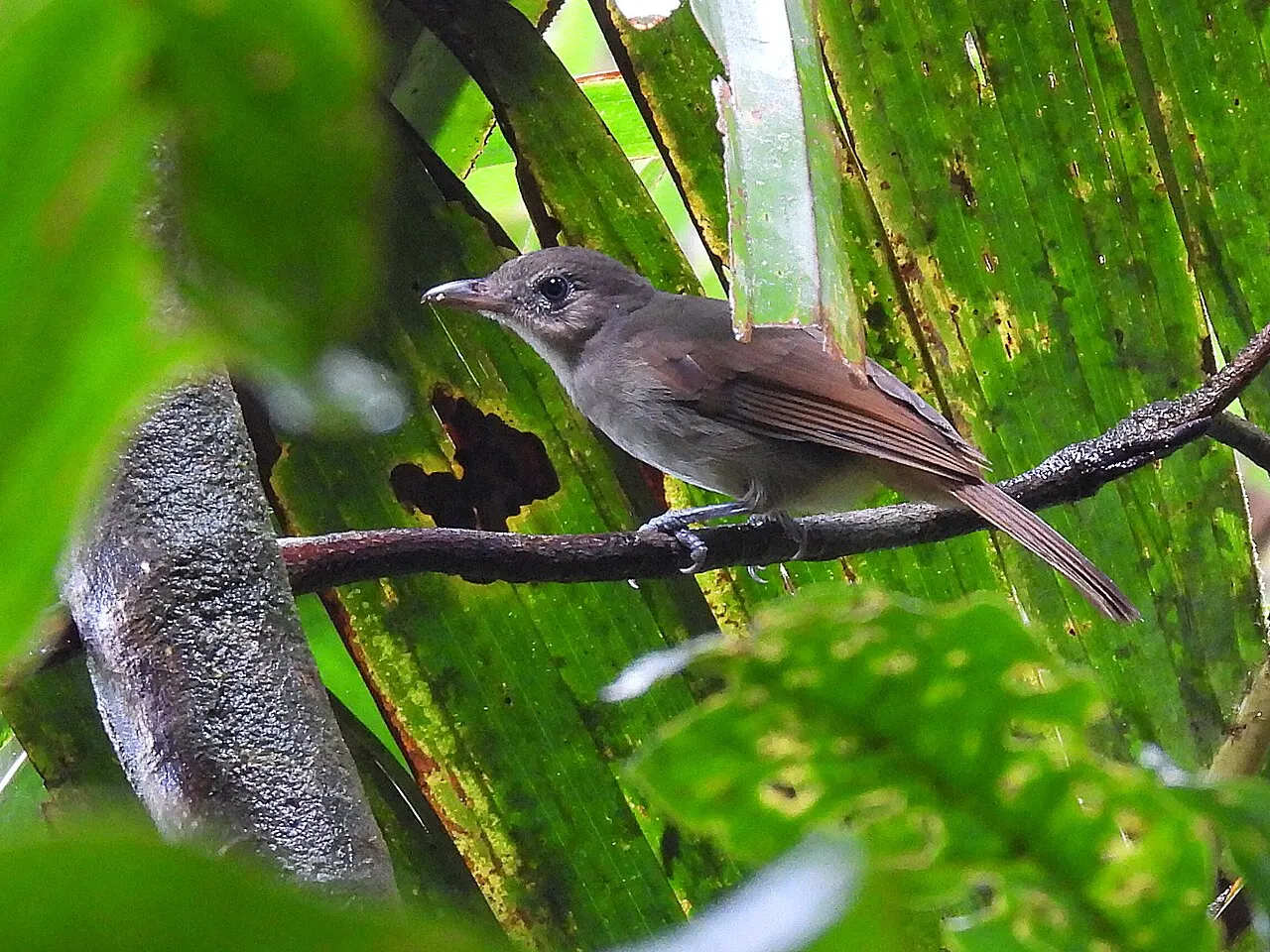
The Sangihe whistler (Coracornis sanghirensis), also called the Sangihe shrikethrush, is a plain brown songbird found only on Sangihe Island, north of Sulawesi in Indonesia. The IUCN Red List rated it Critically Endangered in 2021, with an estimated 50 to 249 mature birds, all in one patch of forest.
How to recognise it
It's a drab, thrush-like bird about 17 cm long. The upperparts are olive-brown with more chestnut on the shoulders and lower back, and the underparts are paler brown with a more rufous belly. It has a strong black bill and black legs.
The golden bulbul on the same island is larger, greener above and yellow on the throat and belly. The whistler's voice is a soft, lisping 'chweep'. Even people who know the forest well can find it hard to spot one.
Where it lives
The species is endemic to Sangihe, a 461 square kilometre island north of Sulawesi. Almost all that remains of its range is the forest around the Sahendaruman crater in the south, and the IUCN estimates the area it occupies at just 12 square kilometres. It has been recorded between 600 and 1,040 m above sea level.
It favours ridgetop forest with large trees and a full canopy, and appears to need primary forest along the crater rim. Habitat modelling cited by the IUCN put the area of truly suitable habitat at only about 6 square kilometres. Until it was found again in 1995, the species was known from a single specimen collected in the 19th century.
Pins are Wikidata “endemic to” fields. Orange dots, when present, are GBIF occurrence tiles — survey bias included.
How it lives
It doesn't migrate. It forages in the middle and upper layers of the forest and in dense rattan undergrowth, and it is seen singly and perhaps sometimes in small groups. Its diet and breeding have hardly been studied, and no nest has been described in the sources checked.
Surveys of Sangihe's birds have been sparse. A study that surveyed the island in 1998 and 1999 found the species either unrecorded or very scarce. Estimates since then include 56 to 205 birds (2007) and 92 to 255 (2009). The IUCN says the true number may be below 100, because the estimates rest on very few sightings.
Why it is in trouble
Loss of forest is the main problem. The original forest on Sangihe has been almost completely converted to farmland. The IUCN lists shifting agriculture, new plantations of exotic trees and small-scale harvesting that harms the species by accident. The population is judged to be declining, and all individuals sit in a single subpopulation.
Protection has been uneven. Indonesia added the bird to its list of protected wildlife in June 2018, and within months a ministry decree removed it, along with four other birds. A BirdLife Indonesia specialist told Mongabay that without protected status the bird becomes more prone to hunting. The same article says trapping for the songbird trade is a smaller threat than habitat loss, because most keepers do not find the species desirable.
What is being done
Community-based village agreements around the crater, run by Burung Indonesia between 2002 and 2006, slowed forest clearance. Education programmes are still running, and the IUCN lists the whole range as identified for conservation. The Gunung Sahendaruman Protection Forest covers 3,500 hectares, but only about 1,300 hectares of it is forest in good condition, and much of the rest is farmland and spice-tree plantation.
Actions the IUCN calls for include zoning the remaining habitat, effective protection of Mount Sahendaruman, restoring recently degraded forest with local communities, and opposing programmes that replace native forest with exotic tree plantations. Burung Indonesia has monitored the species periodically, but there is no recovery plan and no captive population.
Sources
Written for this catalog in our own words from the sources below, checked against them on 12 November 2026. Population figures are estimates and carry the year they were made. Status and assessment year: IUCN. 2026. The IUCN Red List of Threatened Species. Version 2026-1. iucnredlist.org.




