Endangered
Coquerel's giant mouse lemur
Mirza coquereli
Coquerel's giant mouse lemur (Mirza coquereli) is a nocturnal, tree-living primate from the dry forests of western Madagascar. The IUCN Red List rates it Endangered (assessed 2020, population decreasing). It sleeps in woven leaf nests, stays active all year, and is losing forest to shifting agriculture and hunting.
How to recognise it
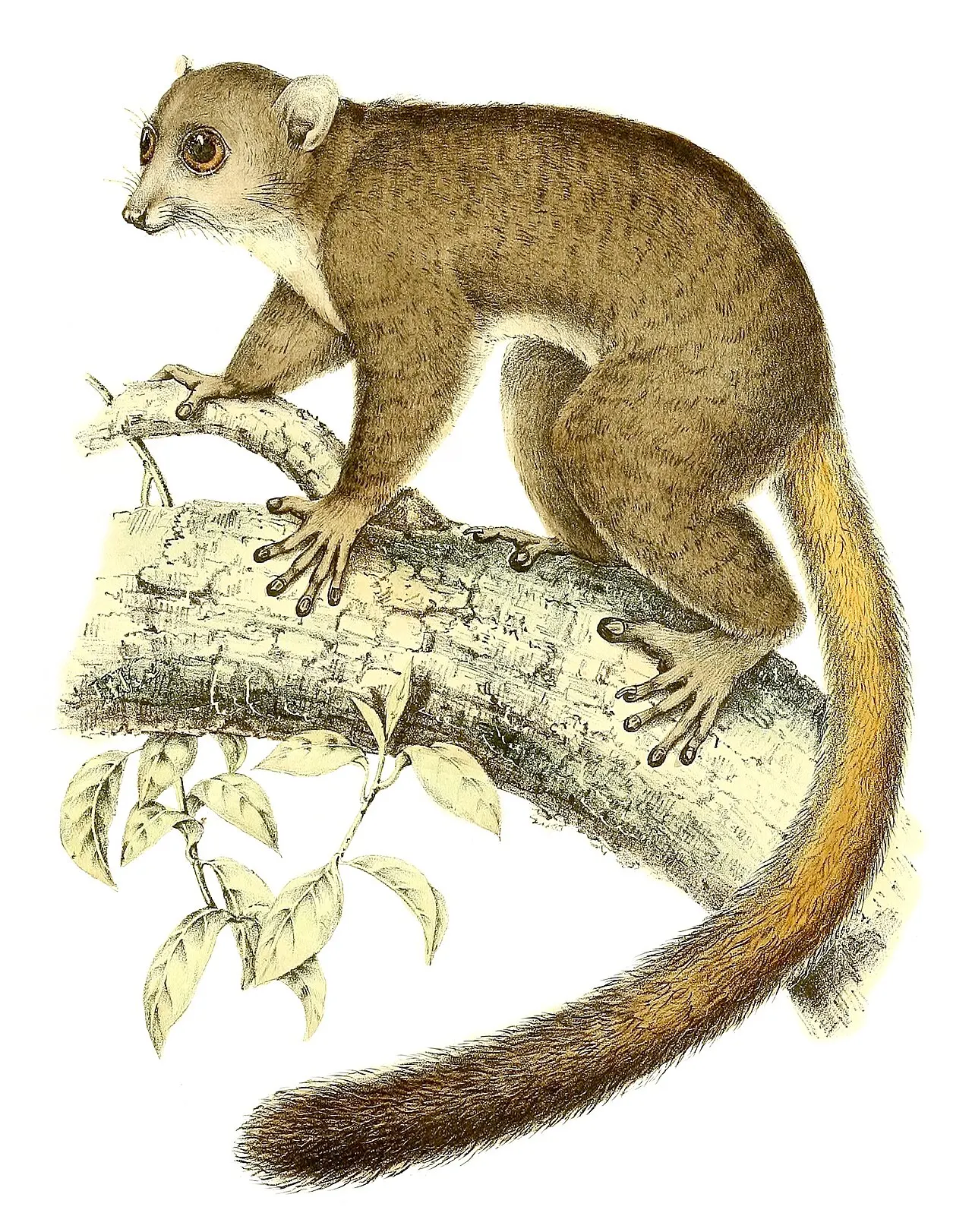
It is a small, big-eared lemur, light brown to grayish brown on the back and yellowish gray underneath, with a long tail that darkens to brown or black at the tip. A reference account gives a body length of about 21 centimetres, a tail of about 33 centimetres and a weight near 300 grams. That makes it several times larger than the true mouse lemurs.
Where it lives
The species is found only in Madagascar, in dry forest in the west, from sea level to about 700 metres. It was first described from the Morondava area in 1867. The southern population reportedly lies between the Onilahy River in the south and the Tsiribihina River in the north, and its distribution is patchy, split among separate areas of forest.
The IUCN puts its extent of occurrence at about 85,975 square kilometres, calls the population severely fragmented, and records dry forest and plantations among its habitats.
Pins are Wikidata “endemic to” fields. Orange dots, when present, are GBIF occurrence tiles — survey bias included.
How it lives
Unlike the true mouse lemurs, it doesn't hibernate. It forages alone at night and eats fruit, flowers, buds, tree gum, spiders and insects, and sometimes small vertebrates. In the dry months it reportedly leans heavily on the sugary secretions of insect larvae and on gum.
By day it sleeps in round nests, up to about 50 centimetres across, woven from lianas, leaves and twigs and set 2 to 10 metres up. Individuals reportedly move between ten or so nests every few days. Gestation lasts about 90 days, and litters are small, usually one or two young and sometimes three. Wild animals rarely live past five or six years. Predators reportedly include the Madagascar buzzard, fossa and owls.
Why it is in trouble
The IUCN records an ongoing decline in forest area and in the species' range, and lists shifting agriculture and hunting for the species as threats, though the scale of each is unknown. It rates the combined effect as a population decline of an estimated 50 per cent over the past, present and coming generations (a generation is about five years).
What is being done
The IUCN records that the species lives in at least one protected area and is covered by international trade controls. The CITES convention reportedly lists it on Appendix I. The IUCN gives no figure for total population.
Colonies once held in the United States and Europe under this name have reportedly since been reclassified as the northern giant mouse lemur, so there is no known breeding population outside Madagascar.
Sources
Written for this catalog in our own words from the sources below, checked against them on 12 November 2026. Population figures are estimates and carry the year they were made. Status and assessment year: IUCN. 2026. The IUCN Red List of Threatened Species. Version 2026-1. iucnredlist.org.




