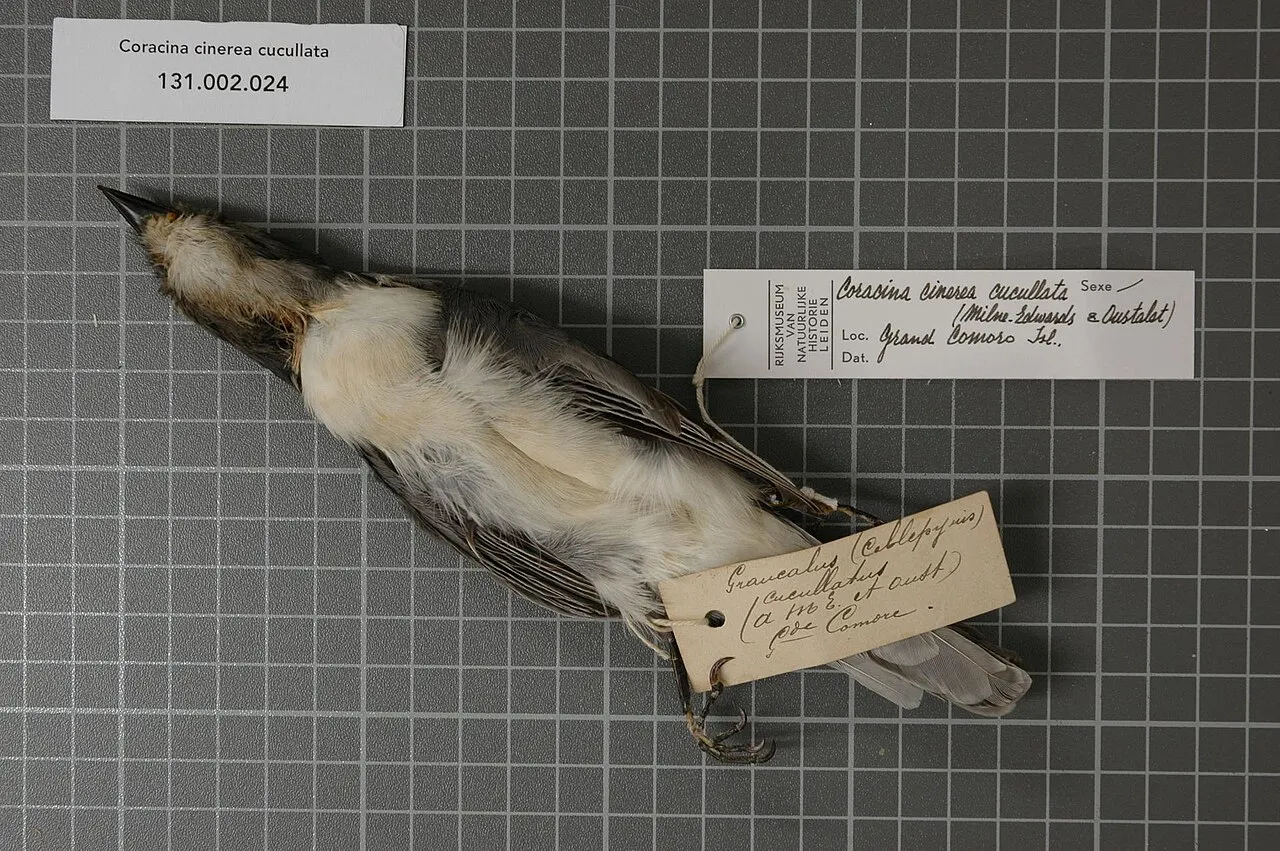
Endangered
Comoros cuckooshrike
Ceblepyris cucullatus
The Comoro cuckooshrike (Ceblepyris cucullatus) is a forest bird found nowhere but the Comoro Islands, off Africa's east coast. The IUCN Red List assessed it as Endangered in 2021, with an estimated 1,000 to 2,499 mature individuals. Some authorities treat it as a form of the Madagascar cuckooshrike.
What it is
It belongs to the cuckooshrikes (Campephagidae), a family of songbirds. Alphonse Milne-Edwards and Émile Oustalet described it in 1885, and it is sometimes treated as a subspecies of the Madagascar cuckooshrike. The IUCN assesses it as a species in its own right, and so does the IOC checklist. It also appears under the older name Coracina cucullata.
One data source gives a weight of about 47 g and a wing length of about 97 mm. It is classed as an invertebrate eater that stays on its islands year-round.
Where it lives
The species is endemic to the Comoros. Photographs and recordings come from Mount Karthala on Grande Comore and from sites on Mohéli (Mwali). The IUCN gives its extent of occurrence as about 1,206 square kilometres and the area it actually occupies as about 540 square kilometres. It counts one to five locations and two subpopulations, the largest holding about 251 to 1,000 birds.
It lives in moist forest, both lowland and montane. It is a resident and does not migrate.
Pins are Wikidata “endemic to” fields. Orange dots, when present, are GBIF occurrence tiles — survey bias included.
Why it is in trouble
The 2021 assessment says the population and its occupied area are both declining. Small-holder farming and small-scale harvesting are the main pressures on its forest habitat, each affecting most of the population and causing slow but significant declines. A further threat from unspecified species is rated negligible. The assessment records no protected area covering the species.
The previous global assessment, in 2016, rated it Vulnerable, before it moved up to Endangered in 2021.
What is being done
Little protection is in place. The IUCN lists site and area protection, awareness and communications work, and alternative livelihoods as the kinds of action the species needs. Conservation sites have been identified over its entire range, but there is no recovery plan, no systematic monitoring scheme and no captive breeding.
Sources
Written for this catalog in our own words from the sources below, checked against them on 12 November 2026. Population figures are estimates and carry the year they were made. Status and assessment year: IUCN. 2026. The IUCN Red List of Threatened Species. Version 2026-1. iucnredlist.org.




