Endangered
Silverstone's rocket frog
Silverstone's rocket frog
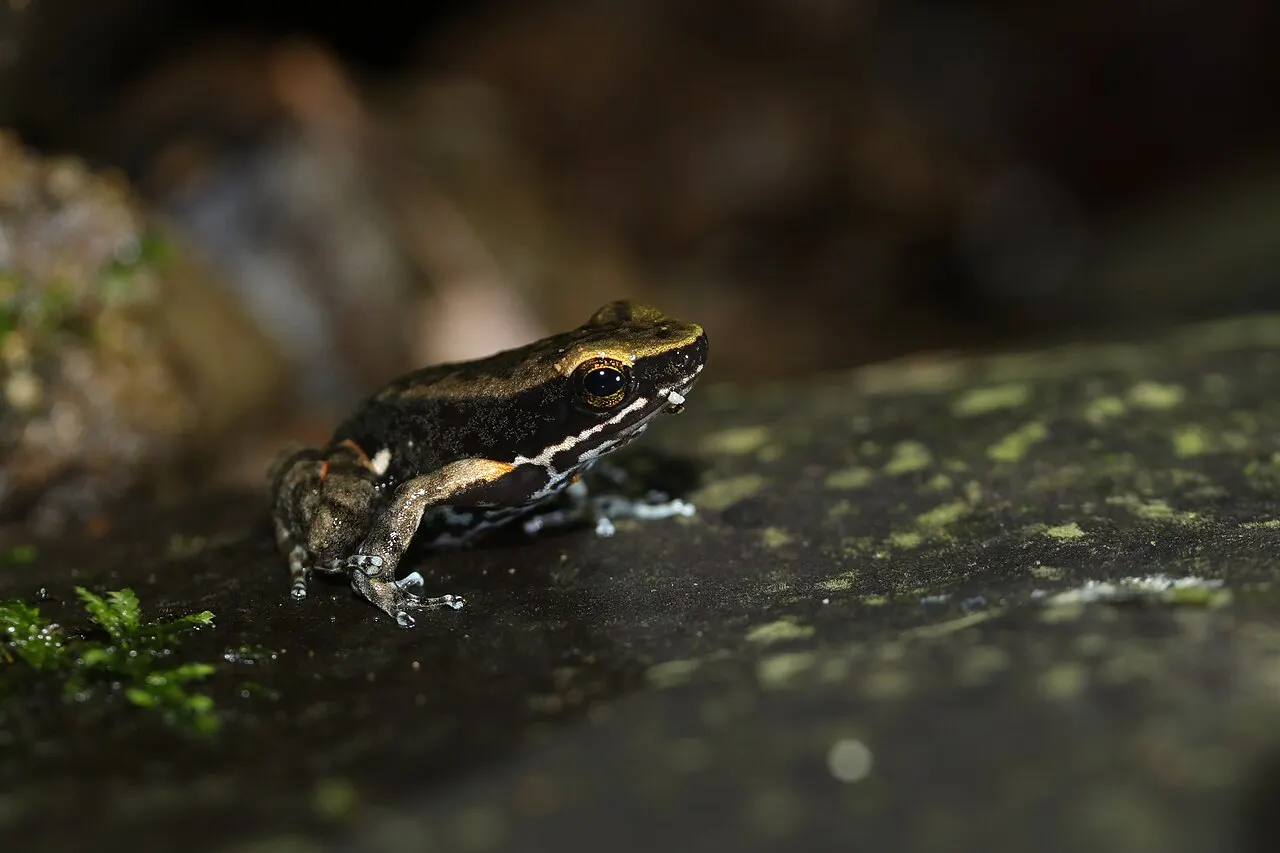
Silverstone's rocket frog, known as Silverstone's rocket frog, is a small ground-living frog found only in Colombia, near streams in lowland rainforest. The IUCN Red List classes it as Endangered (2019 assessment) because the forest it depends on is shrinking and its population is decreasing.
Where it lives
This frog is endemic to Colombia. Of the 66 occurrence records gathered by GBIF, 46 come from Chocó department and 16 from Antioquia. It was described in 1975 by Silverstone.
It is a terrestrial species, seen near streams in lowland forest and occasionally on banana plantations. The Red List gives its elevation as 200 to 300 metres above sea level and counts between one and five distinct locations. At least one protected area, Utría National Park, lies within its range.
Pins are Wikidata “endemic to” fields. Orange dots, when present, are GBIF occurrence tiles — survey bias included.
How it lives
Accounts of its breeding are thin and not fully consistent about which sex carries the tadpoles. One reports that the female carries them to a stream, where they swim and grow. That would be unusual for the genus, where males usually do the carrying.
Why it is in trouble
The Red List records continuing decline in the area the frog occupies. The pressures it lists include small-holder farming, housing and urban growth, mining and quarrying, and storms and flooding. Logging and legal and illegal agriculture add to forest loss, and farm pollution can reach its streams.
Gold mining near the places it is known from is also a worry, since frogs living around mine sites may be at risk. Chytridiomycosis, the fungal disease that has killed amphibians worldwide, can kill this species, though its effect on populations is unknown.
The Red List shows the population trend as decreasing. No population estimate has been published. The 2019 Endangered rating, under criterion B1ab(iii), replaced a 2004 Data Deficient rating.
What is being done
Protection is limited to the places where its range overlaps with Utría National Park. The Red List lists site and area management and protection of resources and habitat as the actions needed, along with more research on life history, population size, distribution and threats.
Sources
Written for this catalog in our own words from the sources below, checked against them on 12 November 2026. Population figures are estimates and carry the year they were made. Status and assessment year: IUCN. 2026. The IUCN Red List of Threatened Species. Version 2026-1. iucnredlist.org.




