Endangered
Colombian Mountain Grackle
Macroagelaius subalaris
The Colombian mountain grackle (Macroagelaius subalaris) is a slim, long-tailed blackbird found only in the humid oak forests of Colombia's northern Eastern Andes. The IUCN Red List rates it Endangered, most recently assessed in 2017, with a small, broken-up range and a population thought to be shrinking.
How to recognise it
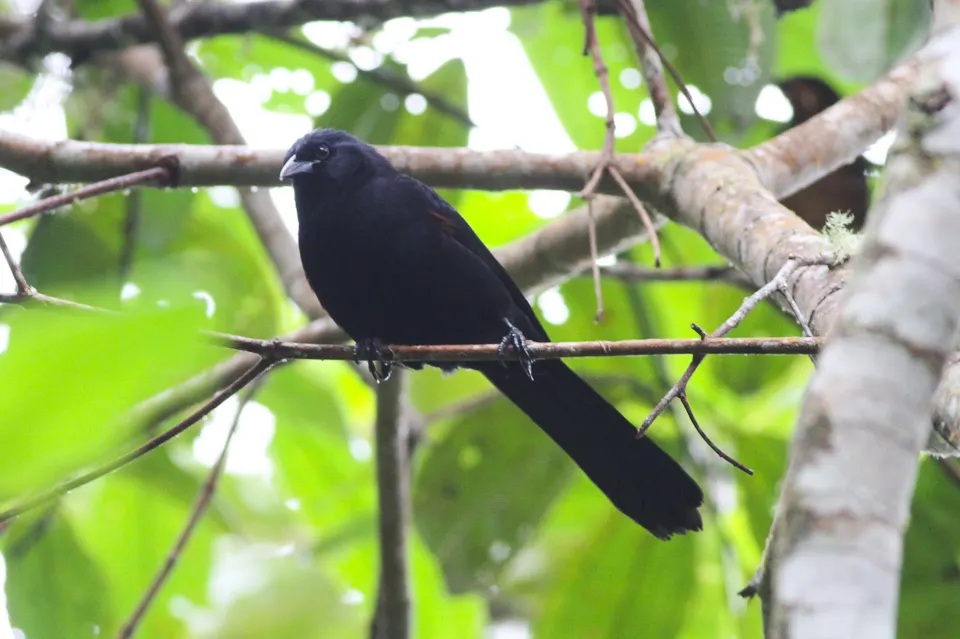
This is a lean, long-tailed icterid, the family that also holds the oropendolas, orioles and New World blackbirds. It measures roughly 27 to 30 cm. Adults are nearly all black with a bluish sheen and a black, conical bill. Males and females look alike.
The one splash of colour is usually hidden. The linings under the wings are dark chestnut, and they are rarely visible in the field. Young birds are duller brown, with less gloss.
The song is highly variable, a mix of whistles, screeches and other noises, with repeated motifs and sharp check calls. Field teams in Santander reported that some local people had never heard of the bird or mistook it for a cacique (Cacicus chrysonotus), which it often travels with.
Where it lives
It is endemic to Colombia, meaning it occurs nowhere else. It lives on the western slope of the northern Eastern Andes, with records from Norte de Santander, Santander and Boyacá. The species was described in 1840, and the type locality is given as Santa Fe de Bogotá.
The IUCN lists it as a resident of humid montane forest between 2,100 and 2,900 m. Field work in Santander from 2021 to 2022 recorded birds from 1,953 m up to 3,219 m, with an average of about 2,500 m, so the real band looks wider than the Red List figure.
All 7 sites in Santander where the ProAves team found it had some Andean forest with white oak (Quercus humboldtii) and water nearby, such as a stream, river or wetland. The birds also feed in forest remnants and wooded pastures beside these patches, and seem to like them for nesting.
Pins are Wikidata “endemic to” fields. Orange dots, when present, are GBIF occurrence tiles — survey bias included.
How it lives
Mountain grackles travel in groups of 3 to 8, most often about 6, and small groups can merge into flocks of several dozen. At one stream in Santander, more than 40 were seen feeding together. They forage mostly in the upper layers of the forest and the canopy, searching flowers, leaf bases, bark and lichens for crickets, spiders, caterpillars, beetles, stick insects and ticks. They also eat parts of small berries.
They defend themselves and each other boldly. A local observer described a group mobbing a white-throated hawk (Buteo albigula) in July 2022 after it attacked one of them, and the injured bird lost its tail. A group with a nest was seen driving off a black-billed mountain-toucan.
Breeding is only partly known. The breeding season is reportedly May to September, with nests usually in oaks about 5 to 10 m up and groups of up to five adults sharing the work. That fits cooperative breeding, though the 2023 ProAves paper says it is unclear how the groups are organised. Clutch size and incubation time are unrecorded. Fledglings were seen being fed whole arthropods.
Why it is in trouble
The bird depends on one kind of forest, and that forest has been cut back hard. In Santander, ProAves estimated that about 83 percent of Andean forest at 1,800 to 3,200 m has been transformed. Roughly 1,407 square kilometres of humid Andean forest remain there, out of an estimated 8,186 originally.
The IUCN's threat list includes small-holder and large-scale grazing and farming, shifting agriculture, housing, other ecosystem modifications and unintentional effects of harvesting. The ProAves paper names farmland expansion, pasture creation, selective logging and mining. It found mines near three of its survey sites, though farming pressure at those places was low.
The Red List estimates 600 to 1,700 mature individuals as of 2017, calls the population severely fragmented and decreasing, and uses an area-based criterion (B2ab). The history is not a straight line. It was reportedly rated Critically Endangered in 2000, then Endangered from 2007 as more was learned about the species. The decline is still thought to continue.
What is being done
The ProAves paper records the grackle in 8 protected areas in Colombia's national registry, including Serranía de los Yariguíes National Park and the Santurbán regional park. The IUCN lists protecting more suitable habitat as the action needed, and records that no recovery plan or systematic monitoring scheme was in place at the 2017 assessment.
A project in Santander, run by Fundación ProAves and funded by Mubadala with the Mohamed bin Zayed Species Conservation Fund, started in September 2021 and is planned to run to September 2024. The project covers surveys, bird banding and a conservation action plan, with new protected areas and habitat restoration as planned work. A converted school bus serves as a mobile classroom, and by 28 February 2023 it had reached more than 12,450 children.
The IUCN also lists research needs: life history and ecology, and the bird's population size, distribution and trends, including areas nobody has checked recently.
Sources
Written for this catalog in our own words from the sources below, checked against them on 11 November 2026. Population figures are estimates and carry the year they were made. Status and assessment year: IUCN. 2026. The IUCN Red List of Threatened Species. Version 2026-1. iucnredlist.org.
- IUCN Red List assessment, Macroagelaius subalaris (2017)
- Davila, Cortes-Diago and Borrero-Alvarez (2023), Aspectos de la historia natural del Chango de montana, Conservacion Colombiana 28(1)
- Colombian mountain grackle, Wikipedia
- Mountain Grackle, World Bird Names
- GBIF species page, Macroagelaius subalaris
- Colombian Mountain Grackle, Species Conservation Fund and Mubadala
- oiseaux.net photo record, Santa Elena, Boyaca




