Endangered
Natal pygmy gecko
Coleodactylus natalensis
The Natal pygmy gecko is a tiny lizard of the Atlantic Forest of north-eastern Brazil, first found in coastal dunes at Natal in Rio Grande do Norte. Adults are about 2 cm from snout to vent. The IUCN lists it as Endangered (assessed 2014, published 2021) because its forest habitat is fragmented and shrinking.
How to recognise it
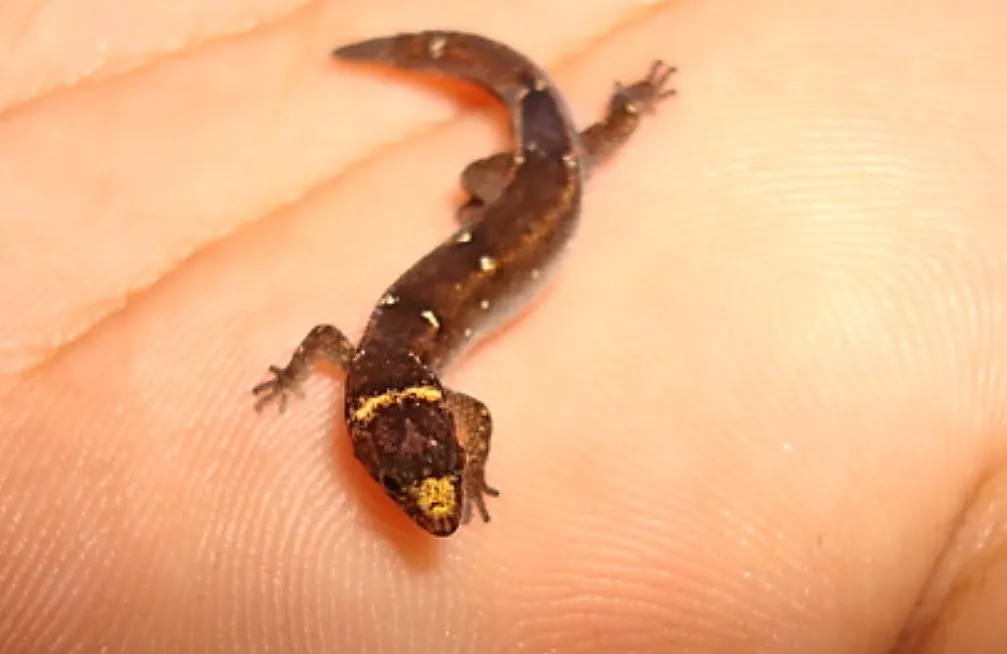
Coleodactylus natalensis is among the smallest lizards known, at about 35 mm including the tail. Males measure 19 to 22 mm from snout to vent, with tails of 12 to 16 mm. Females reach 19 to 24 mm, with tails of 15 to 18 mm. The back is light or dark brown, usually with a whitish band on the neck. Males have white spots edged in black and a white snout patch, a head pattern that females lack.
Freire described the species in 1999. Its type locality is in the coastal dunes at Natal, the city that gave it its name. A very tall snout scale with a W-shaped back edge, and a claw sheath of five scales, set it apart.
Where it lives
The species is endemic to Brazil, known from Rio Grande do Norte. A 2012 study of the Parque Estadual Dunas de Natal, a forest and dune reserve surrounded by the city, reported the gecko concentrated in forest leaf litter at lower elevations, in wetter and milder spots than the area average. Mean density was about 98 lizards per hectare, with wide variation between plots.
The IUCN habitat entry is subtropical or tropical moist lowland forest. A 2012 diet study in the same park, based on 49 lizards, found that woodlice and spiders were the main prey. The species lays eggs, probably one at a time, and hatchlings measure about 11 mm from snout to vent.
Pins are Wikidata “endemic to” fields. Orange dots, when present, are GBIF occurrence tiles — survey bias included.
Why it is in trouble
The IUCN lists the species as Endangered because its range is small (an extent of occurrence of about 2,185 km2) and its forest is fragmented and continuing to decline. The assessment names housing and urban development as a threat, rated low impact, and the population trend is unknown.
The assessment records that the species occurs in at least one protected area and that an area-based regional management plan exists. Research priorities are population size and distribution, and life history and ecology.
Sources
Written for this catalog in our own words from the sources below, checked against them on 12 November 2026. Population figures are estimates and carry the year they were made. Status and assessment year: IUCN. 2026. The IUCN Red List of Threatened Species. Version 2026-1. iucnredlist.org.
- IUCN Red List assessment, Coleodactylus natalensis (2021)
- Natal pygmy gecko (encyclopedia entry)
- The Reptile Database, Coleodactylus natalensis
- Lisboa, Sales and Freire (2012), Zoologia 29(4), feeding ecology of C. natalensis
- Lisboa and Freire (2012), South American Journal of Herpetology 7(2), repository record




