Endangered
Coahuilan box turtle
Terrapene coahuila
The Coahuilan box turtle is the only box turtle that spends most of its life in water, about 90% of its time. It occurs only in the spring-fed wetlands of the Cuatro Cienegas valley in Coahuila, Mexico. The IUCN lists it as Endangered (assessed 2007, decreasing), and it is on CITES Appendix I.
How to recognise it
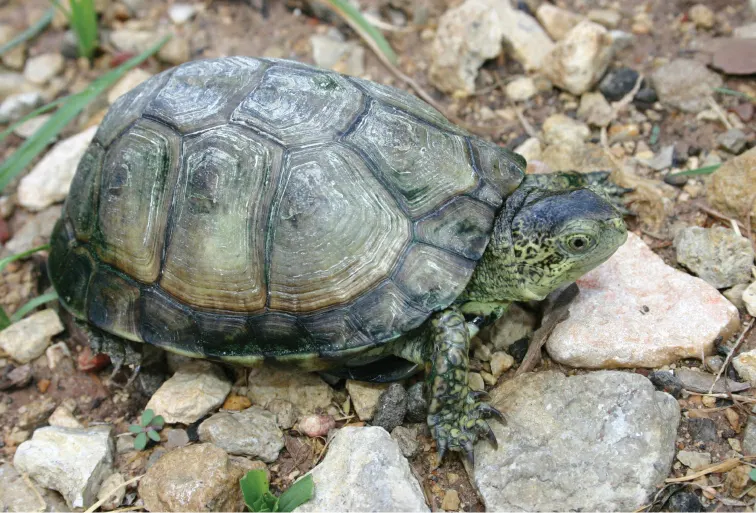
It's a small turtle with a domed shell that reaches roughly 17 cm in length, according to one reference. The shell is dark brown to black and often coated with algae. The skin is dark brown or grey, nearly black in places, with scattered yellowish markings reported on the head and limbs, and the feet are webbed.
Males have a slightly dished underside, a longer and thicker tail, and sometimes red or orange eyes. Females have a flatter underside and a shorter tail. Hatchlings are brighter, with yellow and black spots.
Where it lives
Its entire range is the Cuatro Cienegas basin in the Chihuahuan Desert, a spring-fed wetland area that is also a UNESCO biosphere reserve. The IUCN lists springs, small pools, marshes and slow streams as its habitat. One reference puts the occupied area at under 800 square kilometres, split into several separate pockets.
The turtle spends about 90% of its time in the water, often buried in mud among thick plants. During the rainy season it may cross stretches of desert beyond its home range. Researchers suggest it descended from a land-living ancestor that adapted to the desert springs, and it's a close relative of the common box turtle.
Pins are Wikidata “endemic to” fields. Orange dots, when present, are GBIF occurrence tiles — survey bias included.
How it lives
It eats both plants and animals, including insect larvae, beetles, spiders, snails, crayfish, small fish and water plants, and it will scavenge. Mating happens in shallow water over many months, from autumn through spring in some accounts. Nesting runs from about May to September, with clutches usually of two to four eggs.
Raccoons take eggs, hatchlings and adults, and other mammals and snakes also eat the eggs. Individuals stay in a small area. One reference gives a home range about 25 m across.
Why it is in trouble
The central problem is water. The IUCN lists small-holder farming, dams, roads, commercial development and groundwater abstraction as ongoing threats, scored low individually. The Turtle Conservancy points to groundwater loss driven mostly by intensive agriculture outside the valley, a fast-growing local population, and swings in annual rainfall. Illegal collection for the pet trade is also reported by hobbyist sources.
No reliable count exists. The Turtle Conservancy's own page says about 1,500 turtles remain in the wild in its text, and about 500 in a photo caption. An older reference reports up to 156 adults per hectare in good marsh habitat. The IUCN rates the trend as decreasing under criteria A2c+4c and B1ab, based on its small range and declining habitat.
What is being done
The turtle lives inside the Cuatro Cienegas federal protected area, and the IUCN lists habitat restoration, site protection and management, awareness work and captive breeding as actions in place. The Turtle Conservancy says it has acquired a parcel of 2,124 acres (roughly 860 hectares) of wetland in the valley. Captive breeding has been reported at zoos including the Jersey Wildlife Trust and the New York Zoological Society.
Sources
Written for this catalog in our own words from the sources below, checked against them on 12 November 2026. Population figures are estimates and carry the year they were made. Status and assessment year: IUCN. 2026. The IUCN Red List of Threatened Species. Version 2026-1. iucnredlist.org.




