Endangered
Chuuk Monarch
Metabolus rugensis
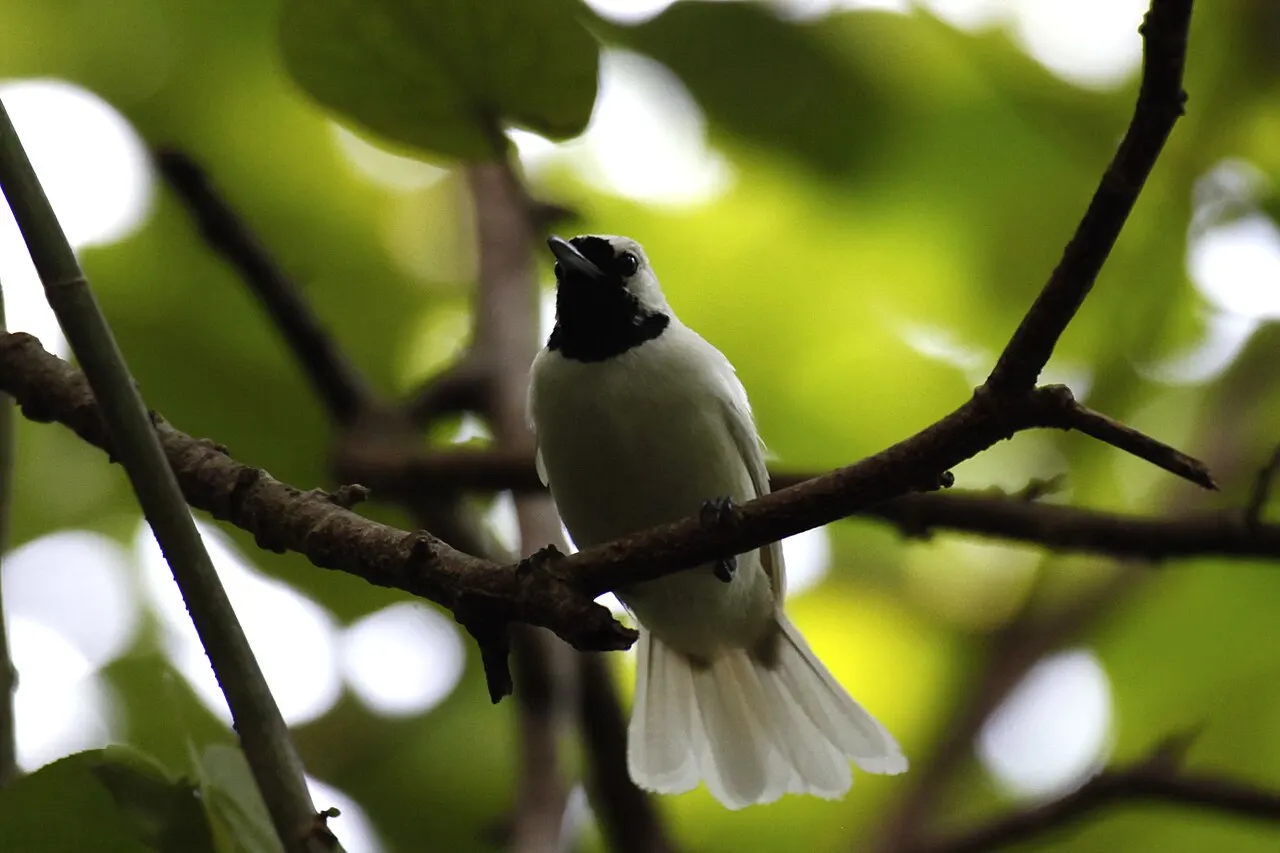
The Chuuk monarch (Metabolus rugensis) is a large flycatcher found only on the islands of Chuuk, in the Federated States of Micronesia. The IUCN Red List classes it as Endangered (2024 assessment), with a declining population tentatively put at 1,000 to 2,499 mature birds. The male is almost entirely white.
How to recognise it
This is a big monarch flycatcher, about 20 cm long, and the only member of its genus. Adult males are nearly all white, with a glossy blue-black face and throat and black tips to the main flight feathers. Some carry a pale salmon or buff wash underneath.
Females are very different. They are dark slate, and many are blotched with rufous feathers kept from their juvenile plumage. Young birds are bright rufous above and rufous-buff below, with a faint buff eyebrow.
It has no real song. Its calls include human-sounding whistles that slide up or down and a plaintive two-note cry, which gives the bird its local name. It is slow-moving and rather tame, yet surprisingly hard to spot in the foliage.
Where it lives
The species occurs nowhere outside Chuuk, a group of high volcanic islands and reef islets inside a large lagoon. It is widely but sparsely spread over all or nearly all of the high lagoon islands and some outer reef islets, and has been recorded from sea level up to about 435 m.
It is densest in small patches of upland native forest, but also uses moist montane forest, dry forest, mangroves above the high-tide line, moist shrubland, rocky slopes and, rarely, plantations. The assessment counts between 5 and 15 subpopulations, the largest holding an estimated 200 to 400 birds. The area it actually occupies is only about 240 square kilometres.
Pins are Wikidata “endemic to” fields. Orange dots, when present, are GBIF occurrence tiles — survey bias included.
How it lives
It hunts insects, lizards and other small prey, gleaning them from foliage, and favours places with a thick, leafy understorey. It is found in small family groups and appears to be strongly territorial. It does not migrate.
Nests are built in trees with dense foliage, and nesting has been recorded from April to July.
Why it is in trouble
The last island-wide estimate was made in 1984, when the population was put at 2,168 birds (a figure from Engbring and colleagues, 1990). Records since suggest a decline, but nobody has measured it. Densities appeared lower in 2001, and no birds were found on Tol South in 1991 and only 3 or 4 in 1993, though birds were seen there again in 2005. On Weno it was thought lost after a fire destroyed a forest patch where it had been uncommon in the 1970s, though two males were seen in Sopo Forest in 2005.
The Red List names small-holder farming, housing and urban growth, and past clearing for large-scale agriculture as the main pressures on its habitat. The bird probably declined sharply in the 1940s, when farming expanded under Japanese administration. Storms and flooding are also listed. Birds may be taken intentionally (there are second-hand reports of slingshots on Weno) or caught by accident, though the effect is rated as unknown or minor.
What is being done
Protection is thin. Conservation sites have been identified across its range, but the bird does not occur in any formal protected area, and there is no recovery plan or monitoring scheme. The Red List calls for awareness work to discourage persecution, protection of the remaining native forest and mangroves, control of invasive species and fresh surveys to find out how many birds are left.
Sources
Written for this catalog in our own words from the sources below, checked against them on 12 November 2026. Population figures are estimates and carry the year they were made. Status and assessment year: IUCN. 2026. The IUCN Red List of Threatened Species. Version 2026-1. iucnredlist.org.




