Endangered
Veneto Mountain Grasshopper
Chortopodisma cobellii
The Veneto mountain grasshopper (Chortopodisma cobellii) is a wingless, light green grasshopper known only from a small patch of the Italian Alps around Monte Pasubio. The IUCN Red List lists it as Endangered (assessed 2016), with a decreasing population.
How to recognise it
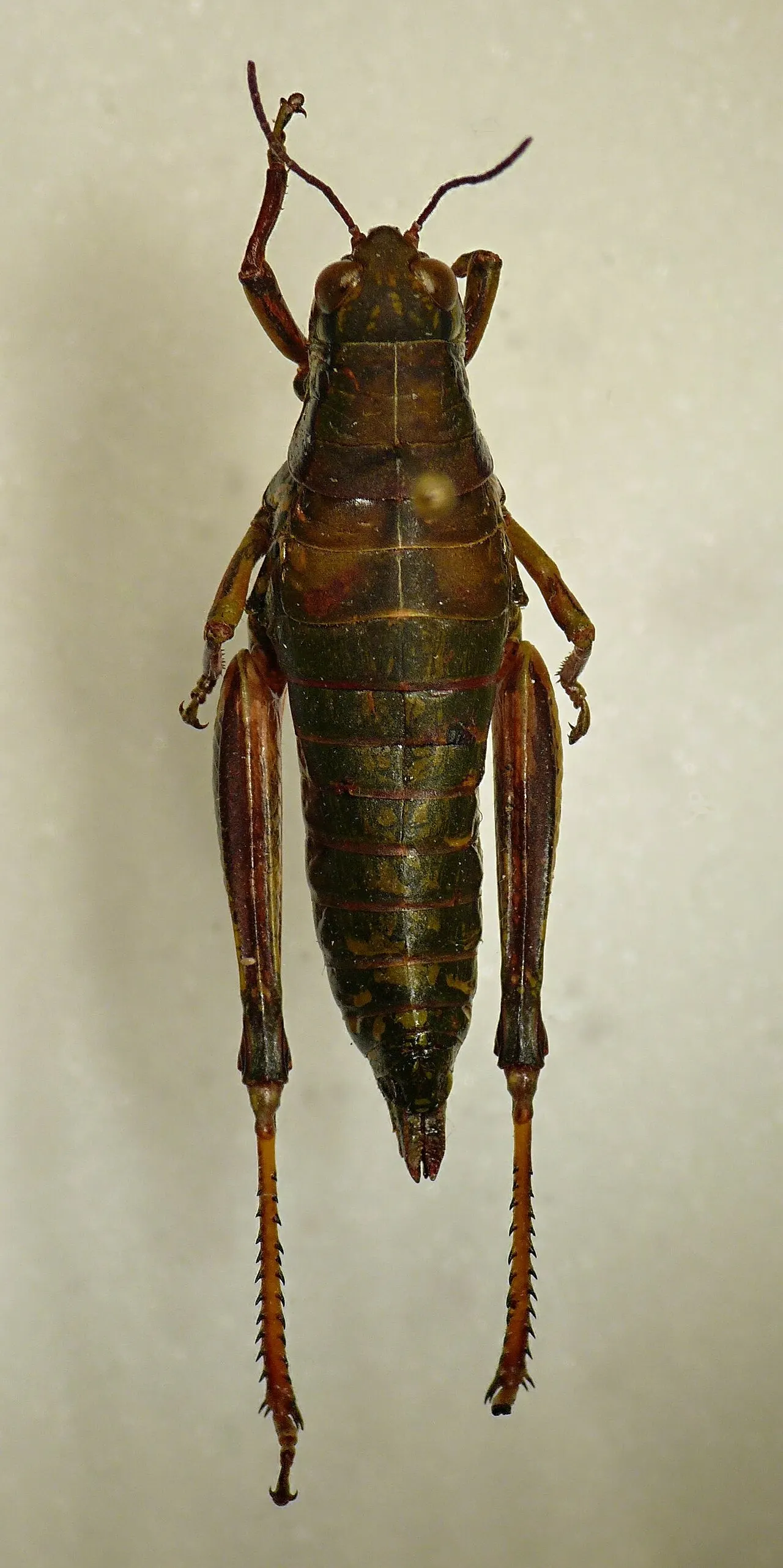
This is a light green, flightless grasshopper. Its hearing organ is reduced to small remnants. It has a short dark band along each flank, which usually ends at the rear edge of the plate behind the head. In males the band can reach further back and break into separate spots. The underside of the hind thigh is reportedly orange and the hind shin yellow.
It looks much like the Monte Baldo mountain grasshopper (Pseudoprumna baldensis). According to one naturalist's account, the two differ in the development of the hearing organ and, in females, in the length of the dark stripe running back from the eye.
Where it lives
It is found only in northern Italy, in a narrowly limited area around Monte Pasubio. The 2016 Red List assessment puts its extent of occurrence at about 890 square kilometres, with an area of occupancy near 52 square kilometres, spread over 3 locations. At least one of those locations lies in a protected area.
The grasshopper lives in herb-rich pastures and grassland, and the assessment also lists temperate shrubland. The Red List gives an elevation range of 1,500 to 2,200 m.
The Monte Baldo mountain grasshopper lives across the deep Adige valley. One account suggests the two species share a common ancestor and were split into separate ice-free refuges during the last glacial period.
Pins are Wikidata “endemic to” fields. Orange dots, when present, are GBIF occurrence tiles — survey bias included.
How it lives
Adults can be found from August to October. Beyond that, very little has been published about its diet, breeding or behaviour, and it is not a migrant.
Why it is in trouble
A species with this small a range has little margin for error. The assessment lists changes to its grassland habitat and recreational activities as ongoing pressures, each affecting a minority of the population and causing slow, significant declines. The population is judged to be decreasing, though the assessment gives no population count. Whether the area it occupies is shrinking is unknown.
What is being done
Part of the range is protected, but no recovery plan or monitoring scheme exists and no animals are kept in captivity. The one conservation action listed is awareness and communication. Better knowledge of its numbers, distribution and habitat trends is listed among the research needs.
Sources
Written for this catalog in our own words from the sources below, checked against them on 12 November 2026. Population figures are estimates and carry the year they were made. Status and assessment year: IUCN. 2026. The IUCN Red List of Threatened Species. Version 2026-1. iucnredlist.org.




