Endangered
Epirus dancing grasshopper
Epirus dancing grasshopper
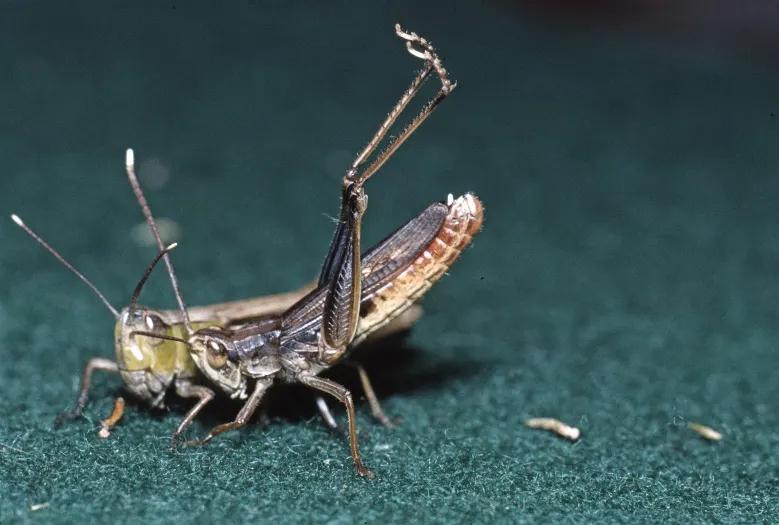
The Epirus dancing grasshopper, Epirus dancing grasshopper, lives only in the wet grasslands of Epirus in north-west Greece. It was listed as Critically Endangered in 2012 and 2016, then moved to Endangered in the 2025 Red List assessment. Its habitat is scattered, small and still shrinking.
Where it lives
This grasshopper is a steno-endemic, meaning it's tied to a very narrow set of conditions in one small region. It lives only in Epirus, in lowland grasslands and marshy ground from sea level up to about 500 metres. It needs wet soil, and it lives in temporary grasslands that flood in winter.
The 2025 Red List assessment puts its range at roughly 1,650 to 2,250 square kilometres, but the area it actually occupies is only about 140 to 200 square kilometres. It is split into some 12 subpopulations across 4 locations.
Pins are Wikidata “endemic to” fields. Orange dots, when present, are GBIF occurrence tiles — survey bias included.
How it lives
It breeds in summer, when it feeds in tall herb vegetation. The assessment gives a generation length of one year, so adults live a single season and populations can swing quickly if the grassland is lost or dries out.
Why it is in trouble
A conservation project funded in 2016 reported that the species lost between 85 and 99 percent of its habitat during the last century, and the loss continues. The project named urbanisation, drainage, conversion to farmland and intensive cattle grazing. The Red List threat list covers water abstraction for farming, agro-industry, grazing by smallholders' livestock, housing, commercial development, tourism and drought, and records continuing declines in area, subpopulations and locations.
Preliminary fieldwork in summer 2016 suggested it might already be gone from three known sites, one of them in a Natura 2000 area. Counts of surviving populations vary by source, from five to seven or fewer in older reports, up to 12 subpopulations in the 2025 assessment.
What is being done
A 2016 grant of 12,500 US dollars from the Mohamed bin Zayed Species Conservation Fund paid for fieldwork to map the species' range and assess its status and threats, with training for staff of the Lake Pamvotis management body. A 2023 genetic study in the Journal of Insect Conservation found moderate to high genetic diversity and three loosely separated genetic clusters. It argued that protecting and managing suitable habitat is essential.
Most of the population, 91 to 100 percent by the Red List's estimate, occurs inside protected areas, and a systematic monitoring scheme is in place. Habitat restoration, site management and species recovery are listed as conservation actions. No formal recovery plan or captive breeding is in place, and the species is not recorded as used or traded.
Sources
Written for this catalog in our own words from the sources below, checked against them on 12 November 2026. Population figures are estimates and carry the year they were made. Status and assessment year: IUCN. 2026. The IUCN Red List of Threatened Species. Version 2026-1. iucnredlist.org.
- IUCN Red List assessment, Epirus dancing grasshopper (2025)
- Mohamed bin Zayed Species Conservation Fund, Epirus Grasshopper project
- Toli et al. 2023, Journal of Insect Conservation 27, Conservation genetics of the steno-endemic Epirus dancing grasshopper (abstract seen via search)
- Wikipedia, Epirus dancing grasshopper




