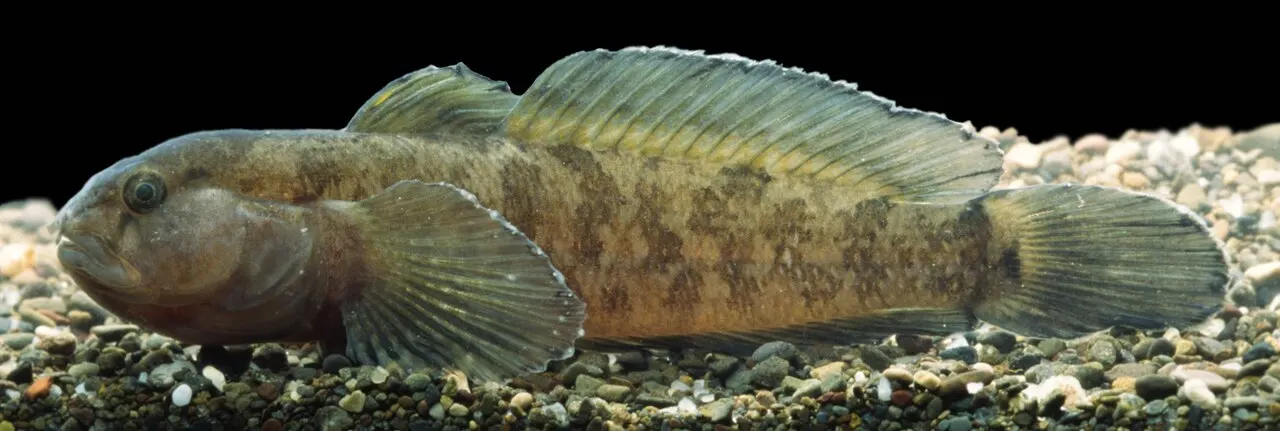
Endangered
Chornaya tubenose goby
Proterorhinus tataricus
The Chornaya tubenose goby (Proterorhinus tataricus) is a small freshwater fish known from one short stretch of one river on the Crimean peninsula. The IUCN Red List assessed it as Endangered in 2024, down from Critically Endangered in 2008. Water abstraction and drought are the main threats.
How to recognise it
It's a tubenose goby that lives near the bottom of its stream. The largest recorded fish measured about 9.2 cm in standard length, which leaves out the tail fin. Head length is 26 to 29 per cent of standard length.
Specialists separate it from other tubenose gobies mainly by counting. It has 45 to 54 scales along the middle of the side, plus 2 or 3 more at the tail base, 18 or 19 rays in the second dorsal fin and 15 to 17 in the anal fin. Breeding males grow a hump behind the eye.
Where it lives
The goby is found only in the Chornaya River in Crimea. Jörg Freyhof and Alexander Naseka described it in 2007 from moderately fast-flowing and still sections of this medium-sized stream, which carries about 10 cubic metres of water per second. The name honours the Crimean Tatars.
FishBase gives the fish's range as a very limited stretch of about 25 km, where it was still abundant but declining. The IUCN counts a single location, with an extent of occurrence of 362 square kilometres, and lists permanent rivers and streams as its habitat.
Pins are Wikidata “endemic to” fields. Orange dots, when present, are GBIF occurrence tiles — survey bias included.
How it lives
Almost nothing is published about its diet, breeding season or lifespan, and FishBase lists no biological data. The IUCN records that it gathers in groups all year round and doesn't migrate.
Why it is in trouble
The 2007 description warned that heavy water extraction for irrigation leaves the lower river almost dry in summer, and that this was likely to drive the species extinct. The IUCN's 2024 assessment, made under criterion B1ab(iii), lists abstraction of surface water and groundwater for farming, industry and households as ongoing threats. It also lists drought, which it scores as affecting the whole range.
The assessment records a continuing decline in the area the fish occupies. It rates the overall population trend as unknown and gives no population estimate.
What is being done
No protective action is recorded. The assessment shows no recovery plan, no monitoring scheme, no protected area, no conservation sites and no captive population. It lists research on the fish's taxonomy, population trends and habitat trends as needed.
Sources
Written for this catalog in our own words from the sources below, checked against them on 12 November 2026. Population figures are estimates and carry the year they were made. Status and assessment year: IUCN. 2026. The IUCN Red List of Threatened Species. Version 2026-1. iucnredlist.org.



