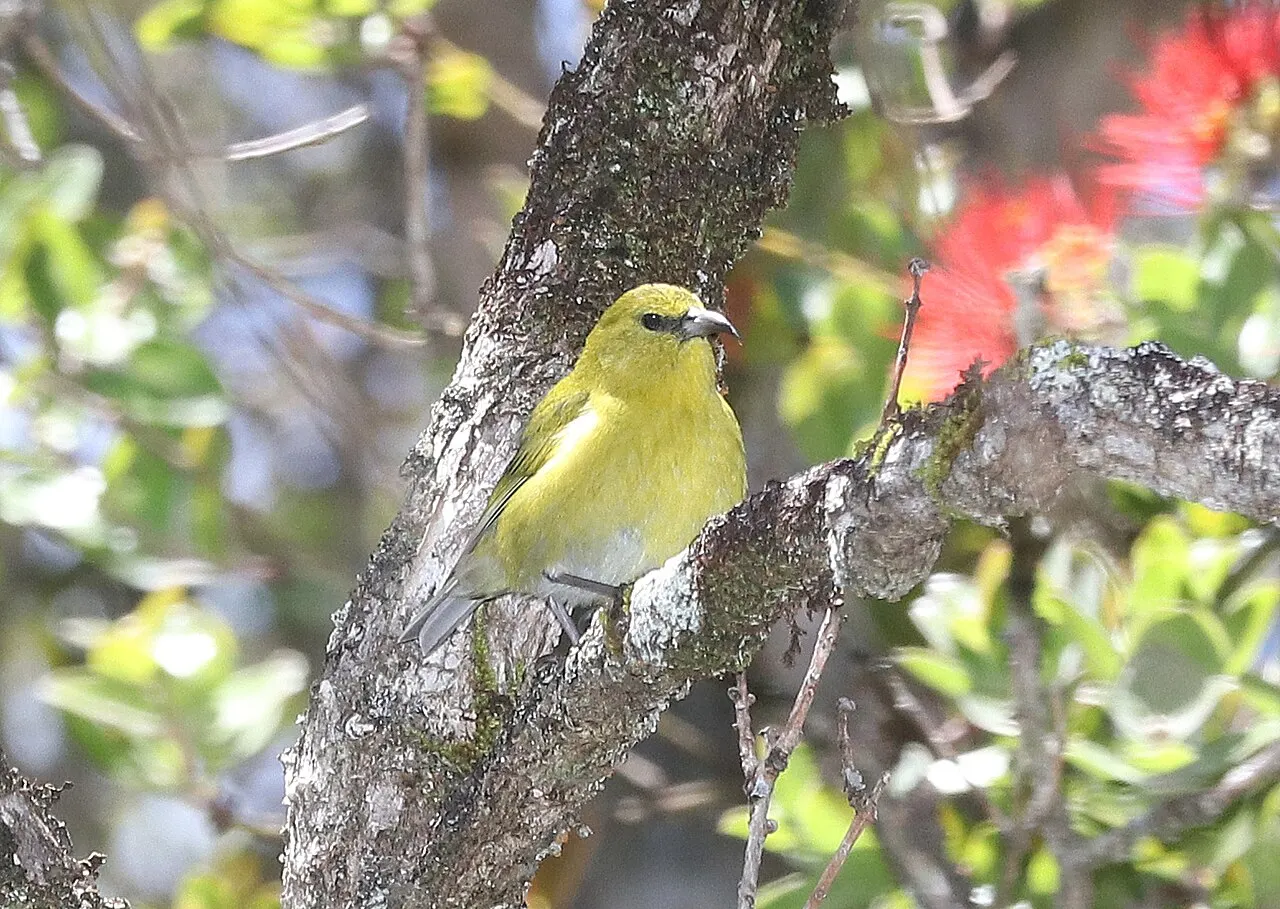
Endangered
Kauaʻi ʻamakihi
Chlorodrepanis stejnegeri
The Kauaʻi ʻamakihi is a small greenish-yellow Hawaiian honeycreeper with a curved bill, found only on Kauaʻi. The IUCN Red List raised it from Vulnerable (2016) to Endangered in 2023. Mosquito-borne disease is the main concern, and a July 2026 report says numbers may have fallen sharply since.
How to recognise it
It is a greenish-yellow bird with dark lores, the patch between the eye and the bill. The bill is long, sickle-shaped and curved downward, and it is the best clue to identity. Males have larger bills and brighter colours than females, and young birds resemble females. The bird is about 11 centimetres long. Its Hawaiian name is reportedly linked to kihi, meaning curved, a reference to the bill.
This is the largest of the ʻamakihi group, with a heavier bill and a shorter tail than its relatives. The bill is so much bigger than other ʻamakihi that birders have often mistaken it for the Kauaʻi nukupuʻu, a rare honeycreeper with a thin black bill. The song is a vigorous trill and the usual call is a sharp chirp.
Where it lives
It occurs nowhere but Kauaʻi. The Red List puts the species at a single location, with an area of occupancy of about 356 square kilometres and elevations of 600 to 1,600 metres. Its habitat is moist montane forest, especially ʻōhiʻa forest, where it often nests. Places where it has been recorded include Waimea Canyon, the Nā Pali plateau, the Alakaʻi Swamp and the Makaleha Mountains.
It once occurred at lower elevations. Habitat loss has pushed it upslope, and it is now found mostly above 600 metres.
Pins are Wikidata “endemic to” fields. Orange dots, when present, are GBIF occurrence tiles — survey bias included.
How it lives
It is a bark specialist, prying at bark with its bill and picking insects from crevices. Like other ʻamakihi it has a tubular tongue for taking nectar. Information on its breeding biology is incomplete, and what is known comes largely from other honeycreeper species.
Why it is in trouble
Avian malaria and avian pox, carried by introduced mosquitoes, are the main concern. Kauaʻi's high forests were long too cool for the mosquitoes, which made them a refuge. A 2016 study in Science Advances, led by USGS researcher Eben Paxton and drawing on about 30 years of surveys, found that six of eight native forest birds in the island's high-elevation forests were declining rapidly. The study linked this to warming that let disease spread to the uplands.
The 2023 Red List assessment, by BirdLife International, estimated 2,200 to 4,400 mature birds and a decreasing population, with a decline of 55 to 70 percent assessed for the past, the present and the projected future. Listed threats include introduced species, habitat shifts, storms and flooding, and past agricultural clearing.
The picture may now be worse. In July 2026, Lisa Crampton of the Kauaʻi Forest Bird Recovery Project told Hawaii News Now that earlier survey data showed about 9,000 Kauaʻi ʻamakihi, but that raw data now pointed to hundreds of ʻamakihi and ʻanianiau combined. No new island-wide survey had been done that year. The cause of the drop since 2023 had not been fully determined. Food shortages and nest losses in heavy rain and wind were named alongside disease.
What is being done
As of the 2023 assessment, the whole range was covered by identified conservation sites, at least one protected area held the bird, and invasive species control and systematic monitoring were in place. There was no recovery plan, no captive population and no recent education programme. The assessment calls for continued range-wide surveys and research on disease immunity.
The 2026 report said crews planned to begin capturing wild ʻamakihi and ʻanianiau and collecting their eggs in September. The birds would go to breeding facilities at the Honolulu Zoo and to mosquito-free habitat on Maui and Hawaiʻi Island, with the long-term aim of returning them to Kauaʻi once the threats are controlled.
Sources
Written for this catalog in our own words from the sources below, checked against them on 12 November 2026. Population figures are estimates and carry the year they were made. Status and assessment year: IUCN. 2026. The IUCN Red List of Threatened Species. Version 2026-1. iucnredlist.org.




