Endangered
Chlorocypha schmidti
Chlorocypha schmidti
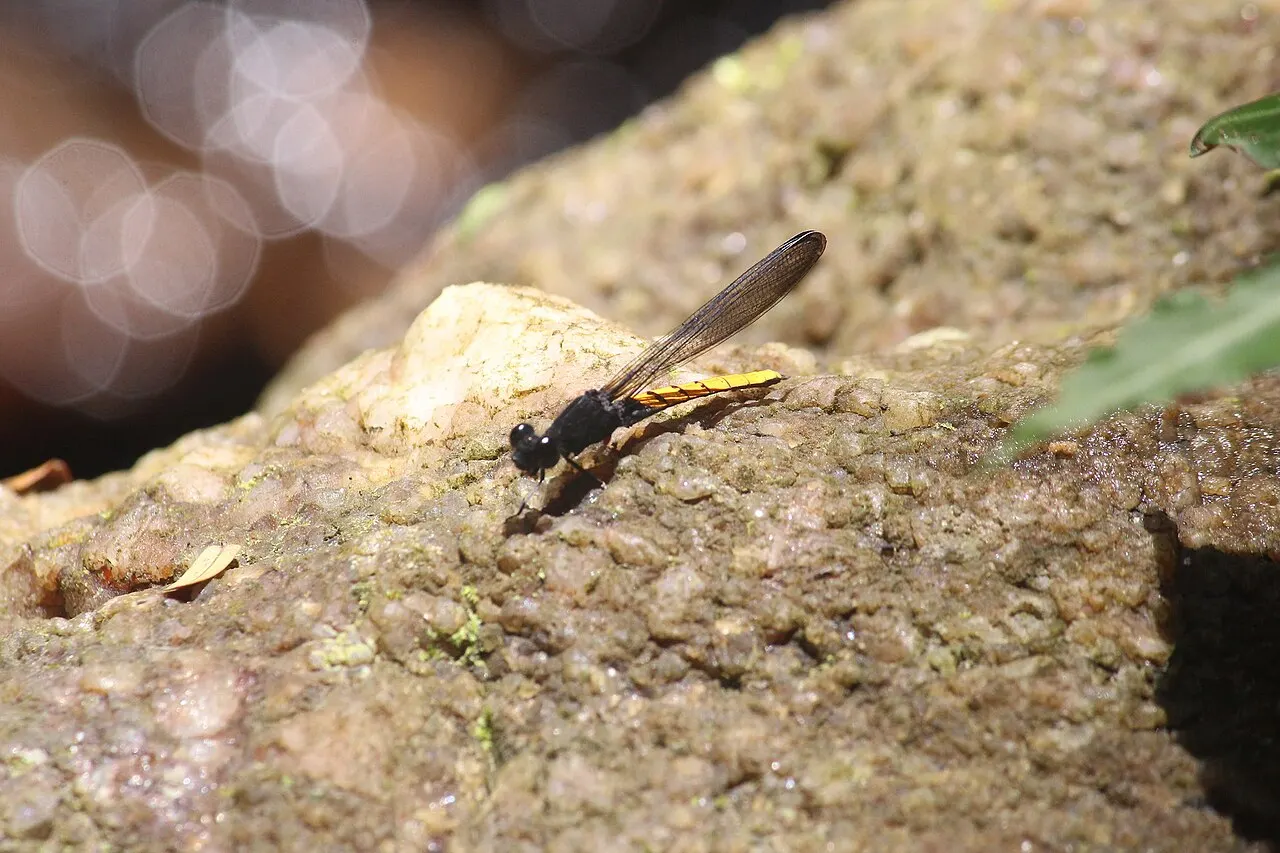
Chlorocypha schmidti, the Albertine jewel, is a jewel damselfly of Central African forest streams. It is confirmed from the eastern Democratic Republic of the Congo, and Tanzania is uncertain. The IUCN Red List rates it Endangered (2018 assessment), with four known locations and a small occupied area.
What it is
This is a damselfly in the family Chlorocyphidae, the jewel damselflies, a group of about 160 species found in tropical Africa and Asia. Males in the family are known for striking colours linked to elaborate courtship. The entomologist Elliot Pinhey named this species in 1967.
Its genus, Chlorocypha, holds roughly 30 species restricted to tropical Africa, mostly West and Central Africa, living in forested running water. A 2026 molecular study of the family reclassified 26 species into other genera, but its classification still lists schmidti under Chlorocypha.
Where it lives
The Red List counts the Democratic Republic of the Congo as a country of confirmed presence and lists Tanzania as presence uncertain. Some reference works also name the Republic of the Congo, which the Red List assessment does not. Records are few. The global biodiversity database GBIF holds just one public observation, a damselfly photographed in March 2022 in North Kivu, with its coordinates deliberately blurred by about 31 km to protect the species.
Its habitat is rivers and streams within moist montane forest. The assessment puts the number of locations at four, the area it occupies at about 20 square kilometres, and its overall range at about 2,960 square kilometres. It does not consider the population severely fragmented.
Pins are Wikidata “endemic to” fields. Orange dots, when present, are GBIF occurrence tiles — survey bias included.
Why it is in trouble
The assessment names farming as the threat, both large agro-industry and small-holder plots, and describes the stresses as conversion and degradation of its ecosystem. Whether the population is shrinking, stable or growing is recorded as unknown.
The Endangered rating rests on criteria B1ab(ii,iii), which cover a small range limited to a few locations, with decline in the extent and quality of habitat. The species was rated Endangered in 2006, Vulnerable in 2010 and Endangered again in 2018.
What is being done
The 2018 assessment lists no conservation actions in place for this species. It identifies habitat restoration and site management as the actions needed.
Sources
Written for this catalog in our own words from the sources below, checked against them on 12 November 2026. Population figures are estimates and carry the year they were made. Status and assessment year: IUCN. 2026. The IUCN Red List of Threatened Species. Version 2026-1. iucnredlist.org.
- IUCN Red List assessment, Chlorocypha schmidti (2018)
- GBIF species record, Chlorocypha schmidti
- GBIF occurrence search for this species
- Fomekong-Lontchi et al. 2026, Molecular phylogeny and updated classification of jewel damselflies, Arthropod Systematics & Phylogeny 84
- Wikipedia article, Chlorocypha schmidti
- Wikidata item Q1311266




