Critically Endangered
Edith's Leafhopper
Chlorita edithae
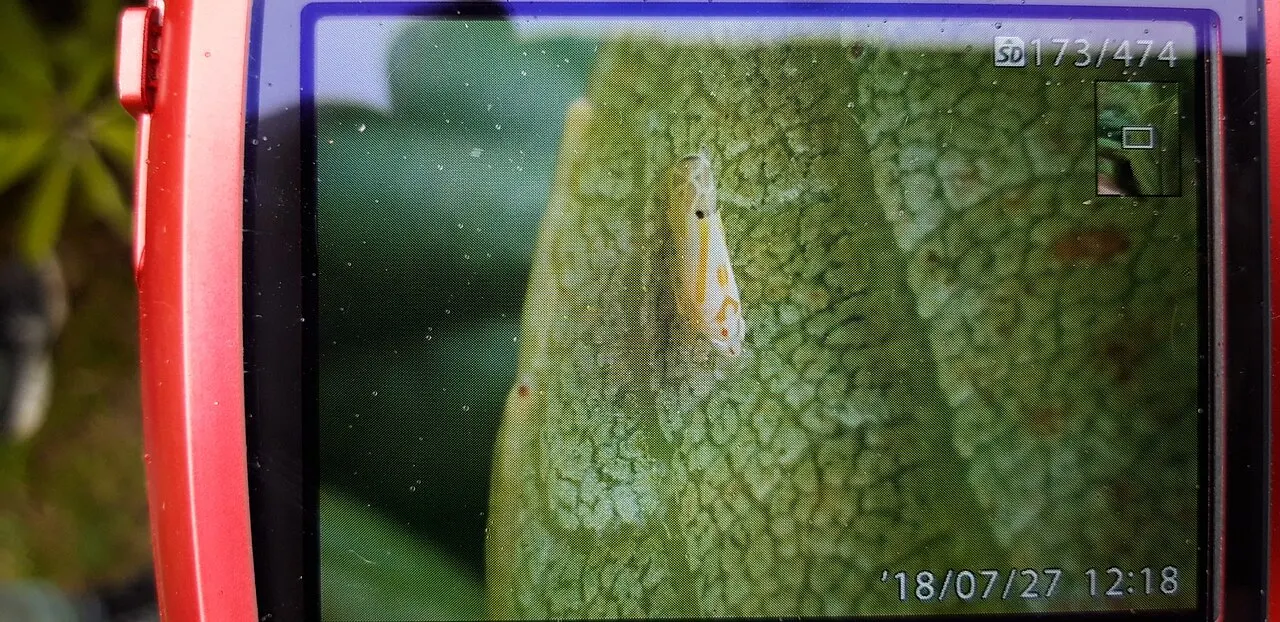
Edith's leafhopper (Chlorita edithae) is a tiny insect found only on Saint Helena, a remote island in the South Atlantic. The IUCN Red List rates it Critically Endangered (assessed 2018). It survives at a single location on Diana's Peak, and after its first collection in the 1800s it went unseen for well over a century.
How to recognise it
This is a leafhopper, a member of the family Cicadellidae in the true bug order Hemiptera. Adults measure only about 3 mm long, so a casual walker would never notice one.
The species was described by White in 1878 from material collected on the island in the nineteenth century, and it sits in the genus Chlorita.
Where it lives
Saint Helena has more endemic species than any other British Overseas Territory. A conservation fact sheet counted at least 502 described endemic animals and plants there, of which 437 are invertebrates.
Edith's leafhopper is one of them. The Red List assessment records it from the main island only, in the upper parts of the High Central Ridge, in moist forest at roughly 709 to 750 metres. It is treated as a single location. Its area of occupancy is just 4 square kilometres and its extent of occurrence about 6.5 square kilometres.
All three modern records came from the endemic whitewood tree (Petrobium arboreum), and the assessors presume the insect depends on that tree. At least part of its range lies inside a protected area.
Pins are Wikidata “endemic to” fields. Orange dots, when present, are GBIF occurrence tiles — survey bias included.
A species that went missing
Rare island insects can be very hard to find. The collector Thomas Vernon Wollaston found this leafhopper at three places in the nineteenth century: Cason's Gate, High Peak and Diana's Peak. It was then thought to have vanished.
A member of the Peaks conservation team photographed a live adult on the north-west side of Diana's Peak on 1 April 2013. It was found at another spot on the south-east side in March 2014 and seen there again in October 2016. It has not been refound at the other two old sites.
Why it is in trouble
The Red List assessment names invasive, non-native predators as the main threat, including the common wasp (Vespula vulgaris) and Gray's stream frog (Strongylopus grayii). With the predator burden rising, the assessors infer that the population is declining.
Because the insect appears tied to one tree that grows at higher altitudes, warming that shrinks the tree's range would reduce its habitat further. The loss of two historic populations has cut both its area of occupancy and its extent of occurrence from 8 to 4 square kilometres, according to the assessment.
The Critically Endangered rating rests on criteria B1ab(iii)+2ab(iii), which apply to very small ranges confined to a single location where habitat quality is still declining.
What is being done
No recovery plan or systematic monitoring scheme was in place at the time of the assessment. The species is protected under the island's 2016 Environmental Protection Ordinance and is covered by the 2016 to 2021 St Helena Invertebrate Conservation Strategy.
The assessment calls for expanding and linking habitat fragments, removing invasive non-native species where possible, and long-term monitoring and research on population size, distribution, life history and threats.
Sources
Written for this catalog in our own words from the sources below, checked against them on 12 November 2026. Population figures are estimates and carry the year they were made. Status and assessment year: IUCN. 2026. The IUCN Red List of Threatened Species. Version 2026-1. iucnredlist.org.




