Endangered
Vaillant's mabuya
Chioninia vaillantii
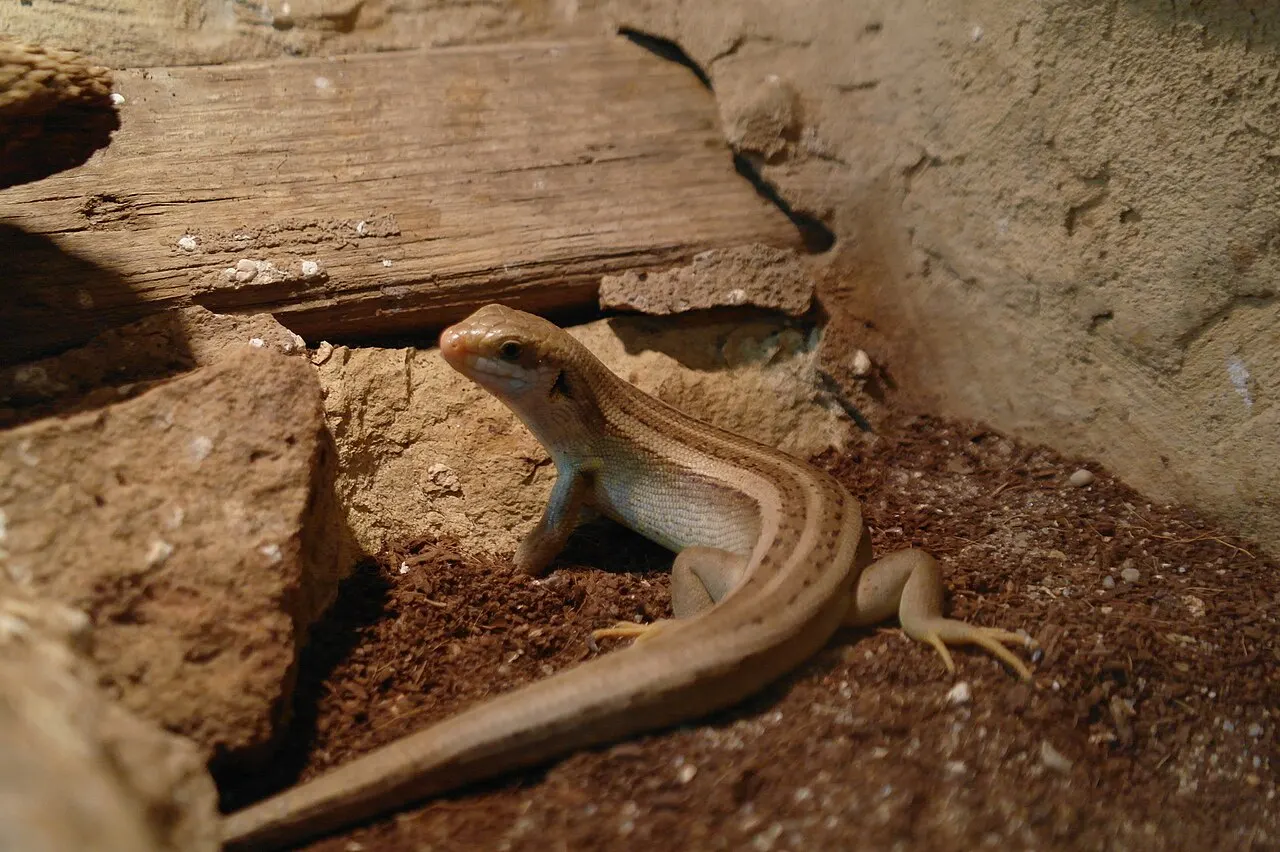
Vaillant's mabuya (Chioninia vaillantii) is a striped skink with an orange-reddish snout, found only on the Cape Verde islands. The IUCN Red List rated it Endangered in 2013, with a decreasing population and a tiny range. Its main problem is the loss of land to small-scale farming.
How to recognise it
It has golden to dark brown stripes running along its back, and the orange-reddish snout is the easiest field mark. In the Santiago form, adults measure 92 to 123 mm from snout to vent, averaging about 110 mm. Boulenger described the species in 1887, and the name honours the French zoologist Léon Louis Vaillant.
Two subspecies are recognised. The nominate form, C. v. vaillantii, is restricted to Santiago. The smaller C. v. xanthotis, described in 2010 from near Mosteiros, lives on Fogo and, according to one source, the Rombos islets.
Where it lives
Cape Verde is the only country listed by the IUCN, and the skink is endemic to it. It occurs on Santiago and Fogo. Sources differ on the smaller islands: one lists the islet Ilhéu de Cima, while others place the Fogo form on the Rombos islets. In 2013 the IUCN counted just three locations, an area of occupancy of about 20 and an extent of occurrence of about 445 square kilometres, and described the population as severely fragmented.
Its habitat includes tropical dry shrubland, but also arable land and plantations. It shelters under rocks and in stone walls.
Pins are Wikidata “endemic to” fields. Orange dots, when present, are GBIF occurrence tiles — survey bias included.
How it lives
The skink is mostly active by day. It is an omnivore, eating insects such as grasshoppers, ants and beetles, along with the leaves and buds of some plants. It gives birth to live young, which the Reptile Database lists as ovoviviparous. A Macaronesian biodiversity page calls it uncommon with a scattered distribution and says more distribution data are needed.
Why it is in trouble
The IUCN names small-holder farming as the biggest ongoing threat. It affects the majority of the population (50 to 90 percent) and is rated as causing very rapid declines, with the area it occupies still shrinking. Persecution or control by people is also listed as ongoing. Two future threats are volcanic eruptions, which could hit a minority of the range, and the introduced lizard Agama agama.
What is being done
The IUCN lists site protection and management, habitat protection, awareness work and national-level action as needed, and flags research into population size, distribution, life history and threats. Whether the skink occurs in a protected area was recorded as unknown in 2013. No recovery programme turned up in the sources.
Sources
Written for this catalog in our own words from the sources below, checked against them on 12 November 2026. Population figures are estimates and carry the year they were made. Status and assessment year: IUCN. 2026. The IUCN Red List of Threatened Species. Version 2026-1. iucnredlist.org.




