Endangered
Chinese crocodile lizard
Shinisaurus crocodilurus
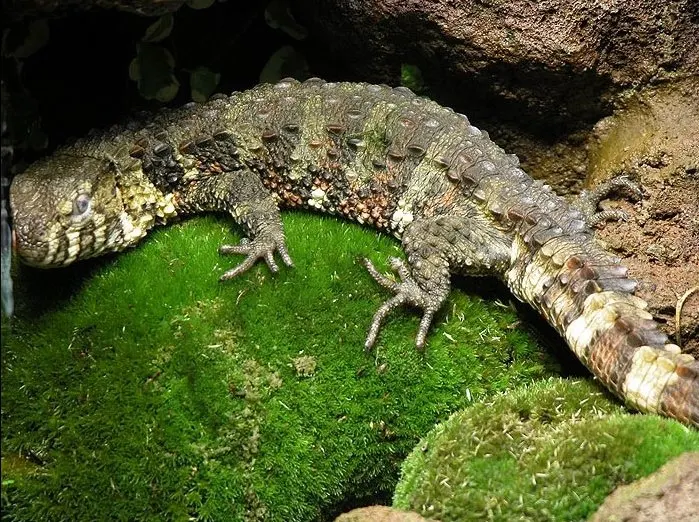
The Chinese crocodile lizard (Shinisaurus crocodilurus) is a semi-aquatic lizard with a ridged, crocodile-like tail, found only in cool forest streams in southern China and northern Vietnam. The IUCN Red List assessed it as Endangered in 2022. It is the sole living member of its family, and wild numbers have collapsed.
How to recognise it
Adults measure roughly 40 to 46 cm including the tail. They're usually green, often with darker bands and a reddish neck, and bony ridged scales run down the back and along the muscular tail. Males are larger and more colourful than females, especially in the breeding season.
The species is the only member of its genus and family. Its lineage, the shinisaurians, has a fossil record reaching back more than 120 million years.
Where it lives
In China it survives in isolated forest patches in Guangxi and Guangdong. The IUCN lists it as possibly extinct in Hunan. A population in north-eastern Vietnam lives on Yên Tử Mountain and is sometimes treated as its own subspecies. The lizards live in subtropical broadleaf forest beside clear, cool streams and pools, at about 200 to 1,500 m above sea level. They shelter in tree holes and rock crevices and rest on branches hanging over water, and are rarely seen on the forest floor.
Pins are Wikidata “endemic to” fields. Orange dots, when present, are GBIF occurrence tiles — survey bias included.
How it lives
It's a sit-and-wait hunter. From a branch above a stream it takes invertebrates, shrimp, tadpoles and small fish, with the odd frog or lizard. Vietnamese animals eat mostly land invertebrates, especially earthworms. Males are territorial, and one dominant lizard often holds a whole pond or stretch of stream, using gaping, tail-whipping and a push-up display.
Females give birth to live young, usually 2 to 12 each spring after a gestation of up to nine months. Mating mainly takes place in July and August. Lizards mature at around three years.
Why it is in trouble
Surveys point to a steep fall. One estimate put the Chinese population at about 6,000 animals in 1978 and about 2,500 in 1990. A 2004 estimate gave roughly 950 across eight remaining areas, and at least seven small populations are reported to have vanished. In Vietnam, about 60 adults were estimated in 2013 and 41 in 2015. Those are old figures, and the IUCN still records a decreasing trend and a severely fragmented range.
Collection for the pet trade, for food and for traditional medicine has driven much of the loss. The species entered the international pet trade in the 1980s, and most animals sold as captive-bred in 1990 were probably wild-caught. Logging, mining, small-scale farming, road building, sewage and the loss of stream habitat add to the pressure.
What is being done
The lizard has been protected in China since 1989 and has been on CITES Appendix I, which prohibits commercial international trade, since 2017. Some subpopulations lie inside nature reserves. Breeding programmes in China, including at the Daguishan reserve in Guangxi, and zoo programmes support possible reintroduction.
Daguishan has also run an outbreeding experiment since 2010, crossing Chinese and Vietnamese lizards. A 2024 study in Current Zoology reported that early hybrids survived much better than purebred captive animals and that the captive outbred group peaked at 128 animals in 2016. The study stressed that long-term monitoring is still needed. No release of these animals into the wild has been reported.
Sources
Written for this catalog in our own words from the sources below, checked against them on 12 November 2026. Population figures are estimates and carry the year they were made. Status and assessment year: IUCN. 2026. The IUCN Red List of Threatened Species. Version 2026-1. iucnredlist.org.




