Endangered
Charpentieria nobilis
Charpentieria nobilis
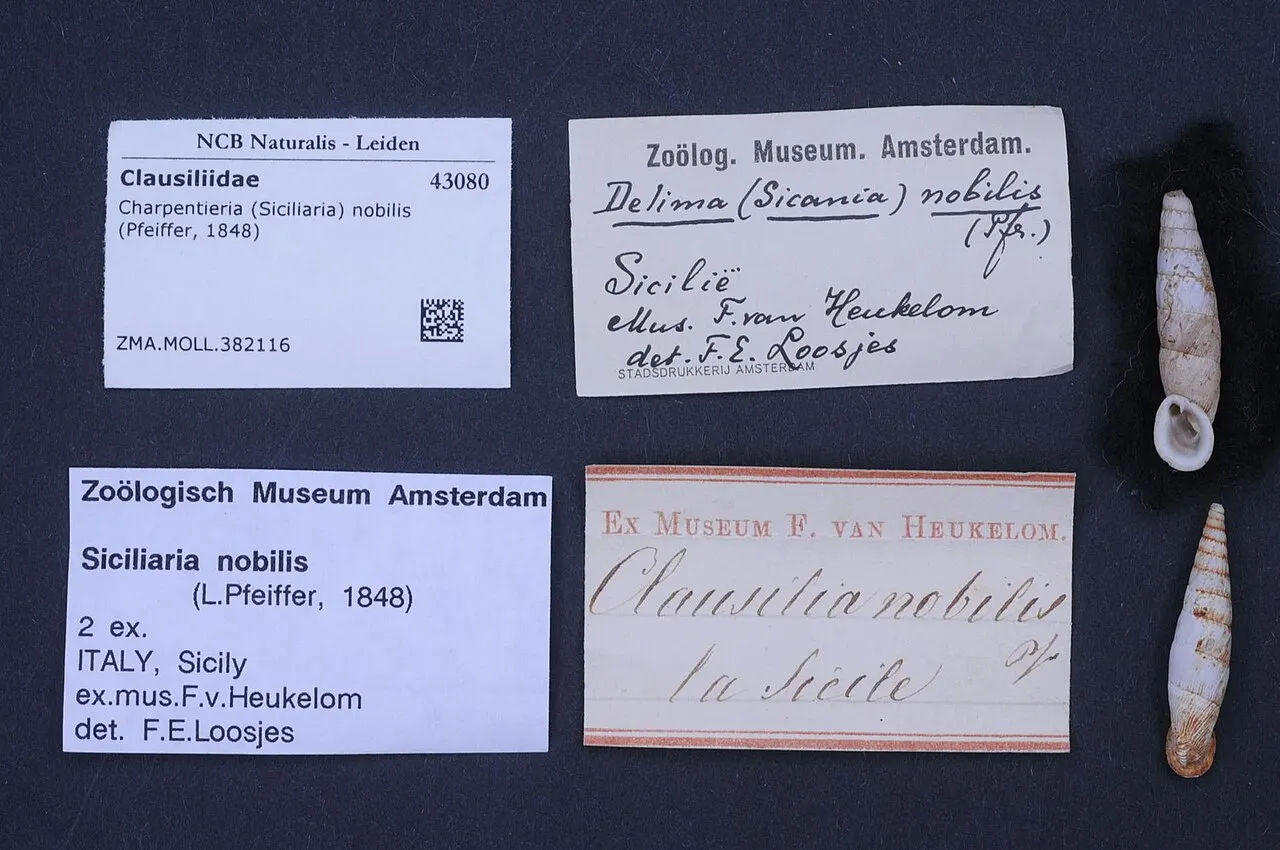
Charpentieria nobilis, now usually called Sicania nobilis, is a small, slender land snail found only on limestone cliffs and boulders in north-western Sicily. The IUCN Red List assessed it as Endangered in 2017. Its range is just a few hills, and its shell is coated in a chalky white layer.
How to recognise it
This is a clausiliid, a family of land snails with narrow, spindle-shaped shells and a small hinged plate (the clausilium) that closes the opening. Adult shells in this species are decollate, meaning the tip of the spire breaks off and is sealed over as the snail grows. A 2021 revision measured 45 decollate shells and found an average height of about 23 mm, and a whorl width of about 5 mm.
The shell has a well-developed whitish surface layer, weakly ribbed whorls and no keel along its back. Nordsieck compared the white layer to the look of Albinaria snails and considers it an adaptation to open rock habitats.
Where it lives
The snail is endemic to Sicily. It is known from two limestone massifs in the north-west of the island, Monte Cofano and the San Vito lo Capo peninsula, where it occurs from Monte Acci to Monte Monaco. The IUCN counts eight locations, between about 30 and 150 m above sea level, and lists its habitat as rocky areas such as inland cliffs.
It is a strict limestone specialist. It lives on cliffs and large isolated boulders and hides in cracks and crevices. It has been found on dry, sunny cliffs and also on shady walls under dense trees, so it is not tied to one microclimate. At Castelluzzo it was found alongside a related snail, Sicania calcarae, on a shady wall in a holm oak shrub, though the two used different niches.
Pins are Wikidata “endemic to” fields. Orange dots, when present, are GBIF occurrence tiles — survey bias included.
A tangled name
Pfeiffer described the species as Clausilia nobilis in 1848. Since then it has been placed in several genera, appearing as Siciliaria nobilis and as Charpentieria nobilis, the name the IUCN assessment still uses. In 2021, De Mattia, Reier and Haring used DNA and anatomy to move it to the revived genus Sicania. The same study treated a coastal form named episoma, described as smaller with a more strongly ribbed shell, as a junior synonym, and made the neighbouring snail spezialensis a subspecies, Sicania nobilis spezialensis, rather than a separate species.
Why it is in trouble
The IUCN assessed it as Endangered under criteria B1ab(iii,v)+2ab(iii,v), which covers a small, fragmented range with continuing decline in habitat and numbers. The population is recorded as decreasing and severely fragmented.
The listed threats are intentional use where the species itself is the target, drought and an increase in fire frequency or intensity. The IUCN rates each as affecting the majority of the population. It records no population estimate.
What is being done
The assessment lists site and area management, resource and habitat protection, awareness work and site protection as conservation actions. It records 91 to 100 percent of the population as inside protected areas, but no species recovery plan or systematic monitoring scheme.
Sources
Written for this catalog in our own words from the sources below, checked against them on 12 November 2026. Population figures are estimates and carry the year they were made. Status and assessment year: IUCN. 2026. The IUCN Red List of Threatened Species. Version 2026-1. iucnredlist.org.




