Critically Endangered
Red-throated lorikeet
Charmosyna amabilis
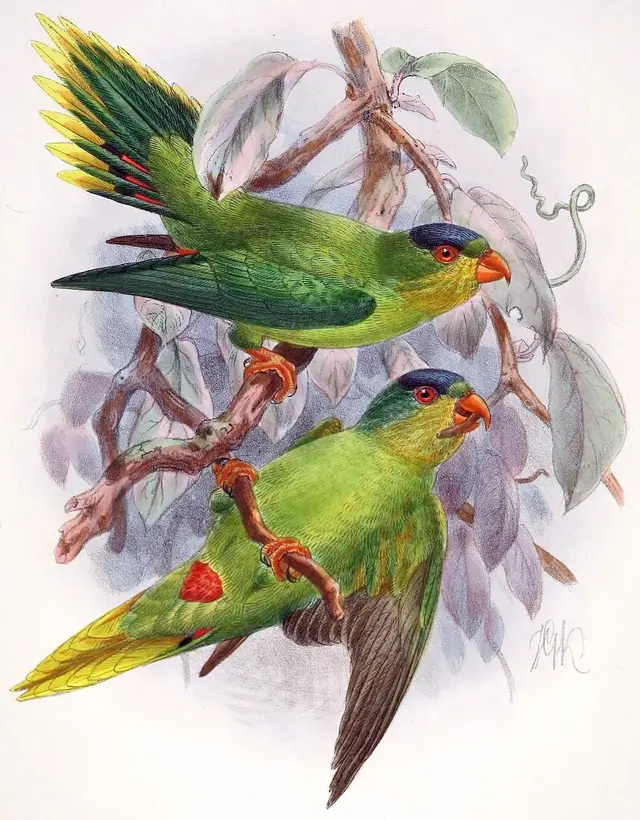
The red-throated lorikeet (Charmosyna amabilis, now often placed in Vini) is a small green parrot from the forests of Fiji, known locally as the kulawai. The IUCN Red List rated it Critically Endangered in 2025, with fewer than 50 birds at most, but it has not been confirmed in the wild since 1993.
How to recognise it
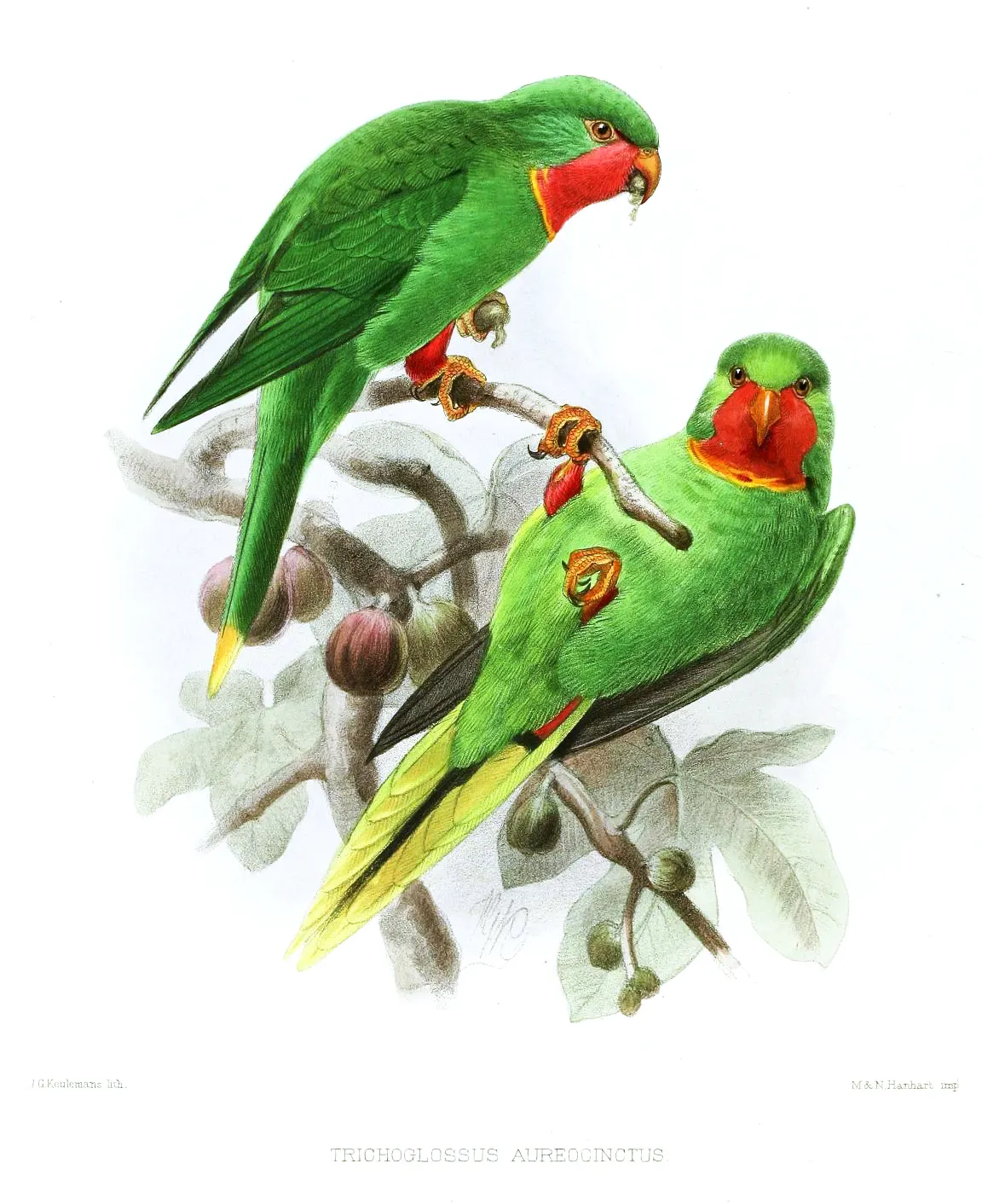
It's a small lorikeet, about 18 cm (7 in) long, bright green overall with red cheeks, throat and thighs. It lives in the upper canopy, which makes it hard to spot even where it occurs.
The scientific name has shifted. A 2020 molecular study of the lorikeets led to its move from Charmosyna into the genus Vini, so you may see it listed either way. The Red List still uses Charmosyna amabilis.
Where it lives
The species is found only in Fiji. Records exist from four islands: Viti Levu, Vanua Levu, Taveuni and Ovalau, and the most recent confirmed records are from Viti Levu, where flocks of up to six birds have been seen. Ten specimens were collected during a one-month visit in the 1920s.
It favours mature upland rainforest up to about 1,000 m, and the IUCN also lists moist lowland forest, from 120 m, as suitable. It feeds on nectar, pollen and fruit, usually high in the canopy. The IUCN calls it nomadic and flags the vuga tree (Metrosideros collina) and other flowering plants as foods whose flowering cycle needs study. Its breeding has not been recorded.
Pins are Wikidata “endemic to” fields. Orange dots, when present, are GBIF occurrence tiles — survey bias included.
The search for a lost bird
The last confirmed record dates from 1993. A sighting on Mount Tomaniivi on Viti Levu in 2001 or 2002 was backed by detailed field notes, and two birds were reportedly seen in the Nausori Highlands in 1998. A six-month survey funded by the World Parrot Trust with the Fiji National Trust in 2001 found no birds. A second survey in 2003 also failed, and surveys of the Viti Levu highlands and the Sovi Basin reported in 2012 did not find it either.
Between 2001 and 2012, experienced observers logged over 2,000 hours of searches and general forest bird surveys without a sighting. The 2025 IUCN assessment gives a population of 0 to 49 birds and an unknown trend, and says serious consideration should be given to the possibility that the species has gone from the wild.
Why it is in trouble
The IUCN suspects that introduced predators are the main reason for the decline, especially the black rat (Rattus rattus). Small Indian mongooses and feral cats also live in its range and may be a threat.
Forest is slowly being cleared in much of Fiji, and growing logging and road building, especially around Monasavu and Serua on Viti Levu, are likely to be increasing rat numbers. Farming is also encroaching on primary forest on Taveuni. The IUCN rates the scale of each threat as unknown, since the bird cannot be studied.
What is being done
A species recovery plan exists, and the whole known range lies within identified conservation sites, including at least one protected area. The IUCN's recommended priorities are more surveys on Viti Levu and Taveuni, including a full year of forest searches timed to the vuga flowering, and a formal analysis of the probability that the species is extinct. If a wild population turns up, the plan calls for captive husbandry in Fiji and public awareness across the country.
From 2010 to 2012, a community awareness programme trained members of a nature club near Tomaniivi to search for the bird, since local residents had occasionally reported it.
Sources
Written for this catalog in our own words from the sources below, checked against them on 12 November 2026. Population figures are estimates and carry the year they were made. Status and assessment year: IUCN. 2026. The IUCN Red List of Threatened Species. Version 2026-1. iucnredlist.org.