Endangered
Chacoan peccary
Catagonus wagneri
The Chacoan peccary, or taguá (Catagonus wagneri), is the largest of the three living peccary species and lives in the hot, dry Gran Chaco of Paraguay, Bolivia and Argentina. It is listed as Endangered by the IUCN (assessed 2015), with a decreasing population. It was known first from fossils and found alive only in the early 1970s.
How to recognise it
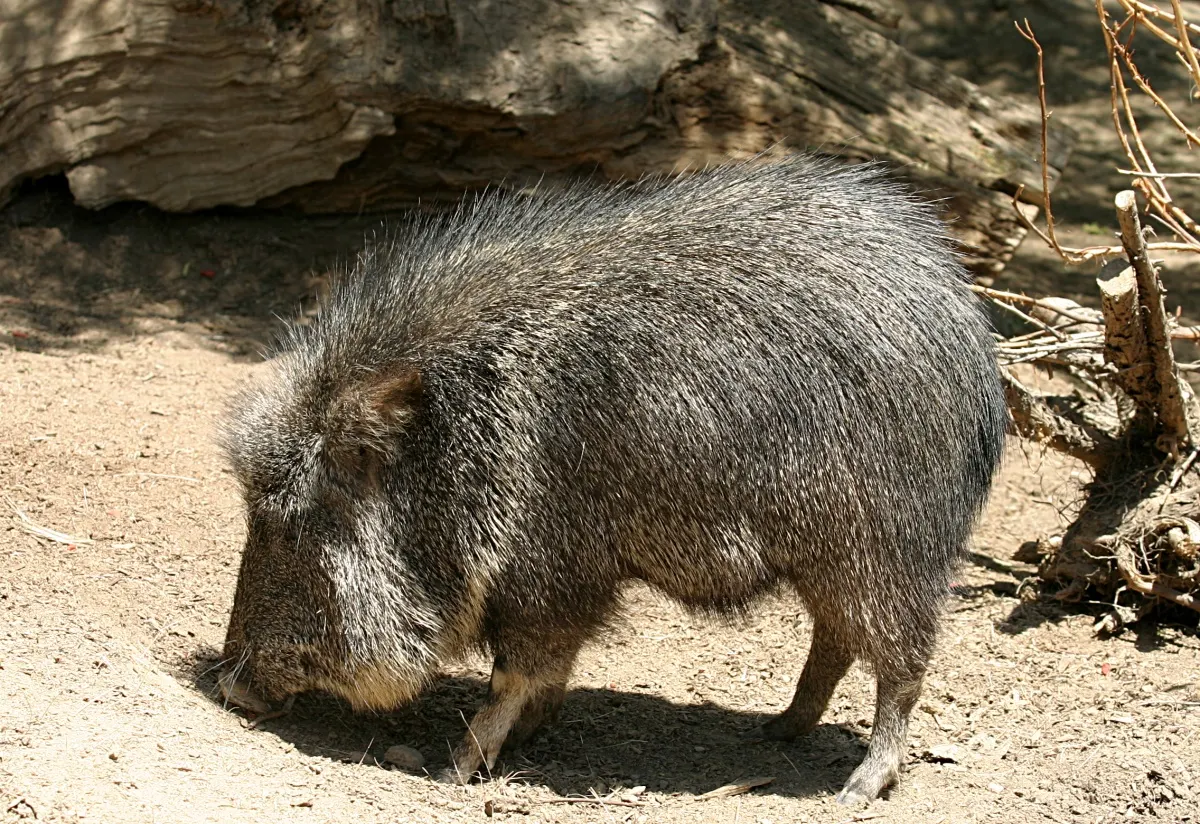
A shaggy, pig-like animal with brownish-grey hair, a dark stripe down the middle of the back and a pale band across the shoulders. Compared with other peccaries it is larger and has a proportionally larger head, with longer ears, legs and tail. Adults weigh about 30 to 40 kg and measure roughly 96 to 117 cm long, standing 52 to 69 cm at the shoulder. Males and females look almost alike in the field.
Where it lives
The species is found only in the Gran Chaco, across a fragmented range of about 140,000 square kilometres in western Paraguay, southeastern Bolivia and northern Argentina. The Red List gives its habitats as dry shrubland and dry savanna. EDGE of Existence describes hot, semi-arid thorn forest and steppe dominated by low succulents and thorny bushes.
Scientists described the species from fossils, in 1930, and assumed it was extinct. A living population was reported in the early 1970s, in Salta Province, Argentina.
Pins are Wikidata “endemic to” fields. Orange dots, when present, are GBIF occurrence tiles — survey bias included.
How it lives
Herds are small, with an average of about four or five animals and a range of one to ten. They are active mostly before midday, and they travel in single file through thorn forest. Cacti make up most of the diet and supply most of the water, since home ranges have no surface water in the dry season. The peccaries also eat bromeliad roots and acacia and mesquite pods, and they eat soil at salt licks and leaf-cutter ant mounds, which are rich in minerals.
Females carry young for about 151 days and usually have two or three, once a year. Young can run within two hours of birth. In the Paraguayan Chaco, annual mortality has been measured at 47 percent. Jaguars and mountain lions are known predators.
Why it is in trouble
Clearing of Chaco thorn forest for cattle pasture and crops is the main pressure, and hunting adds to it. The IUCN also lists dams, and zoo and conservation sources point to probable livestock disease. The San Diego Zoo fact sheet reports declines of more than 50 percent between 1980 and 2011, and local extinctions in parts of Argentina.
Numbers are uncertain. A rough estimate of 3,200 animals dates from 2002, before further large-scale clearing, and some authors have suggested up to 5,000. A Berlin zoo page puts Paraguay's population at 2,000 to 3,000, while other recent sources describe the total as unknown.
What is being done
The species is on CITES Appendix I. The Red List assessment lists site protection, harvest management, education and awareness work, and national-level action, and says it occurs in at least one protected area and is held in zoos. Management actions recommended in the San Diego Zoo fact sheet include a national park where a large population remains, private reserves, enforcement of hunting rules, and using the species as a flagship for environmental education.
San Diego Zoo's parent society has supported Proyecto Taguá, a research and breeding programme in Paraguay, since 1985. Tierpark Berlin has kept the species since 2012 and has coordinated the European breeding programme since 2015, with ten other zoos taking part.
Sources
Written for this catalog in our own words from the sources below, checked against them on 12 November 2026. Population figures are estimates and carry the year they were made. Status and assessment year: IUCN. 2026. The IUCN Red List of Threatened Species. Version 2026-1. iucnredlist.org.
- IUCN Red List assessment
- Wikipedia article on the Chacoan peccary
- San Diego Zoo fact sheet, population
- San Diego Zoo fact sheet, characteristics
- San Diego Zoo fact sheet, reproduction
- San Diego Zoo fact sheet, diet
- San Diego Zoo fact sheet, behavior
- EDGE of Existence species page
- San Diego Zoo 100 timeline
- Zoo Berlin, Chacoan peccary conservation page




