Endangered
Chaco side-necked turtle
Acanthochelys pallidipectoris
The Chaco side-necked turtle (Acanthochelys pallidipectoris) is a small freshwater turtle of the Gran Chaco in Argentina, Paraguay and Bolivia. The IUCN Red List rated it Endangered in 2022. It depends on shallow, seasonal wetlands, which cattle ranching, farming and drought are eroding.
How to recognise it
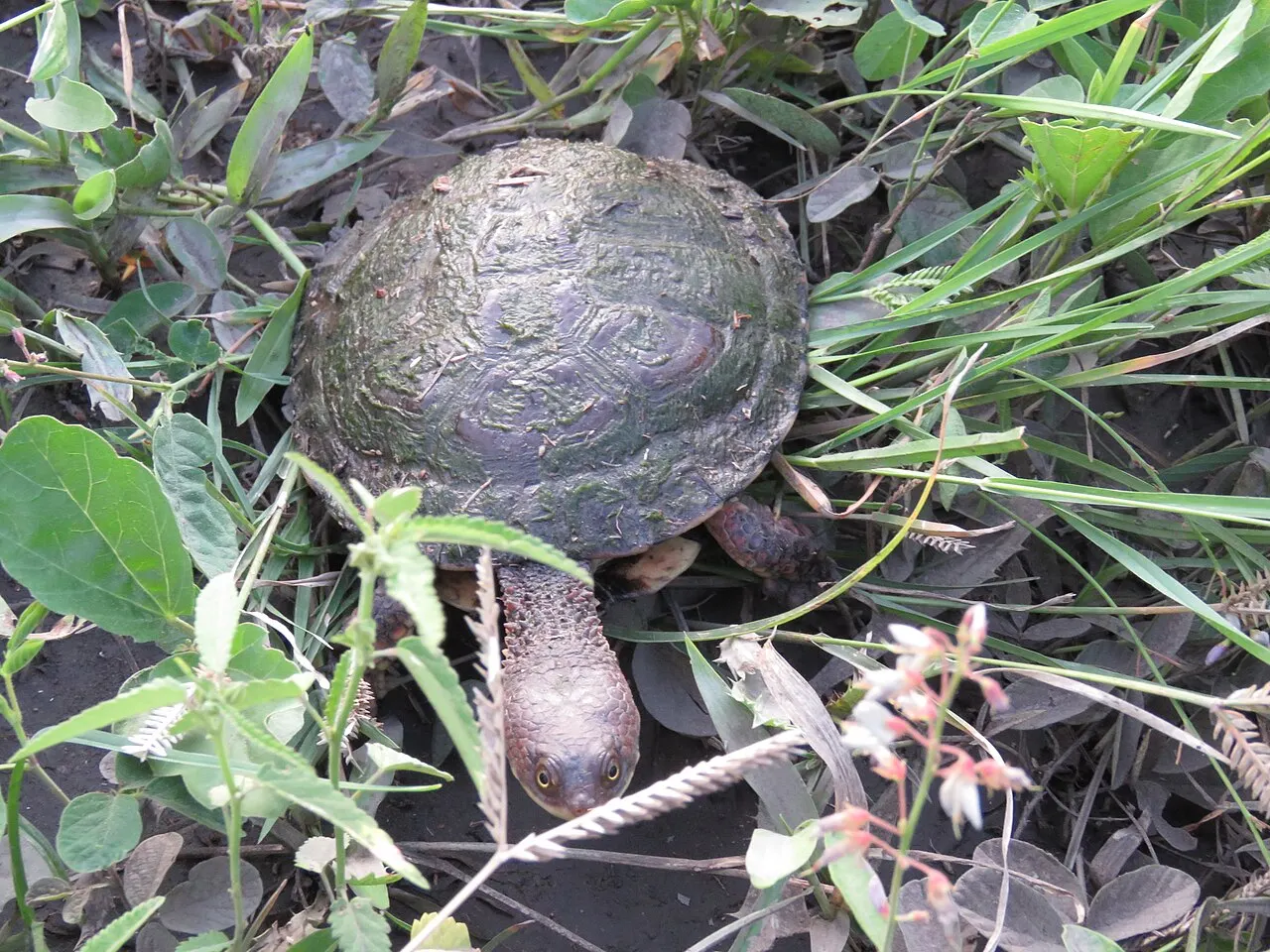
Adults have an oval shell about 12.8 to 16.2 cm long, with a recorded maximum of 17.5 cm, and weigh around 400 g. The shell ranges from yellowish brown through grey-brown to olive, usually with dark seams, and the underside is yellow with broad dark seams. The head is scaly, the neck has conical bumps along its sides, the eye is pale, and the feet are webbed.
Females are a little larger and higher-shelled. Males have thicker tails and a hollowed belly shell. Like other side-necked turtles, it folds its neck sideways, not straight back, when it withdraws.
Where it lives
It is found only in the Gran Chaco. Records come from northern Argentina, western Paraguay and the far south of Bolivia, where it is limited to the Chaco of Tarija. The first specimen described, by Freiberg in 1945, was collected near Presidencia Roque Saenz Pena in Chaco province, Argentina.
The Red List counts 26 locations. Habitats include seasonal freshwater pools and marshes, wet grassland, shrubby wetlands and small ponds, including artificial ones.
Pins are Wikidata “endemic to” fields. Orange dots, when present, are GBIF occurrence tiles — survey bias included.
How it lives
The turtle is active only in the rainy season, around four to six months a year, which makes it hard to study. When streams dry out and no pools remain, it buries itself in mud. A 2017 conservation article estimates about 15 years to maturity, based on similar turtles, and suggests breeding may only succeed in good years. The Red List gives a generation length of 15 years.
Why it is in trouble
The Red List gives the population trend as decreasing, with a best estimate of about 1,000 adults (range 500 to 5,000, 2022 assessment). The 2017 article puts it at fewer than 1,000 mature adults. Threats listed by the Red List include farming and grazing that convert habitat, drought and temperature extremes, harvest for local use, and problem native species or disease. The 2017 article also names the pet trade and conversion of habitat to cattle pasture and soybean fields.
In 2022 a team from WCS Paraguay and local residents recorded the turtle in Mariscal Estigarribia, in Paraguay's Boqueron department, a find the press called a key record. The report added that shifting rainfall from climate change could cause major habitat loss.
What is being done
Listed actions include site protection and management, habitat restoration, control of problem species, awareness work and national and international measures, although no recovery plan or monitoring scheme was in place at the time of assessment. A small grant awarded in 2026 funds a community monitoring project with the Weenhayek and Tapiete peoples in Tarija, Bolivia, to study distribution, habitat and population structure.
Sources
Written for this catalog in our own words from the sources below, checked against them on 12 November 2026. Population figures are estimates and carry the year they were made. Status and assessment year: IUCN. 2026. The IUCN Red List of Threatened Species. Version 2026-1. iucnredlist.org.




