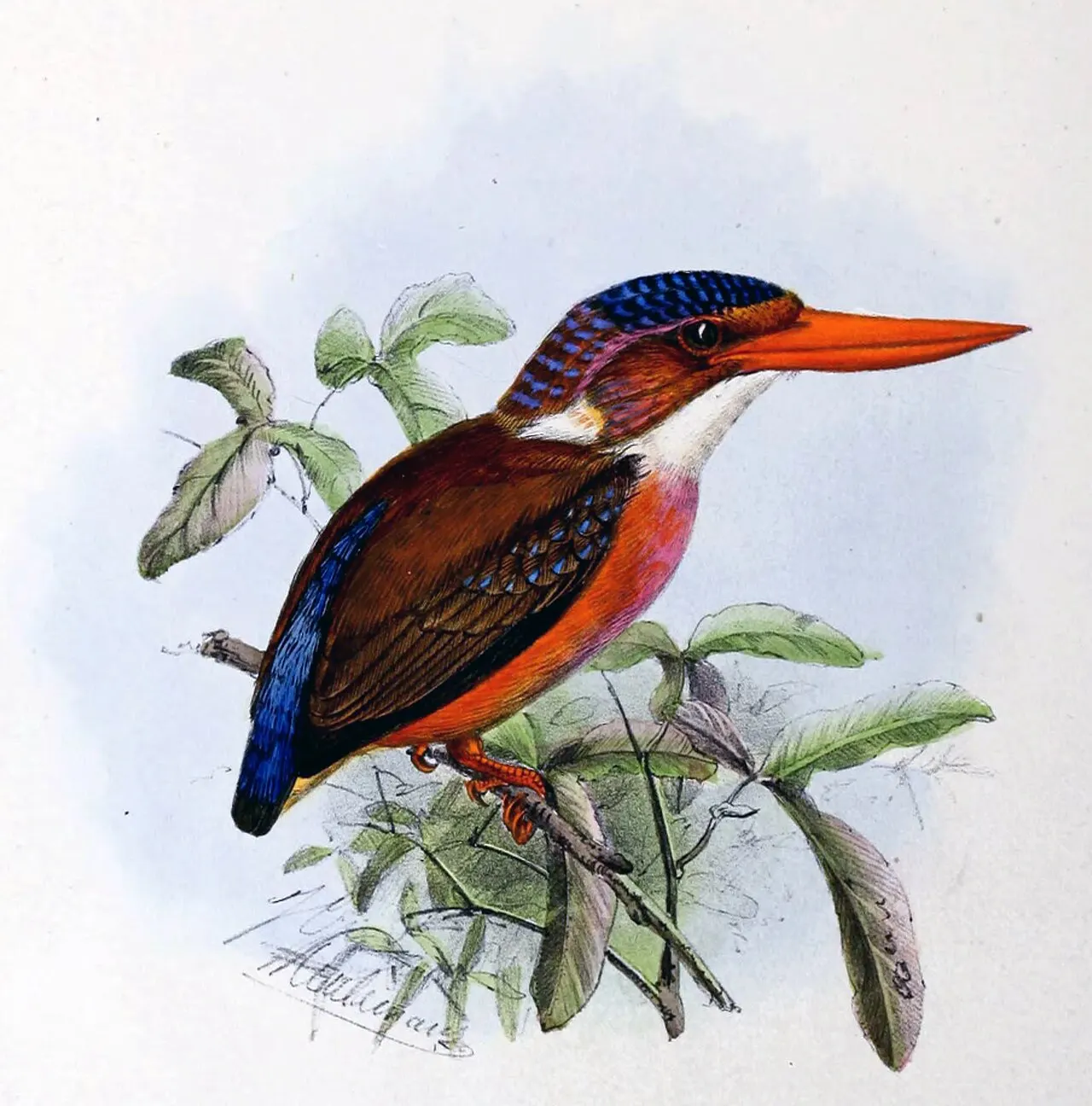
Critically Endangered
Sangihe dwarf kingfisher
Ceyx sangirensis
The Sangihe dwarf kingfisher (Ceyx sangirensis) is a small kingfisher known only from a handful of old museum specimens from Sangihe Island, Indonesia. The IUCN Red List rated it Critically Endangered in 2018. It has not been reliably recorded since the 1870s, and some sources treat it as probably extinct.
How to recognise it
It's a dwarf kingfisher in the family Alcedinidae, closely related to the Sulawesi dwarf kingfisher (Ceyx fallax). The two were treated as one species for much of the 20th century and were split again in 2014, following a taxonomic revision by del Hoyo and Collar.
No field description from a living bird exists, so the species can only be judged from preserved skins. The IUCN assumes its habits are similar to those of its Sulawesi relative.
Where it lives
The species is known from Sangihe Island, in the Sangihe Islands of Indonesia. Some sources also list the Talaud Islands, but its status there is uncertain, and it is unclear whether it ever occurred on Siau or other nearby islands.
The IUCN assumes it favours the interior of lowland primary forest, although it may tolerate some degradation, and that it ranges from sea level to about 1,000 m. Its breeding is unknown. Forest on Sangihe has been almost completely converted to agriculture.
Pins are Wikidata “endemic to” fields. Orange dots, when present, are GBIF occurrence tiles — survey bias included.
What is known of its history
The species was described in 1898 by Meyer and Wiglesworth from specimens collected before 1879. Sources disagree on how many survive: about seven according to one catalogue of recently extinct species, six in an online encyclopedia, and four according to Search for Lost Birds. The last was collected in 1876 and is held by the Natural History Museum of Denmark.
No confirmed record has followed the original specimens. A 1997 sighting was disputed and later withdrawn. Surveys on Sangihe in 1998 and 1999, in 2003, from 2004 to 2006, in 2009 and in January 2014 all failed to find the bird.
Why it is in trouble
The IUCN lists small-holder farming, small-holder plantations and agro-industry farming as the main pressures, along with unintended losses from harvesting by people. In 2009 a government scheme to plant non-native trees was reported to be clearing native forest, at first below 500 m and later at 700 to 900 m.
The 2018 assessment records a decreasing population of 1 to 249 mature birds. That wide band reflects how little is known, and the assessors judged that any survivors would number far fewer than 250.
What is being done
No conservation action aimed at this species is known. The IUCN recommended more surveys of remaining forest patches on the island, as well as wooded wetlands, plantations and gardens, where a few birds could conceivably persist along small forest streams. If the bird is found, its sites should be protected immediately.
The assessment also noted that if further searches fail, the species may be reclassified as Critically Endangered (Possibly Extinct).
Sources
Written for this catalog in our own words from the sources below, checked against them on 12 November 2026. Population figures are estimates and carry the year they were made. Status and assessment year: IUCN. 2026. The IUCN Red List of Threatened Species. Version 2026-1. iucnredlist.org.




